
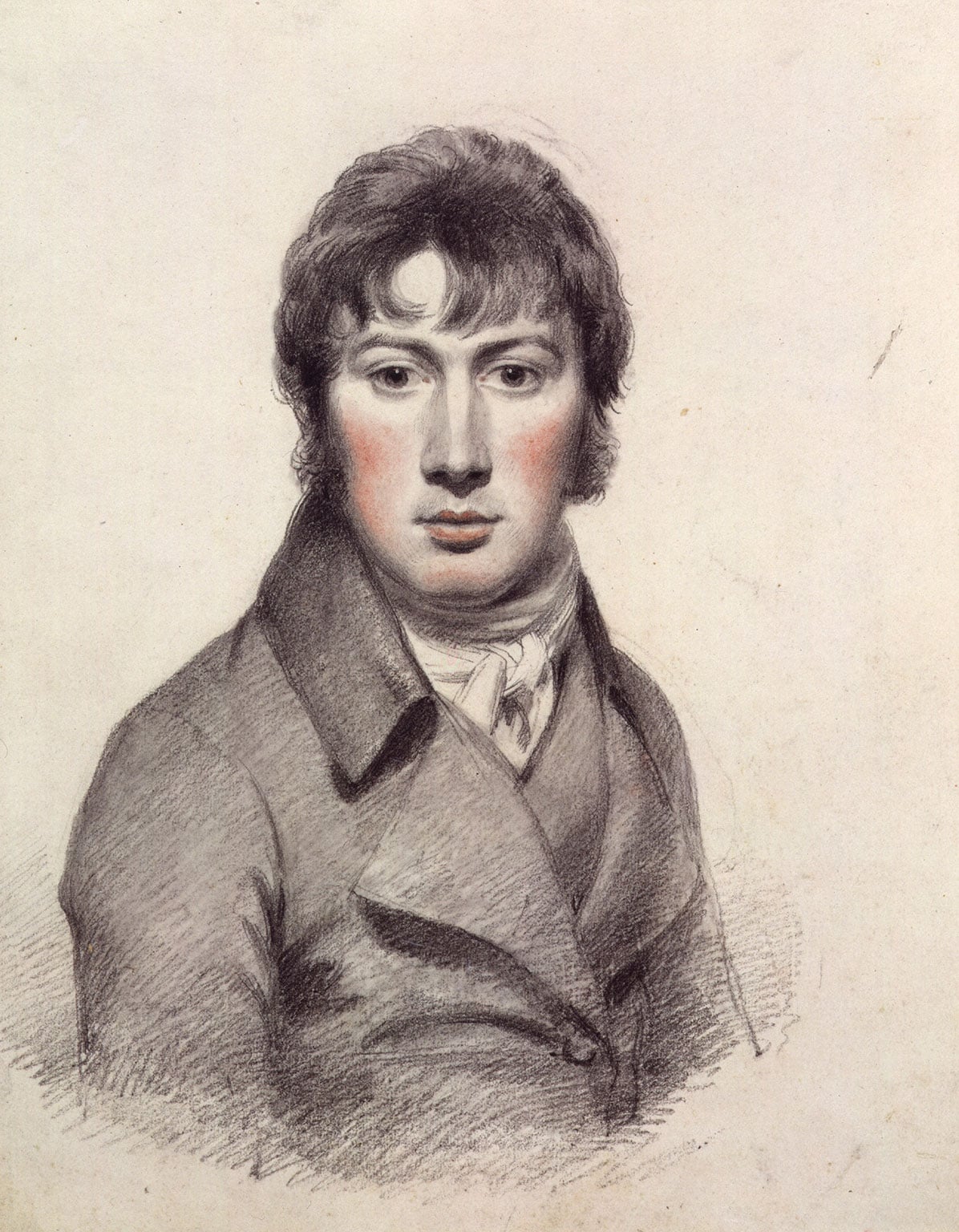
John Constable
June 11, 1776 • March 31, 1837
John Constable (1776-1837) was an English Romantic painter, born in East Bergholt, a village on the River Stour in Suffolk to Golding Constable and Ann Watts. His father was a wealthy corn merchant, owner of Flatford Mill. His older brother was intellectually disabled, so although John was the second son, he was expected to succeed his father in the business. After leaving school John worked in the corn business, but his younger brother Abram eventually took over the running of the mills.
In his youth Constable embarked on amateur sketching trips in the surrounding Suffolk and Essex countryside, which was to become the subject of a large proportion of his art. He was introduced to George Beaumont, a collector who showed him his prized Hagar and the Angel by Claude Lorrain. John found the work very inspiring. Later, while visiting relatives in Middlesex, he met with the professional artist John Thomas Smith, who advised him on painting but also urged him to remain in his father's business rather than take up art professionally.
In 1799 John persuaded his father to let him pursue a career in art. He granted him a small allowance. Entering the Royal Academy Schools as a probationer, he attended life classes and anatomical dissections, and studied and copied old masters. His early style has many qualities associated with his mature work, including a freshness of light, color and touch, and reveals the compositional influence of the old masters he had studied, especially Claude Lorrain. By 1803, he was exhibiting paintings at the Royal Academy. Constable adopted a routine of spending winter in London and painting at East Bergholt in summer. To make ends meet, John took up portraiture, which he found dull, though he executed many fine portraits.
From 1809, his childhood friendship with Maria Elizabeth Bicknell developed into a deep, mutual love. In 1816 the couple got married. In this same year he started painting Flatford Mill, the largest canvas he would ever complete largely outdoors. Shortly after the wedding his parents died in quick succession and Constable inherited a fifth share in the family business.
It was not until 1819 that Constable sold his first important canvas, The White Horse. This painting marked an important turning point in Constable's career. Its success saw him elected an associate of the Royal Academy and it led to a series of six monumental landscapes depicting narratives on the River Stour known as the 'six-footers' (named for their scale). Often they are considered to be the defining works of the artist's career. In 1821, his most famous painting The Hay Wain was shown at the Royal Academy's exhibition.
In his lifetime, Constable sold only 20 paintings in England, but in France he sold more than 20 in just a few years. Constable's pleasure at his own success was dampened after his wife, Maria, started displaying symptoms of tuberculosis. In the hope the sea air could restore her health Constable took lodgings for his family in Brighton in 1824. After the birth of their seventh child in 1828, they returned to Hampstead where Maria died on November at the age of 41. He cared for his seven children alone for the rest of his life. He died on the night of 31 March 1837, apparently from heart failure, and was buried with Maria in the graveyard of St John-at-Hampstead Church in London.