
 Ja`far ibn Muhammad ibn `Ali
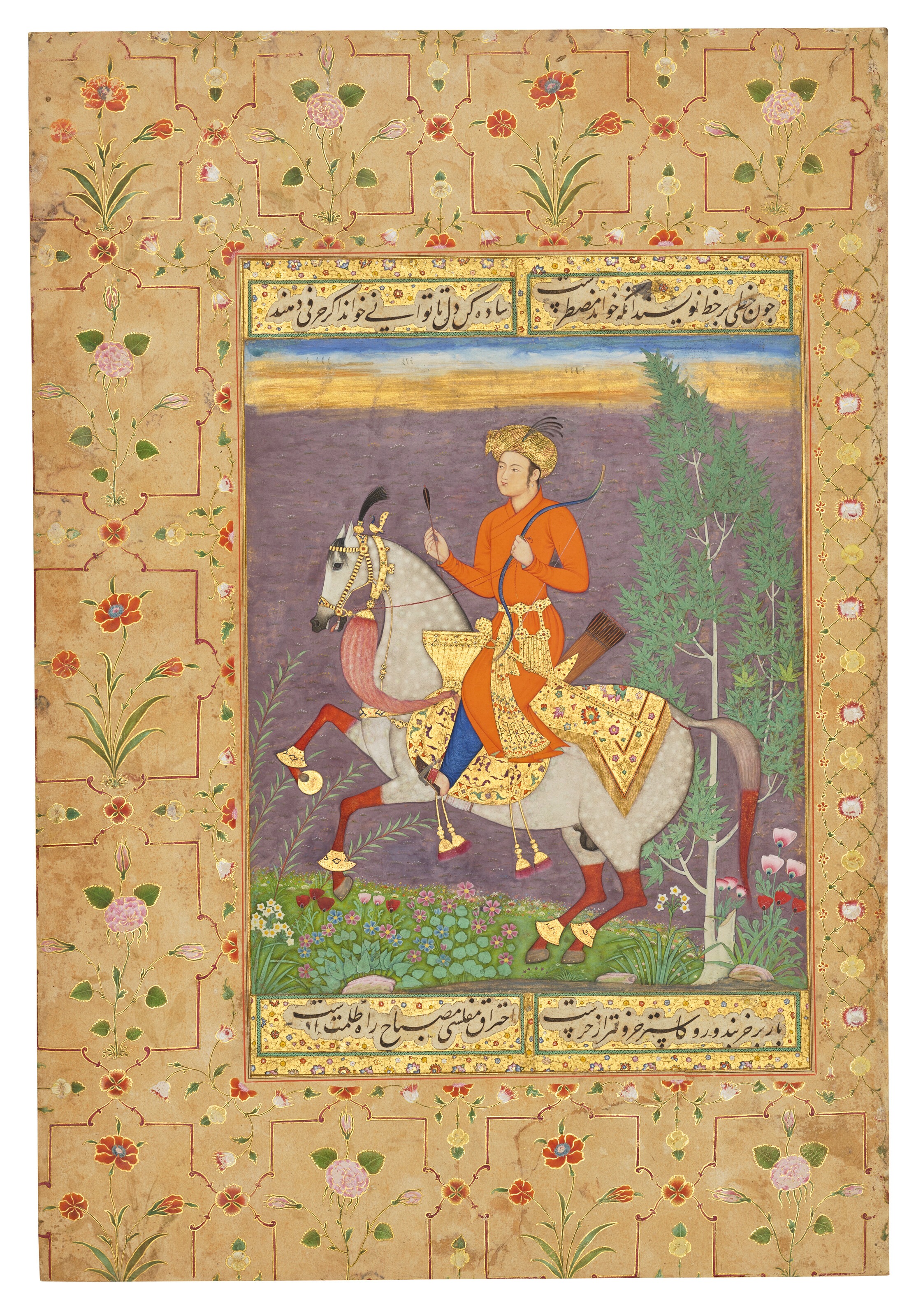
The Mughal painting we present today depicts an elegant prince poised for the hunt. Dressed in a vivid orange robe and golden turban, he lifts an arrow as his stallion—legs and tail tinted with henna—seems to sense the moment before action. Every surface glows with detail: gold saddle, floral patterns, and delicate ornaments rendered with exquisite care. Yet the image is not about the chase; it is a vision of courtly perfection, where grace, confidence, and luxury merge into timeless beauty.
The lush, flowering ground recalls the lyrical landscapes of Bijapur (a historic city in the Indian state of Karnataka) and the influence of Farrukh Beg, a master whose style deeply shaped Muhammad Ali’s own. Both artists brought Persian artistic traditions into India, creating works that combined Mughal elegance with the emotional richness of the Deccan (a vast region in south-central India that was home to powerful and culturally vibrant kingdoms—including the Bahmani Sultanate in the 14th and 15th centuries and its successor states, the Deccan Sultanates: Bijapur, Golconda, Ahmadnagar, Bidar, and Berar. These courts flourished between the 15th and 17th centuries, developing a sophisticated culture distinct from the Mughal North).
Though little is known about Muhammad Ali’s life, his surviving paintings show a singular talent that flourished at the intersection of empires and artistic ideals. This portrait, alive with rhythm and opulence, stands as one of his most striking achievements: a celebration of harmony between man, horse, and nature, rendered in gold, color, and perfect composure.
P.S. Did you know the Mughal emperors were known as great patrons of the arts? Discover the beauty of miniature paintings of the Mughal Empire!