
 Rudolf Bauer
Rudolf Bauer was a German-born painter who was involved in the avant-garde group Der Sturm in Berlin, and whose work would become central to the non-objective art collection of Solomon R. Guggenheim, one of the most important art collectors of the 20th century.
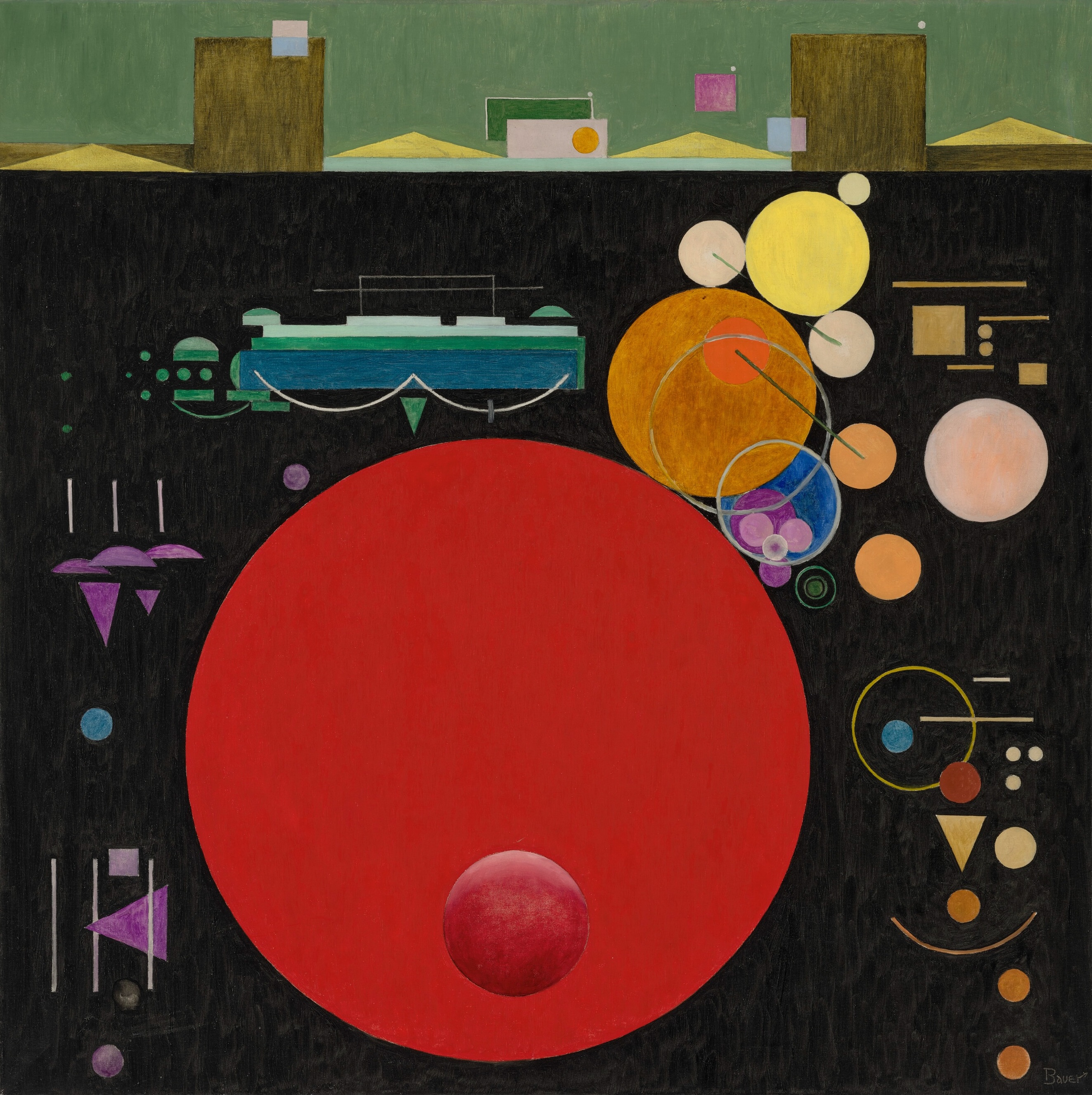
The painting we present today is a defining example of the geometric abstraction that characterized the later phase of Bauer’s pioneering career. The work is structured in two parts: a narrow sage-green band across the top and, below it, a large black field animated by an array of vividly colored shapes—circles, triangles, squares, and linear elements in red, orange, yellow, blue, green, pink, and purple. Although fully abstract, the composition feels carefully poised, with the titular red circle acting as its visual fulcrum. What may initially appear spontaneous is in fact governed by Bauer’s refined sense of proportion and rhythm, lending the painting a dynamic internal balance.
The painting was originally part of the collection of Solomon R. Guggenheim, whose early commitment to abstraction was shaped in close collaboration with the artist and visionary curator Hilla Rebay. In the late 1920s, Rebay introduced Guggenheim to Bauer and to other leading figures of “non-objective” painting, including Wassily Kandinsky and Robert Delaunay.
Rebay later became the founding director of the Museum of Non-Objective Painting, the forerunner of the Solomon R. Guggenheim Museum, and played a central role in introducing non-objective art to American audiences. Under her influence, Guggenheim emerged as one of Bauer’s most devoted patrons, eventually acquiring nearly three hundred of his works.
P.S. How many abstract artists can you name? How many of them are women? Try yourself in our quiz on female abstract artists!
P.P.S. And don’t miss out—grab the last copies of the DailyArt Monthly Wall Calendar with 40% off while they last. Start each month of 2026 inspired by a new masterpiece!