
 Robert Delaunay
Time for a little bit of sun.
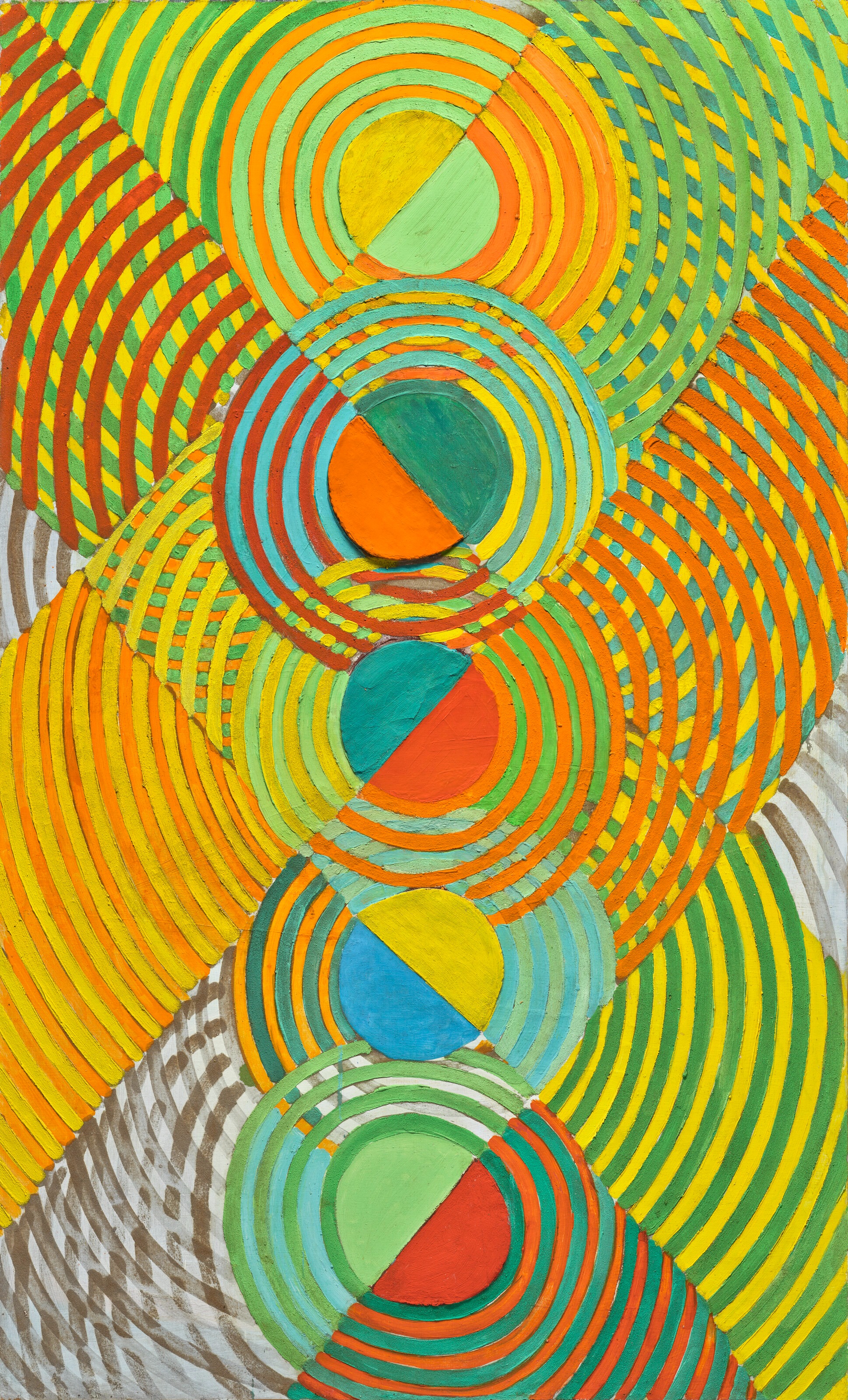
Today we present a radiant celebration of color and movement. Robert Delaunay's Relief orange consists of a central column of five discs that anchors the composition, while rings of brilliant hues—lemon yellow, turquoise, vivid green, and blazing orange—pulse outward like waves of light. Delaunay once wrote, “Everything is roundness—sun, earth, horizons. The driving force in the picture.” Here, that philosophy becomes pure luminosity.
Largely self-taught, Delaunay began in theater design before turning to painting. He admired Cézanne and knew the Cubists, but he could never accept Cubism’s muted palette. “I couldn’t bear surrendering color to form,” he insisted. Influenced by Michel Eugène Chevreul’s theories on simultaneous contrast, Delaunay embraced color as his true subject, calling himself “the heretic of Cubism.” His chromatic experiments, along with those of his wife Sonia, helped forge Orphism, an abstract movement inspired by both light and music. Their paintings aimed not just to be seen, but to be felt—like visual melodies. In Relief orange, repeating circular rhythms create a vibrant, almost musical resonance in the eye.
The work’s tactile surface reveals another of Delaunay’s interests: architecture. By mixing oil paint with cement, he gave the canvas a low relief, echoing the large-scale decorative commissions he was undertaking in the late 1930s, including murals for the 1937 International Exposition in Paris. As critic Guillaume Apollinaire observed, for Delaunay, “color became the ideal dimension.” In this painting, color is not applied—it builds space.
P.S. Read about another masterpiece by Robert Delaunay—Rhythms!