
 Egon Schiele
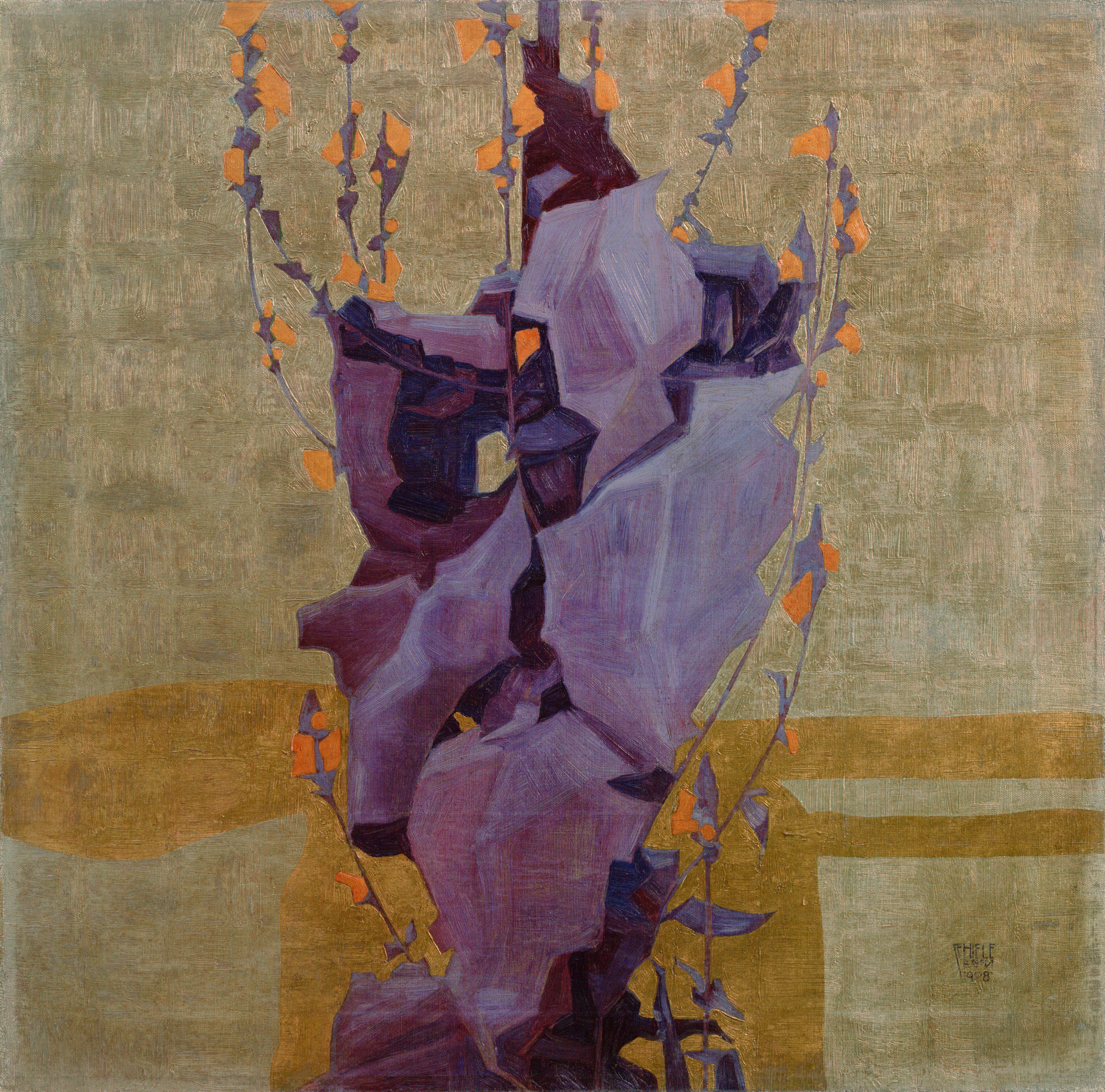
For this painting, created during his time at the Vienna Academy of Fine Arts, Egon Schiele (1890–1918) chose a square canvas, a format that had been very popular in Jugendstil. Gustav Klimt also preferred this shape for his landscape depictions. Klimt’s artistic style is echoed in the planar ground of the vegetal motif, which uses silver and gold pigments to create a shimmering contrast to the plant body’s saturated shades of purple and the orange highlights. The leaves are anti-naturalistic, not only with regard to their coloring. Captured in the process of wilting, they are bulging around the stem, achieving a three-dimensional effect that makes the motif stand out even more strongly from the opaque planarity of the pictorial ground. The elevated silhouette of the plant body already foreshadows the figure paintings of 1909 and 1910 in which Schiele breaks with Klimt’s artistic style and exposes the body on a naked surface.
We present today's work thanks to the Leopold Museum in Vienna (one of my favorite museums!) :)
P.S. If you're planning a museum trip, be sure to check out our free online course on How to Look at Art for some guidance. :)
P.P.S. This work stands out within Schiele’s oeuvre. Soon he would become famous for his expressive figurative paintings. Explore the scandalous art of Egon Schiele!