
 Joseph Mallord William Turner
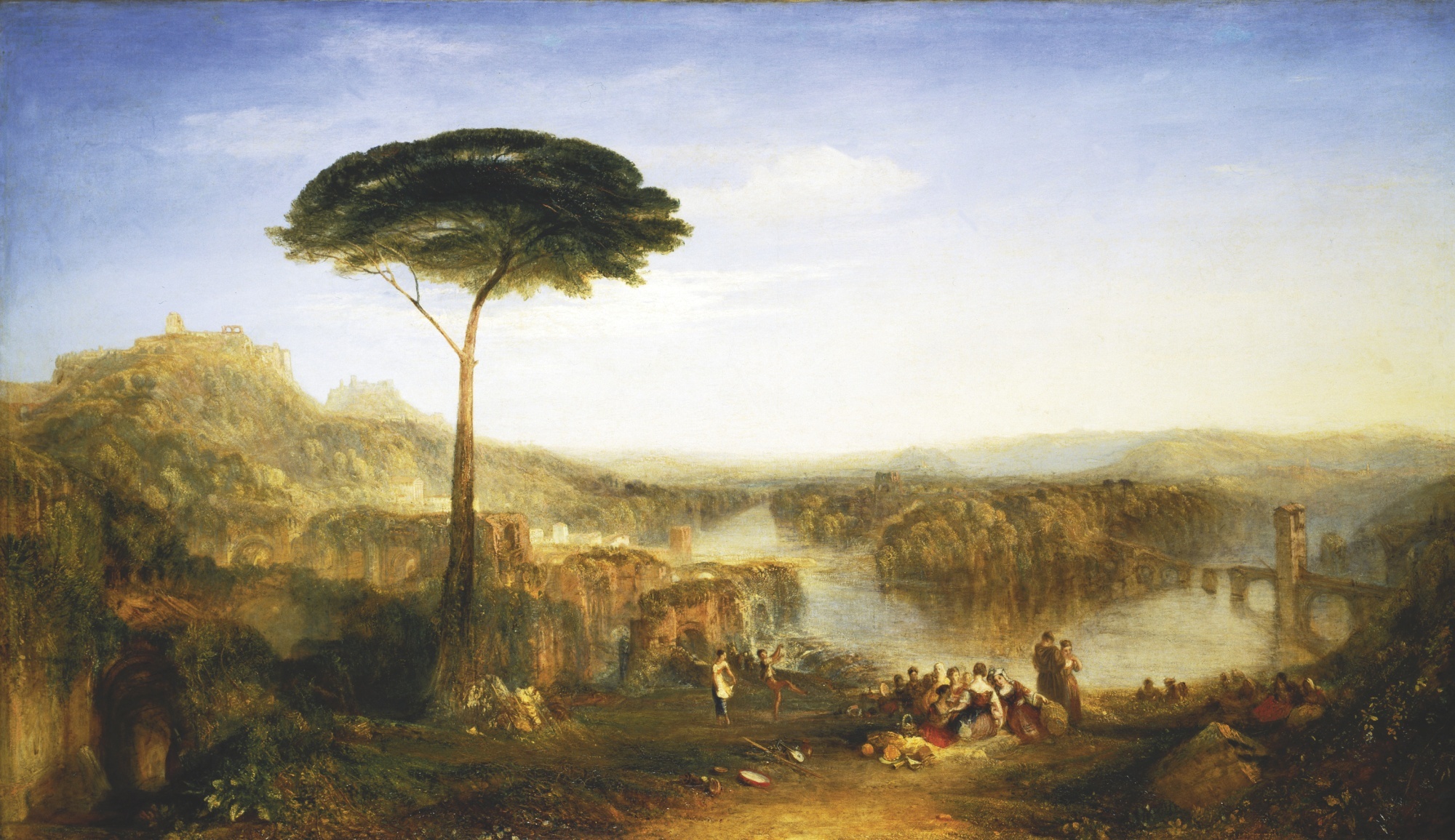
The title of this painting alludes to Lord Byron’s epic poem Childe Harold’s Pilgrimage, a work that reflects on Italy’s grandeur and decline. For Byron, Italy was a land of the loss of political freedom, yet still radiant with beauty. Turner’s painting responds to this idea, presenting an expansive, atmospheric vision of the Italian landscape in which traces of the past coexist with a sense of enduring splendor.
The subject may have been shaped in part by the Royal Academy exhibition of 1829; Turner’s canvas includes a carefully arranged still-life element in the left foreground; notably, the vase was originally added as a separate piece of paper before being painted over. Although the painting was admired in its day, later critics—most famously John Ruskin—lamented its deterioration. Ruskin pointed to the fading and instability of Turner’s pigments and techniques, arguing that changes in color and surface had altered the work dramatically over time. Despite such damage, he acknowledged the enduring beauty of the landscape, especially in the right-hand portion, whose forms were based on Turner’s memories of the Narni gorge and the foothills of the Apennines under evening light.
P.S. Bring the world of art’s most stunning vistas to your fingertips; our Landscapes 50 Postcards Set features breathtaking views—from dramatic mountains to tranquil countryside—perfect for collecting, sending, or displaying as miniature masterpieces.
P.P.S. J. M. W. Turner is one of the most famous British artists. But how well do you know him and his art? Take our Turner quiz and find out!