
 Caravaggio
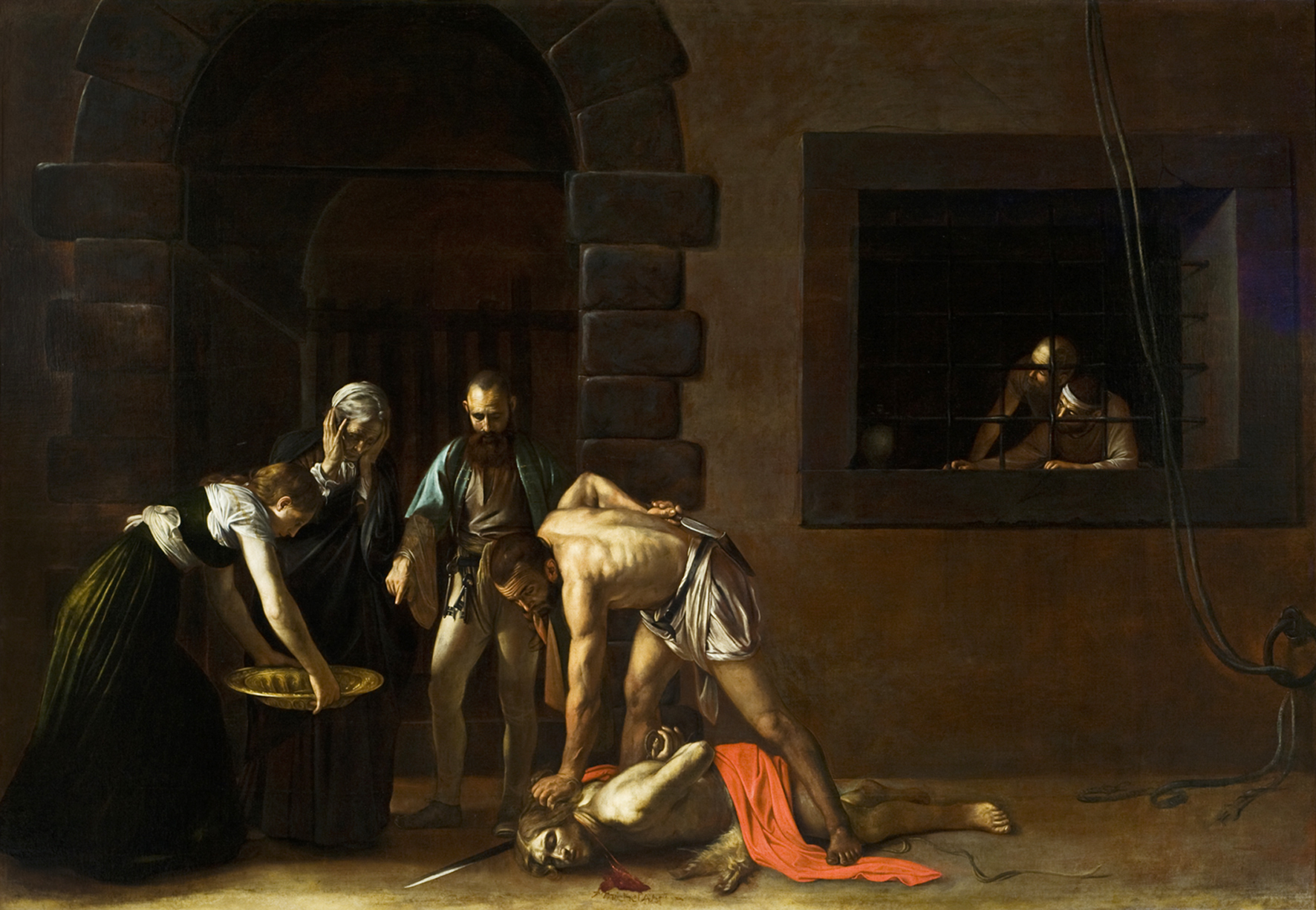
Completed in 1608 during Caravaggio’s stay in Malta, The Beheading of Saint John the Baptist was commissioned by the Knights of Malta as an altarpiece. It is huge! It remains the largest work the artist ever painted and still hangs today in St. John's Co-Cathedral, the church for which it was created. At the time, Caravaggio had been welcomed into the Order and served as a knight.
His association with the Knights, however, proved short-lived. Soon after completing the painting he was imprisoned for an unknown offense and escaped, becoming a fugitive once again. About six months after his induction, the Order formally expelled him, declaring him a “foul and rotten member.” The ceremony of his disgrace reportedly took place in the Oratory itself—before this very painting.
Caravaggio returned to the subject of beheading several times, producing works such as Salome with the Head of John the Baptist, now in London and Madrid. Some scholars believe that one of these later paintings may have been sent to the Grand Master Alof de Wignacourt as an attempt at reconciliation, though this remains uncertain.
The painting itself suffered damage over the centuries but underwent restoration in the 1950s. During this process, viewers rediscovered a striking detail: Caravaggio’s signature, written in the blood flowing from the saint’s wound—“f. Michelang.o,” refers to his brief membership in the Order. The unusual signature has often been interpreted as a personal statement by the artist, whose own life at the time was full of violence, exile, and uncertainty.
One more thing–today is the Christian feast day celebrating the Nativity of John the Baptist :)
Now imagine experiencing this masterpiece in person and recording your impressions as they come. Our Handcrafted Art Journals help you preserve those personal encounters with art.
P.S. One of the most famous painters of all time, here's Caravaggio in 10 masterpieces!