
 Gustav Klimt
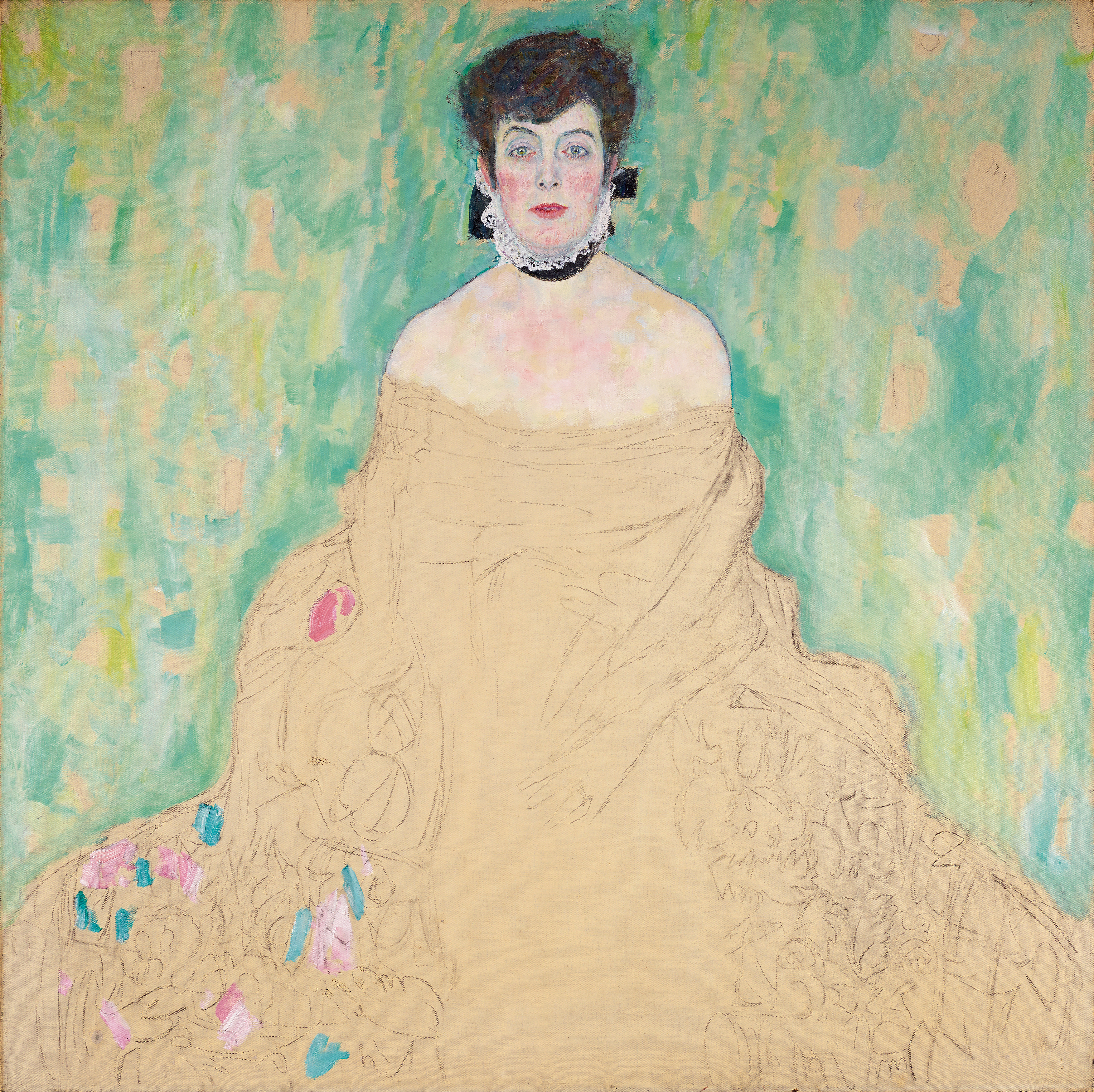
Amalie Zuckerkandl was the daughter of the Viennese writer and playwright Sigmund Schlesinger and the wife of the surgeon Dr. Otto Zuckerkandl. Through her extended family, she moved within one of Vienna’s most vibrant intellectual circles: her brother-in-law was the renowned anatomist Emil Zuckerkandl, and his wife, the writer and art critic Berta Zuckerkandl, was closely connected with many artists of the Vienna Secession. It was likely through these circles that Gustav Klimt was commissioned to paint Amalie’s portrait.
Klimt appears to have completed the sitter’s face and shoulders in the years before the First World War, carefully emphasizing the contrast between her pale complexion, dark hair, and the striking black lace collar tied in a bow. During the First World War, however, Amalie moved to Lviv, where her husband worked as a doctor, and she volunteered as a nurse. When she later returned to Vienna, Klimt made a few additional pencil sketches on the canvas, but the painting remained unfinished. Only faint hints of floral ornamentation can be seen on the green background, while the outlines of the dress and shawl survive merely as drawn suggestions. This world of Viennese modernism and the artistic circle around Gustav Klimt is reflected in our Vienna Secession Planner, inspired by the aesthetics and spirit of the Vienna Secession movement.
Amalie Zuckerkandl’s later life ended in tragedy. Her marriage to Otto Zuckerkandl ended in 1919, and during the Nazi era, she was persecuted under the Nuremberg racial laws. In 1942, she and her daughter, Hermine Müller-Hofmann, were deported, and Amalie was murdered at the Belzec extermination camp.
P.S. Have you ever seen Gustav Klimt's last painting?