
 Unknown Artist
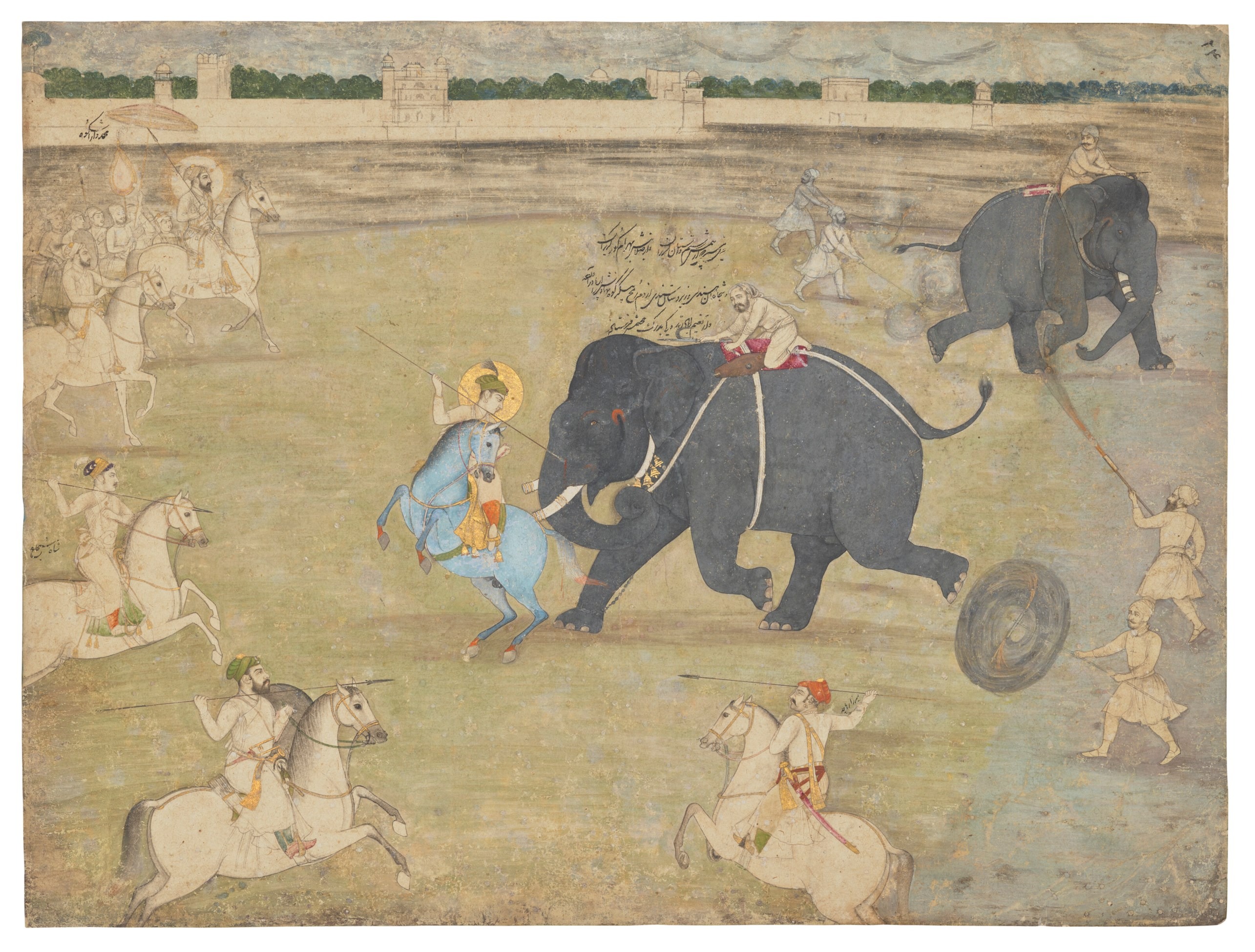
Let's move to South Asia, to the famous Mughal Empire. This painting depicts the celebrated incident of June 1633 in which the future Emperor Aurangzeb demonstrated extraordinary courage by confronting the rampaging elephant Sudhakar during an elephant fight, while his father, Emperor Shah Jahan, watched from a safe distance. The episode became one of the most famous events of Aurangzeb’s youth and was commemorated in several Mughal works of art.
This composition captures a very dynamic moment. Aurangzeb's horse rears dramatically as the prince twists in the saddle to thrust his spear at the advancing beast. Among the known versions of the subject, this work is distinguished by the extended inscription in nastaʿliq script (one of the main calligraphic hands used for Persian and Arabic) above the elephant, which provides a detailed account of the event.
The Mughal Empire was one of the most powerful and influential empires in South Asia, ruling much of the Indian subcontinent from 1526 to the mid-19th century. Renowned for its military strength and cultural achievements, the empire fostered remarkable developments in architecture, literature, and painting, including the celebrated tradition of Mughal miniature art.
P.S. Unfortunately, it was during Aurangzeb's conservative rule that the decline of the magnificent Mughal art tradition began.