
 Max Klinger
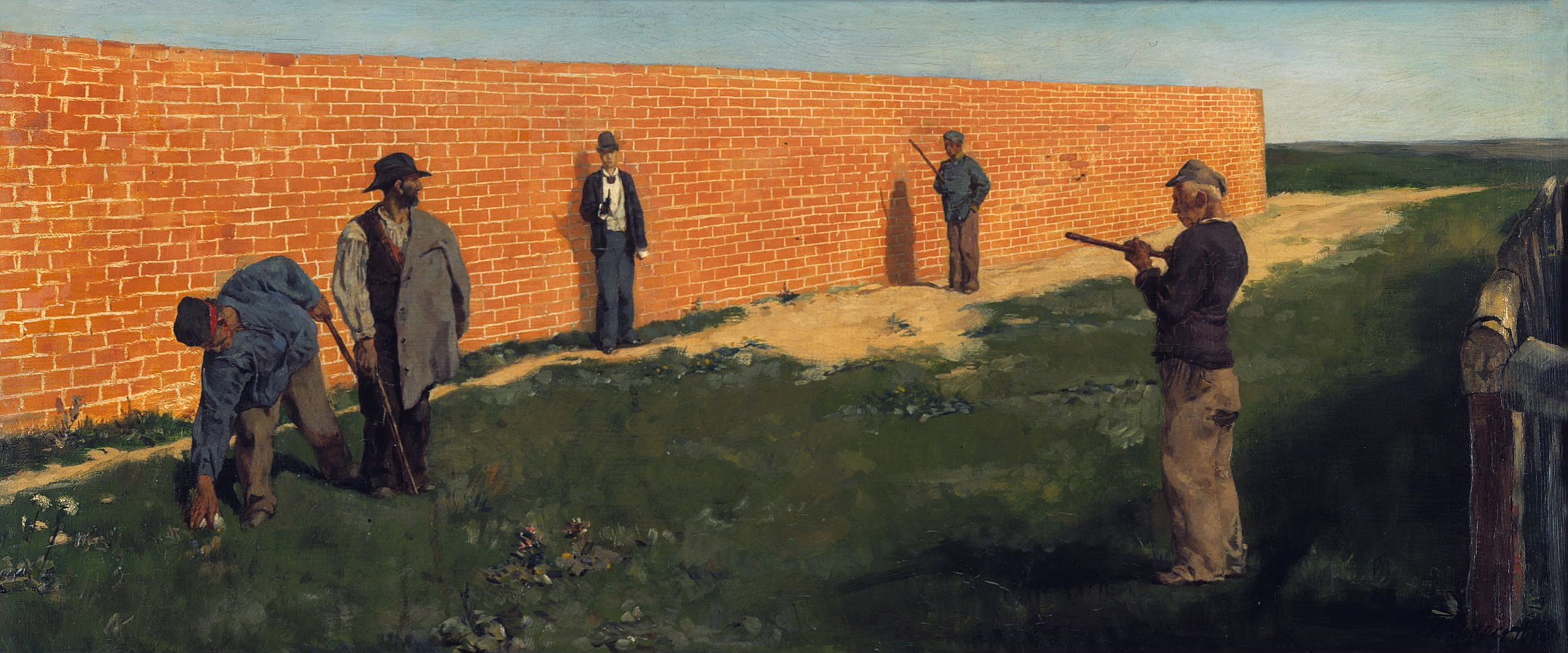
At just 21, a student fresh out of Karlsruhe submitted his very first major oil painting to Berlin's Royal Academy exhibition—and gave it a title that was, quite deliberately, a joke with teeth. The German title of this work, Spaziergänger, means "the stroller" or "the walker," but Klinger meant it ironically: nothing about this scene resembles a pleasant walk.
A well-dressed young man in a bowler hat has his back literally against the wall—a long, garish red-brick wall that cuts the composition in half and blocks any view of the horizon beyond. He's been cornered by a gang of thugs, and in response, he's pulled a revolver: at the time, a strikingly modern, distinctly American weapon to bring into a European genre scene. The painting even circulated under alternate titles: Der Überfall ("The Assault") and, when Klinger tried to submit it to the Paris Salon, Cerné ("Surrounded"). Each title peeled back a little more of the picture's real subject, naked fear in a situation with no way out.
The setting itself is telling. This isn't the city proper, but its ragged edge. It is former farmland swallowed by property speculation during Germany's Gründerjahre boom (the rapid industrialization and economic boom in Germany and Austria during the 19th century, specifically following the unification of Germany in 1871), land already scarred before anything had even been built on it. Klinger leaves the space between his figures wide and empty, stretched out further by an unusually elongated canvas format and long, hard shadows.
Klinger would go on to become far more famous for his etchings (especially the ten-plate series Paraphrase on the Finding of a Glove) and later for sculpture, culminating in his Beethoven monument at the 1902 Vienna Secession.
P.S. Stories like The Walker show how much more there is to discover when we look beyond the surface of a painting. Learn how to uncover hidden meanings, symbols, and historical context in our free course How to Look at Art.
P.P.S. Need a break from work or school? Take our quiz and see if you can guess when these artworks were made! For more quizzes, see below.