
 Unknown Artist
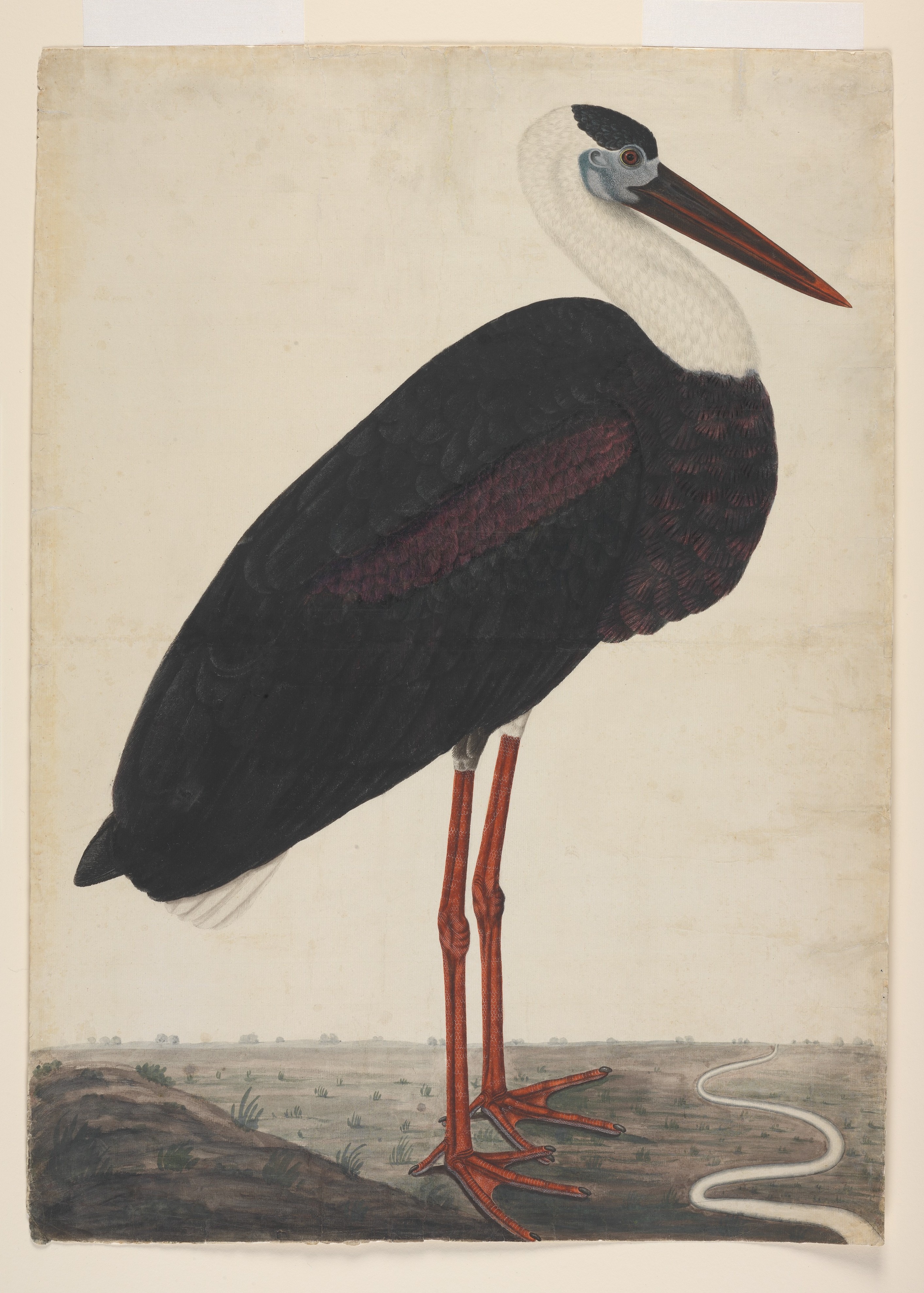
The bird’s white neck feathers, purple-streaked wings, and reddish beak identify it as a Woolly-Necked Stork (Ciconia episcopus). Painted in Lucknow (India) around 1780, the work belongs to an extraordinary moment when Indian artists trained in the Mughal tradition began creating natural-history studies for European patrons. Their paintings combined the detailed observation and refined technique of Mughal art with European approaches to perspective, volume, and landscape. Here, the enormous bird dominates a miniature landscape, while the winding stream may evoke the riverine habitats where the species could be found.
This painting was probably part of an ambitious natural-history project commissioned by Claude Martin, a French-born soldier, collector, and amateur scientist who worked for Nawab Asaf ud-Daula of Lucknow. Martin commissioned hundreds of studies of Indian flora and fauna—records suggest at least 658 birds, 600 plants, and 606 reptiles and other animals—making the project one of the earliest large-scale European attempts to visually catalog the natural world of India. The paintings may have been inspired in part by contemporary European natural-history publications, but Indian artists created them, and their extraordinary precision gave them a distinctive character. Today, works like this are associated with what later became known as Company School painting.
P.S. Explore all different kinds of birds in art in our quiz!
P.P.S. Do you like animals? If yes, please check our Animals in Japanese Art Postcard Set here:)