
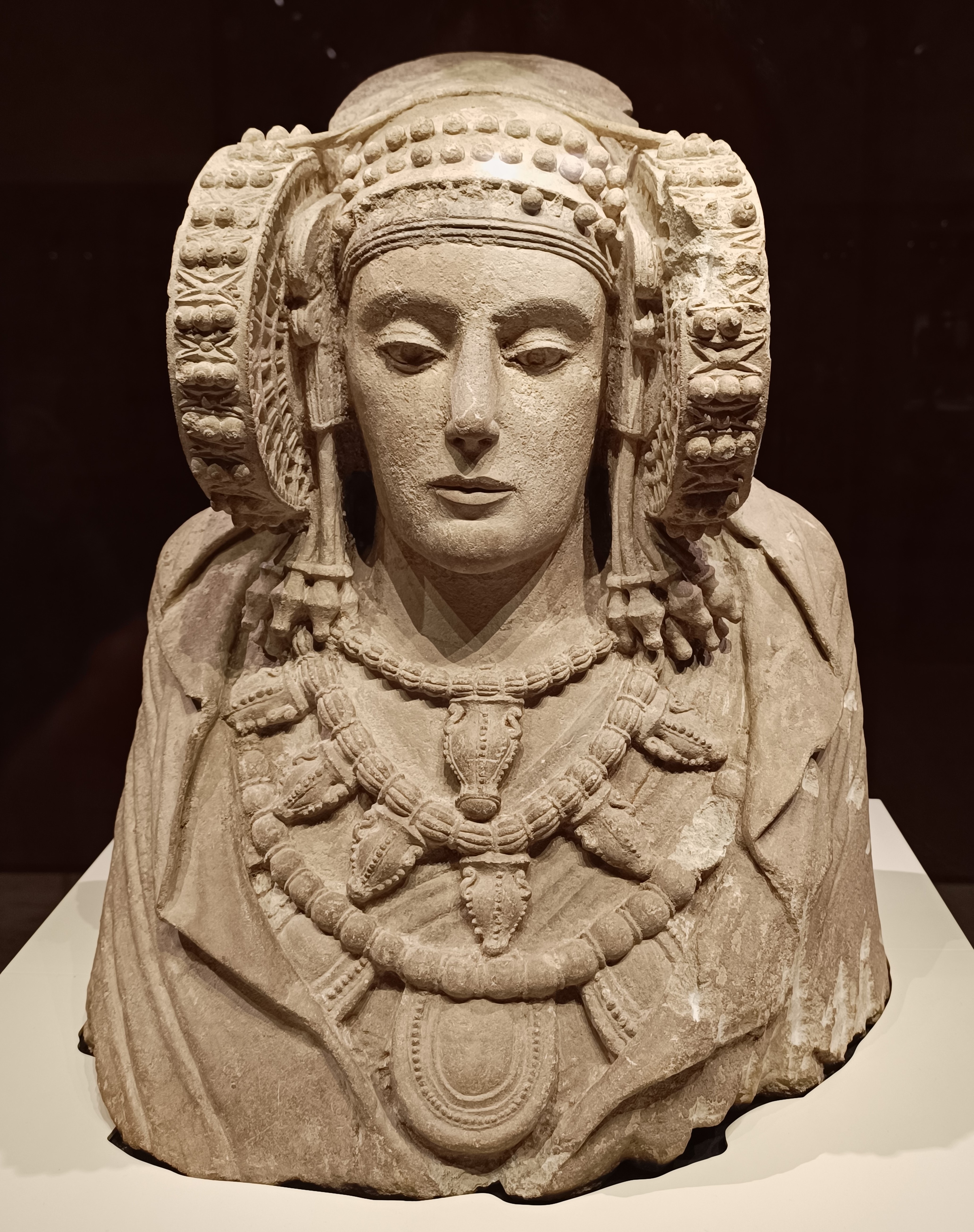
 Unknown Artist
The Lady of Elche was discovered by chance on August 4, 1897, at the archaeological site of La Alcudia in Elche, Spain. Soon afterward, the sculpture was sold to the Louvre Museum in Paris. It returned to Spain in 1941 and has been housed in the National Archaeological Museum in Madrid since 1971.
The stone bust depicts a richly dressed young woman, probably a member of the Iberian aristocracy, wearing an elaborate headdress, enormous ornaments beside her face, and three necklaces decorated with amulets and small amphora-shaped pendants. Although the sculpture appears monochrome today, it was originally brightly painted: traces of red, ocher, Egyptian blue, yellow, and even gold leaf have survived. The deep hollows of the eyes may once have contained colored glass paste. Because the sculpture was found without a clear archaeological context, its original purpose remains uncertain. Scholars have debated whether it was originally a bust or part of a larger seated or standing figure, while a cavity in its back may have held offerings or human remains. One interpretation identifies the mysterious woman as an aristocratic figure who was later venerated or deified by her descendants. Others believed she had a direct association with Tanit, the goddess of Carthage, whom the Punic-Iberians worshiped.
Beautiful, isn't she?
P.S. Have you ever seen ancient sculptures’ colors? Some of them might shock you!