
James Ensor
April 13, 1860 • November 19, 1949
James Sidney Edouard, Baron Ensor (1860-1949) was a Belgian painter and printmaker, born in Ostend His parents were James Frederic Ensor, a cultivated man who studied engineering in England and Germany, and Maria Catherina Haegeman. Ensor himself lacked interest in academic studies and left school at the age of 15 to begin his artistic training with two local painters. From 1877 to 1880 he attended the Académie Royale des Beaux-Arts in Brussels, where one of his fellow students was Ferdinand Khnopff (1858-1921). Ensor first exhibited his work in 1881. From 1880 until 1917, he had his studio in the attic of his parents’ house. His travels were very few: three brief trips to France and two to the Netherlands in 1880s, and a four-day trip to London in 1892. He lived in Ostend almost his entire life.
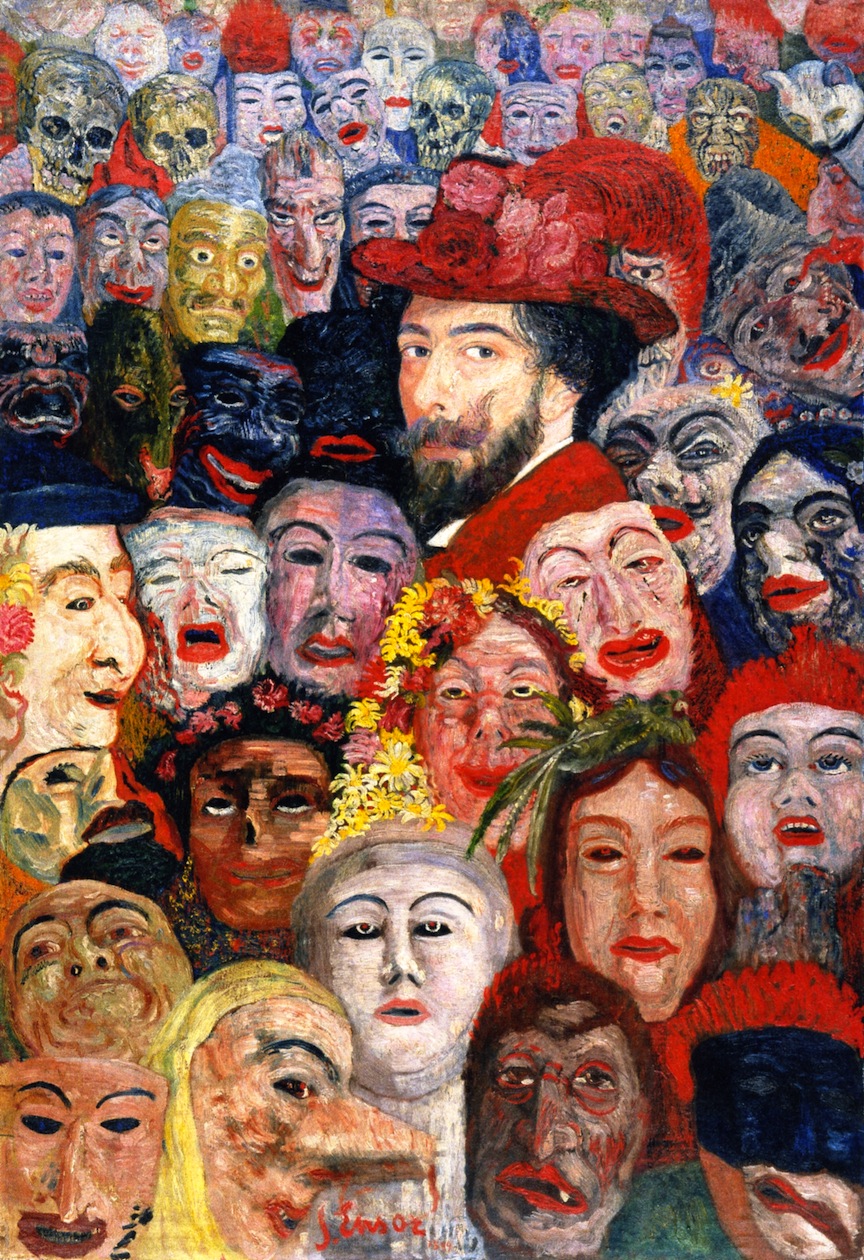
Ensor had an important influence on expressionism and surrealism. He was associated with the artistic group Les XX. While Ensor's early works, such as Russian Music (1881) and The Drunkards (1883), depict realistic scenes in a sober style, his palette subsequently brightened, and he favoured increasingly bizarre subject matter. Such paintings as The Scandalized Masks (1883) and Skeletons Fighting over a Hanged Man (1891) feature figures in grotesque masks inspired by the ones sold in his mother's gift shop for Ostend's annual Carnival. Subjects such as carnivals, masks, puppetry, skeletons, and fantastic allegories are dominant in Ensor's mature work. Ensor dressed skeletons up in his studio and arranged them in colourful, enigmatic tableaux on the canvas, and used masks as a theatrical aspect in his still life’s. Attracted by masks' plastic forms, bright colours, and potential for psychological impact, he created a format in which he could paint with complete freedom. The four years between 1888 and 1892 mark a turning point in Ensor's work. Ensor turned to religious themes, often the torments of Christ. Ensor interpreted religious themes as a personal disgust for the inhumanity of the world. In 1888 alone, he produced forty-five etchings as well as his most ambitious painting, the immense Christ's Entry Into Brussels in 1889. Also known as Entry of Christ into Brussels, it is considered ‘a forerunner of 20th-century Expressionism. In this composition, which elaborates a theme treated by Ensor in his drawing The Aureoles of Christ of 1885, a vast carnival mob in grotesque masks advances toward the viewer. Identifiable within the crowd are Belgian politicians, historical figures, and members of Ensor's family. Nearly lost amid the teeming throng is Christ on his donkey; although Ensor was an atheist, he identified with Christ as a victim of mockery. As Ensor achieved belated recognition in the final years of the 19th century, his style softened, and he painted less. Critics have generally seen Ensor's last fifty years as a long period of decline. The aggressive sarcasm and scatology that had characterized his work since the mid-1880s was less evident in his few new compositions, and much of his output consisted of mild repetitions of earlier works. Significant works of Ensor's late period include The Artist's Mother in Death (1915), a subdued painting of his mother's deathbed with prominent medicine bottles in the foreground, and The Vile Vivisectors (1925), a vehement attack on those responsible for the use of animals in medical experimentation.
In the first decade of the 20th century, however, Ensor’s production was diminishing, and he increasingly concentrated on Music. Although he had no musical training, he was a gifted improviser on the harmonium. In his old age, he was an honoured figure among Belgians, and his daily walk made him a familiar sight in Ostend. During his life Ensor had several female friends, but he never got married. He died there following a short illness, on 19 November 1949 at the age of 89.