
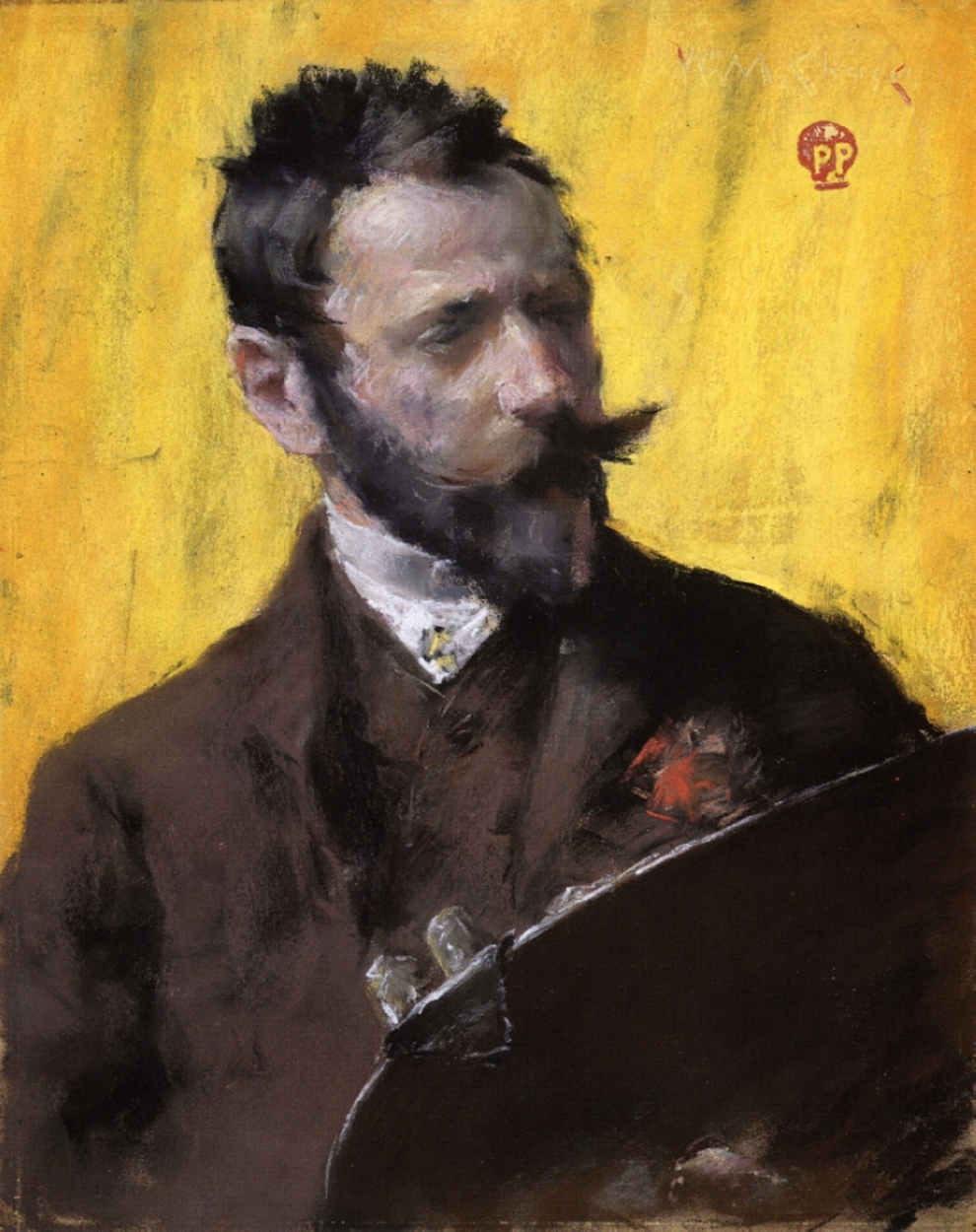
William Merritt Chase
November 1, 1849 • October 25, 1916
William Merritt Chase was an American painter, known as an exponent of Impressionism and as a teacher. He is also responsible for establishing the Chase School, which later would become Parsons The New School for Design. Chase worked in all media. He was most fluent in oil painting and pastel, but also created watercolor paintings and etchings. S.G.W. Benjamin said of his style in a contemporary review: "A noble sense of color is perceptible in all his works, whether in the subtle elusive tints of flesh, or in the powerful rendering of a mass of scarlet, as in his notable painting of the "Court Jester". In the painting of a portrait he endeavors, sometimes very successfully, to seize character, although occasionally rather too impressionist in style."
He is perhaps best known for his portraits, and his sitters including some of the most important men and women of his time. His portrait of painter Lydia Field Emmet in 1892 depicts Emmet in a pose typically reserved for men in old masters' paintings. Emmet's hand is on her hip and she looks over her shoulder at the audience. Chase also frequently painted his wife Alice and their children, sometimes in individual portraits, and other times in scenes of domestic tranquility: at breakfast in their backyard, or relaxing at their summer home on Long Island, the children playing on the floor or among the sand dunes of Shinnecock. In addition to painting portraits and full-length figurative works, Chase began painting landscapes in earnest in the late 1880s. His interest in landscape art may have been spawned by the landmark New York exhibit of French impressionist works from Parisian dealer Durand-Ruel in 1886. Chase is best remembered for two series of landscape subjects, both painted in an impressionist manner. The first was his scenes of Prospect and Central Parks in New York; the second were his summer landscapes at Shinnecock.
Chase continued to paint still lifes throughout his career as he had done since his student days. Decorative objects filled his studios and homes, and his interior figurative scenes frequently included still life images.