
 Maximilien Luce
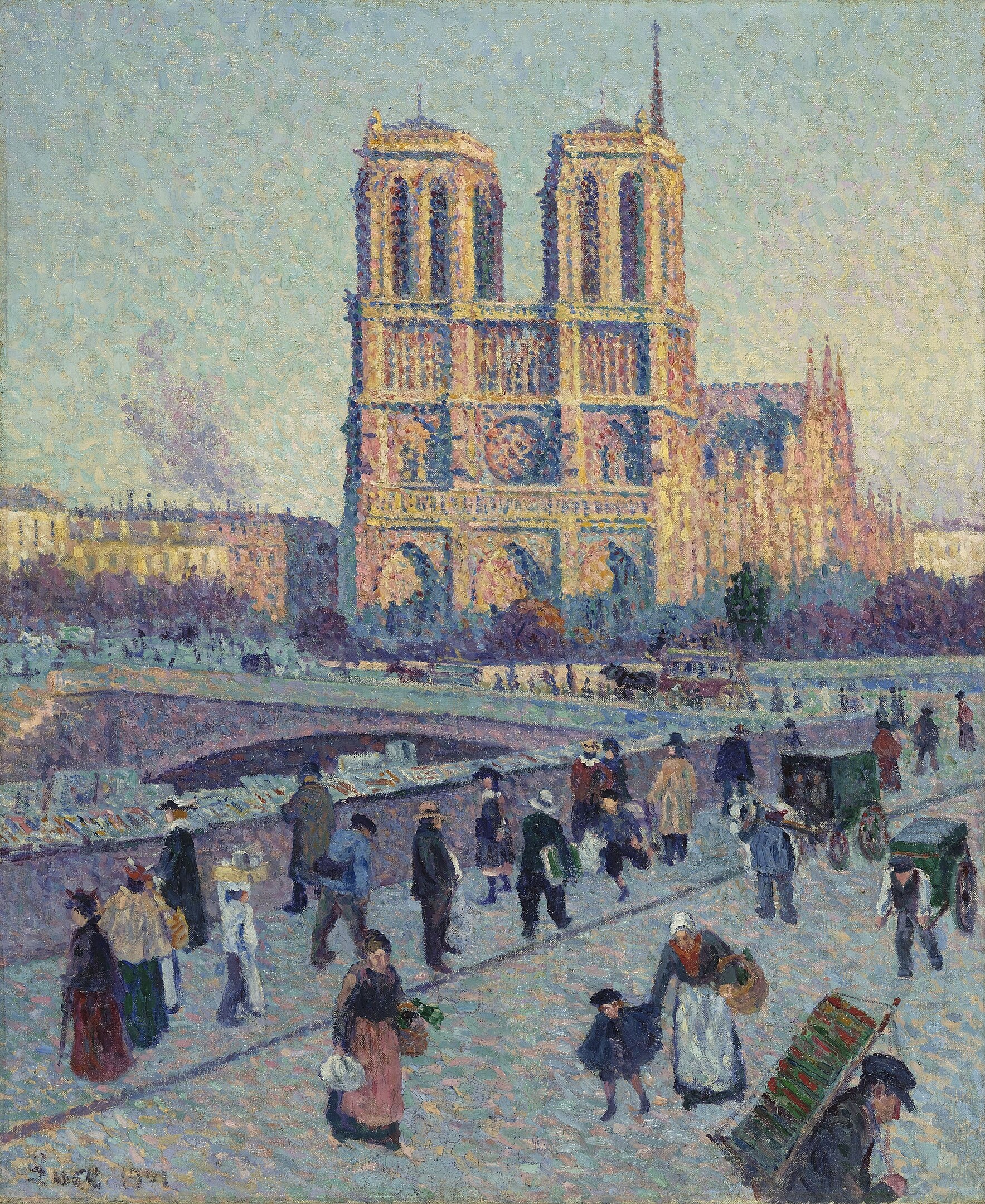
At the turn of the 20th century, Maximilien Luce, a key figure in the Neo-Impressionist movement between 1887 and 1897, employed the technique of divisionism—small, distinct touches of color—for the final time in a group of roughly ten paintings depicting Notre-Dame de Paris, viewed from the Quai Saint-Michel embankment.
At the heart of the composition, the cathedral rises majestically, aglow in a palette of warm hues—mainly oranges, pinks, and reds—contrasted with cool bluish shadows rendered through delicate, adjacent strokes. In contrast, the embankment and bridge below are cast in shadow, painted with broader, more expressive brushwork in tones of sky blue, turquoise, and purplish pink.
Luce captures the rhythm of daily life along the embankment: bourgeois passers-by, maids with baskets of fruit and vegetables, a grandmother guiding a child, and a baker’s apprentice balancing a basket on his head. We glimpse bouquinistes’ stalls, a shaded carriage, an omnibus, and a handcart pulled by a man in shirtsleeves and vest—an animated snapshot of the city’s everyday activity. And presiding over this fleeting bustle, the cathedral stands firm, a symbol of permanence.
Have a great and calm Thursday, everyone! If you'd like to learn more about Luce's technique, enroll in our Post-Impressionism 101 online course. :)
P.S. For centuries, Paris was an inspiration for generations of artists. Take a tour around Parisian landmarks in 10 paintings!