
 Maria Anto
Do you know Maria Anto? She was a Polish artist who created paintings in the spirit of Surrealism, fantastic art, and Primitivism. Allegorical scenes set against exotic and fantastical landscapes, including nocturnal vistas, served as an escape from the reality in which Anto lived and worked—a quest to find harmony and beauty through art.
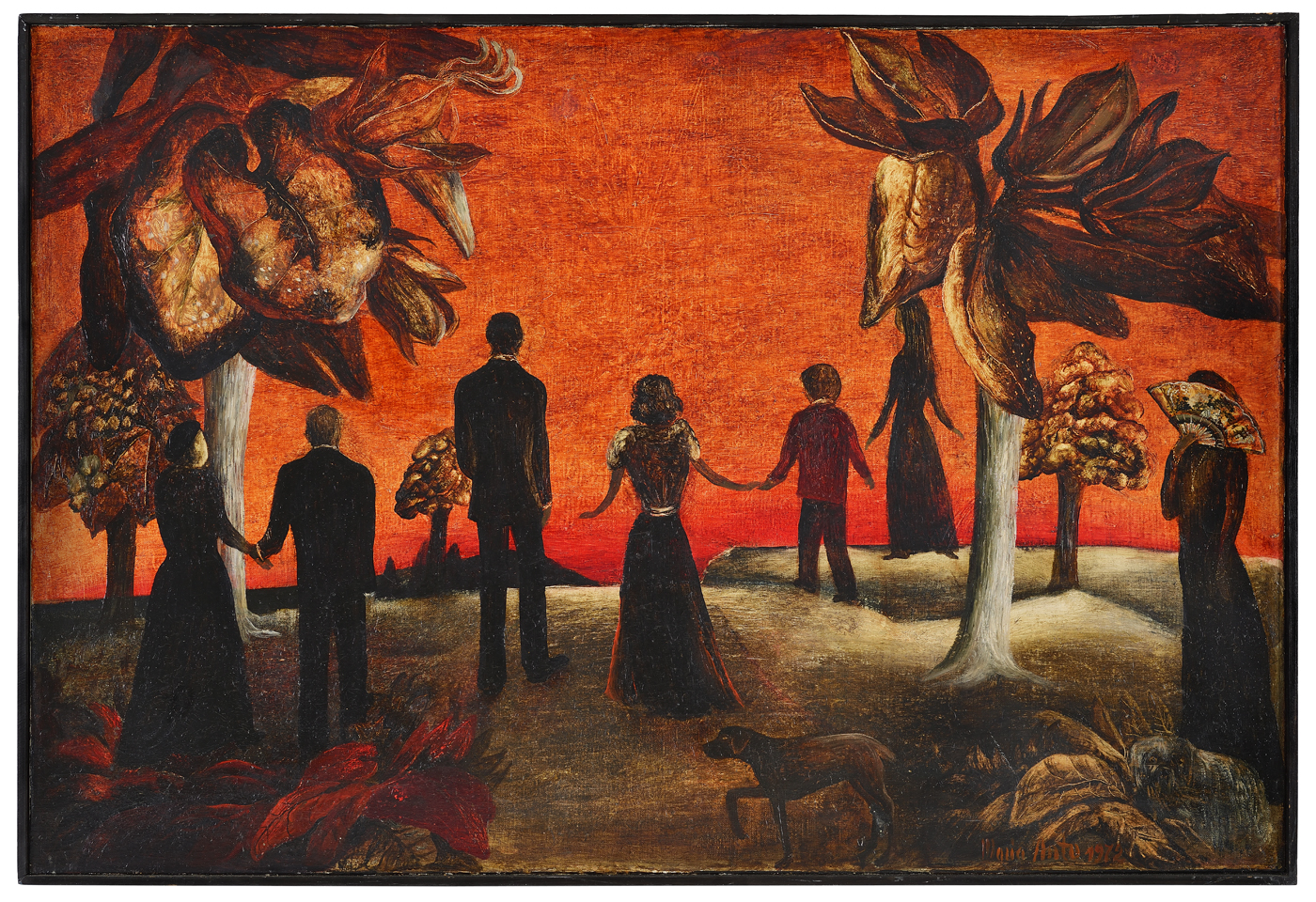
In the Evening Walk, several figures walk through an indefinite space (a park or garden) towards the setting sun. They are turned with their backs towards the viewer; only the woman near the right-hand side edge of the canvas faces the viewer, yet she remains invisible as well with her face hidden behind a fan. These are the living and deceased members of the painter's family. Their elegant clothes, suits and long dresses, look like they are not from the modern times. Two of the trees that surround the walkers stand out for their fantastic leaves, which look like magnified versions of some exotic house plants.
The artist herself gave the following explanation for her device of showing people turned with their backs to the viewer: “… that’s ME turned with my back towards the viewer. I’m looking at the same world that the viewer is seeing. The painted figure wants to show something to the viewer… What is deep within is more important.” In Anto’s paintings, figuration is shrouded in an aura of Surrealism. The motifs on her canvases tell a story, but hardly ever can they be deciphered. The viewer is confronted with a mystery, with references to themes from the artist’s life woven together along with her memories and dreams. Andrzej Osęka, an art critic, wrote that this method involved leaving things “both revealed and concealed, in order to talk about the world of one’s own personal experiences.” Whitney Chadwick, an American art historian who emphasized the uniqueness of the language of Surrealism as used by women artists, argued that while the paintings of men pictured hallucinations and erotic violence, women created a world infused with a fairy-tale atmosphere and fantasy. She did not work on Anto’s art, but the Polish artist could potentially be included in the group of women artists that she described.
We present today's work thanks to the Zachęta–National Gallery of Art in Warsaw!
P.S. If you are intrigued by today's painting, come with us into the magical world of Maria Anto’s art!
P.P.S. Discover more groundbreaking women like her in our Women Artists 50 Postcards Set. Each card celebrates a story, a vision, a voice.