
 Henri Matisse
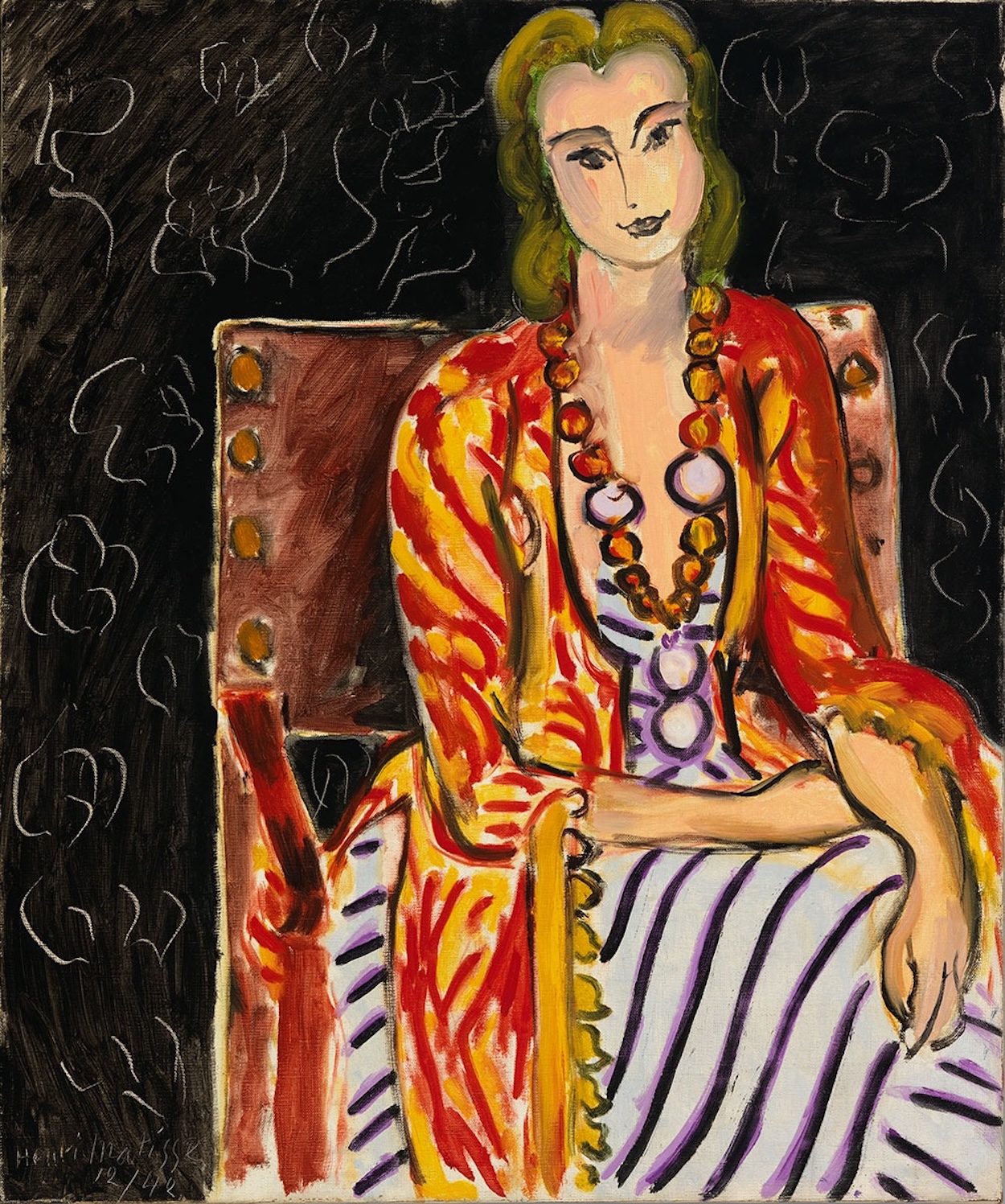
In today's painting, Henri Matisse explores a series of oppositions—between painting and drawing, color and shade, spontaneity and structure—that were central to his work and to modern French painting in the early 1940s. On June 7, 1942, Matisse wrote to his son, art dealer Pierre Matisse, expressing his desire to bring into painting the same directness and unity he had achieved in drawing—“without contradiction.” While he believed his recent Thèmes et variations drawings conveyed sensation and emotion with freedom, he feared his paintings lost that immediacy due to their precisely orchestrated fields of flat color.
Seated Young Woman with an Amber Necklace was an attempt to resolve that tension. Working over a previous layer of paint, Matisse applied mostly thinned pigments with loose, expressive brushwork. For instance, the model’s blonde curls were built up with strokes of yellow blended into a green underlayer, set against the black background, creating a dynamic surface alive with movement. Much of the painting was executed alla prima, or in a single, uncorrected pass, echoing the speed and confidence of his line drawings but in the oil medium.
In this work, Matisse also reexamines the relationship between line and color. He rendered the sitter’s robe with vibrant bars of red and yellow, and used fine, calligraphic strokes of black and cobalt violet—almost as though drawing with a pen or charcoal—to describe the folds of her dress. These marks visually rhyme with the swirling arabesques scratched into the black background, likely with the handle of a brush or a palette knife. In doing so, Matisse transforms the black field into something graphic and rhythmic, akin to a linocut print. It ceases to function as a mere void or backdrop and becomes an active, luminous surface.
P.S. Inspired by Matisse’s dynamic painting? Our How To Look at Art online course will guide you through the secrets of modern art and beyond and will help you learn how to see art differently.
P.P.S. One of the fathers of modern art, here's Henri Matisse in 10 paintings!