
 Jacoba van Heemskerck
Jacoba van Heemskerck was a Dutch painter, stained glass designer, and graphic artist who worked in several modern genres. She specialized in abstract landscapes and still lifes.
The summers Jacoba van Heemskerck spent in Domburg at the home of her lifelong friend and patron, Marie Tak van Poortvliet, were crucial to her artistic development. During her first summer there in 1908, she met fellow artists Jan Sluijters, Jan Toorop, Else Berg, Charley Toorop, Piet Mondrian, and Lodewijk Schelfhout. Mondrian and Schelfhout, in particular, had a profound influence on her early work. Like many artists of the time, she became interested in theosophy and anthroposophy; in the winter of 1909, Mondrian even tutored her. Few works from this early period survive, but they clearly reveal a luminist character.
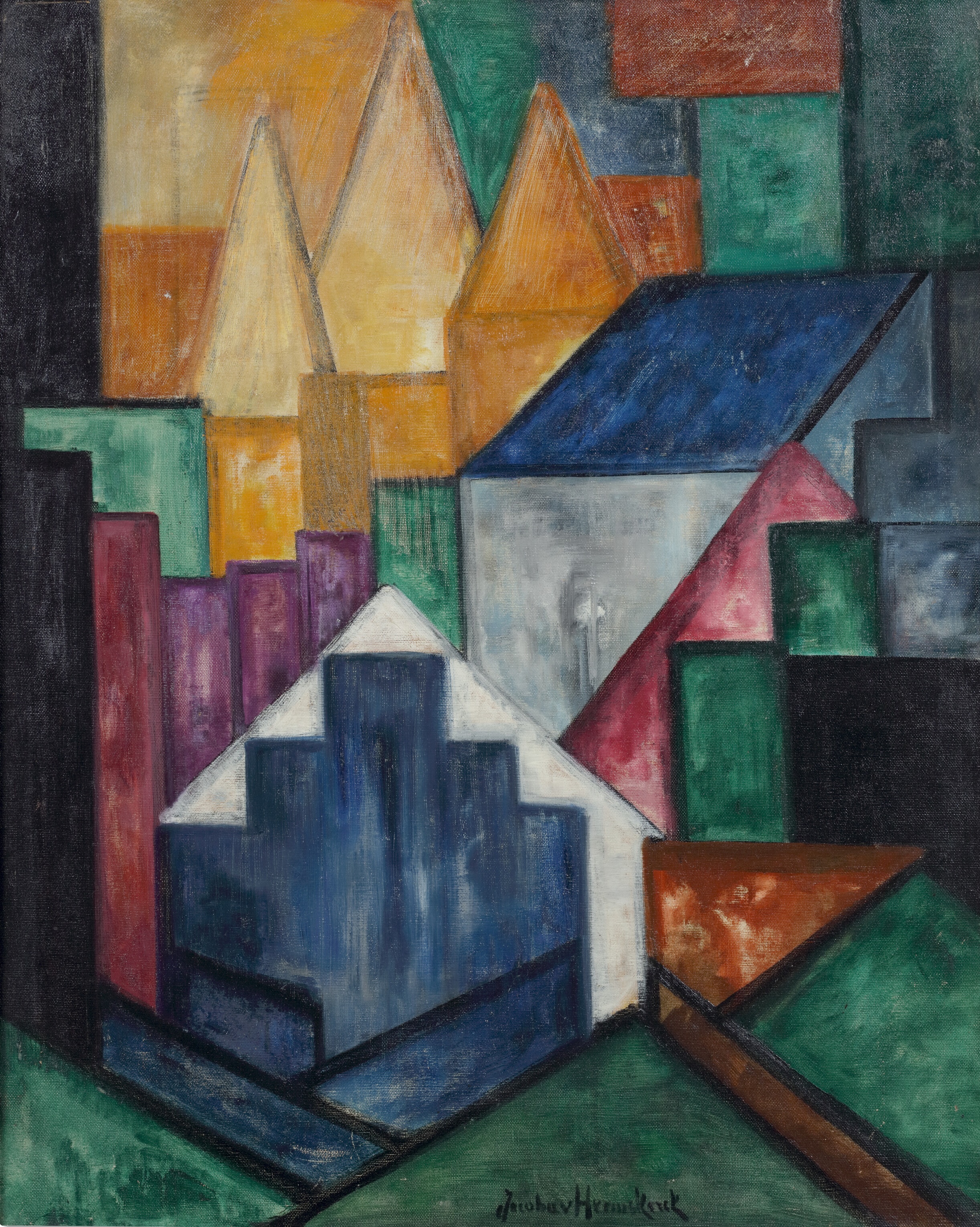
Van Heemskerck’s Cubist phase was brief, but even within it she forged a style of her own. While early Cubist works of hers featured tonal colors and a fragmented play of line, by around 1912 to 1914 her style had evolved toward clear, bold color fields outlined by black, angular lines. Dating her works is difficult—she never dated them or wrote about her process—but Marie Tak van Poortvliet’s writings confirm that theosophical theories of color and form were significant to her, even if a purely theoretical reading risks overshadowing the work’s artistic essence.
Today's painting is perhaps her most purely Cubist work. Unlike others from the same period, it contains no references to natural forms—no flowing, organic lines—reducing all elements to strict geometric shapes and minimizing perspective. In this sense, it stands as one of the high points of Dutch Cubism.
P.S. If Van Heemskerck’s bold shapes and vivid colors intrigue you, you’ll love our Cubism 101 online course. From Picasso and Braque’s groundbreaking experiments to the unique approaches of lesser-known Cubists, you’ll learn how this movement shattered artistic conventions—and how to truly see Cubist art. Enroll now and explore the movement that forever changed modern painting!
P.P.S. Created in 1875, a religious movement greatly impacted art at the turn of the 19th and 20th centuries. Learn more about the relationship between art and theosophy.