
 Hilma af Klint
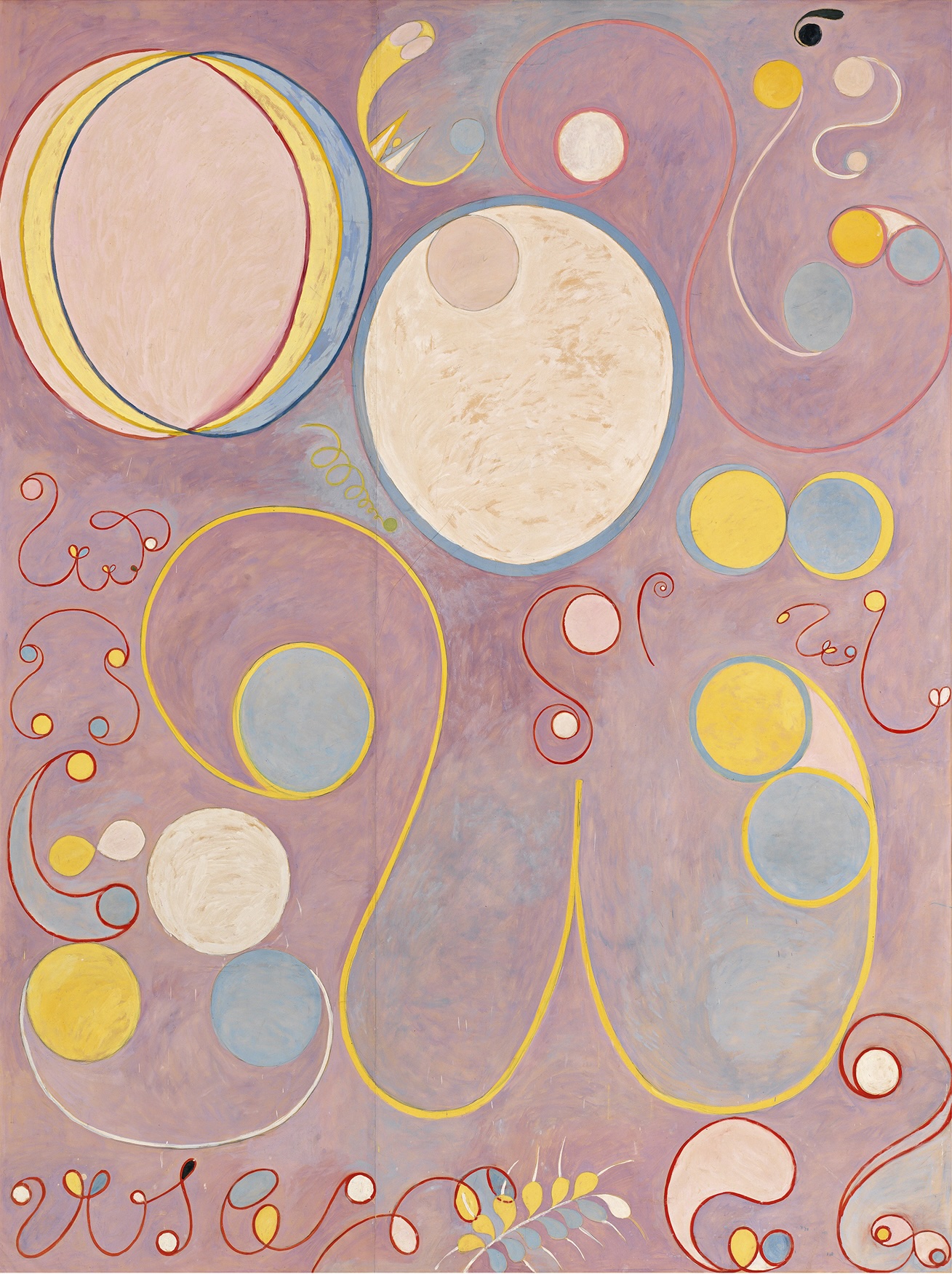
In September 1907, the Swedish artist and the pioneer of abstract art, Hilma af Klint, recorded a vision announcing that “ten paradisaically beautiful paintings” would be created to offer the world a glimpse of life’s stages. The following month, she began work on The Ten Largest.
Largely abstract in character, these monumental canvases chart four phases of human existence—childhood, youth, adulthood, and old age. Botanical motifs underscore af Klint’s belief in humanity’s bond with nature, while invented words, some said to be received from spirits, unfurl across the surfaces in exuberant, looping script.
Each composition was completed in just four days. At the direction of her spirit guides, af Klint invited fellow artist Cornelia Cederberg, a member of her spiritualist circle De Fem (The Five), to assist—though always under af Klint’s command.
Given their sheer scale, the works were likely executed on the studio floor, a radical departure from the conventions of easel painting. Af Klint envisioned them installed together within a spiral temple, forming what she called a “beautiful wall covering.”
This work is the final canvas in the Adulthood section. While it still brims with the swirling letters, symbols, and geometric motifs that define her abstract vocabulary, it conveys a calmer, more measured energy than the preceding three compositions.
This masterpiece is featured in our Weekly Desk Calendar for 2026. Order it now with a 20% discount. Don't miss this chance; the offer ends tomorrow!
P.S. Read more about this absolutely amazing pioneer of abstract art!