
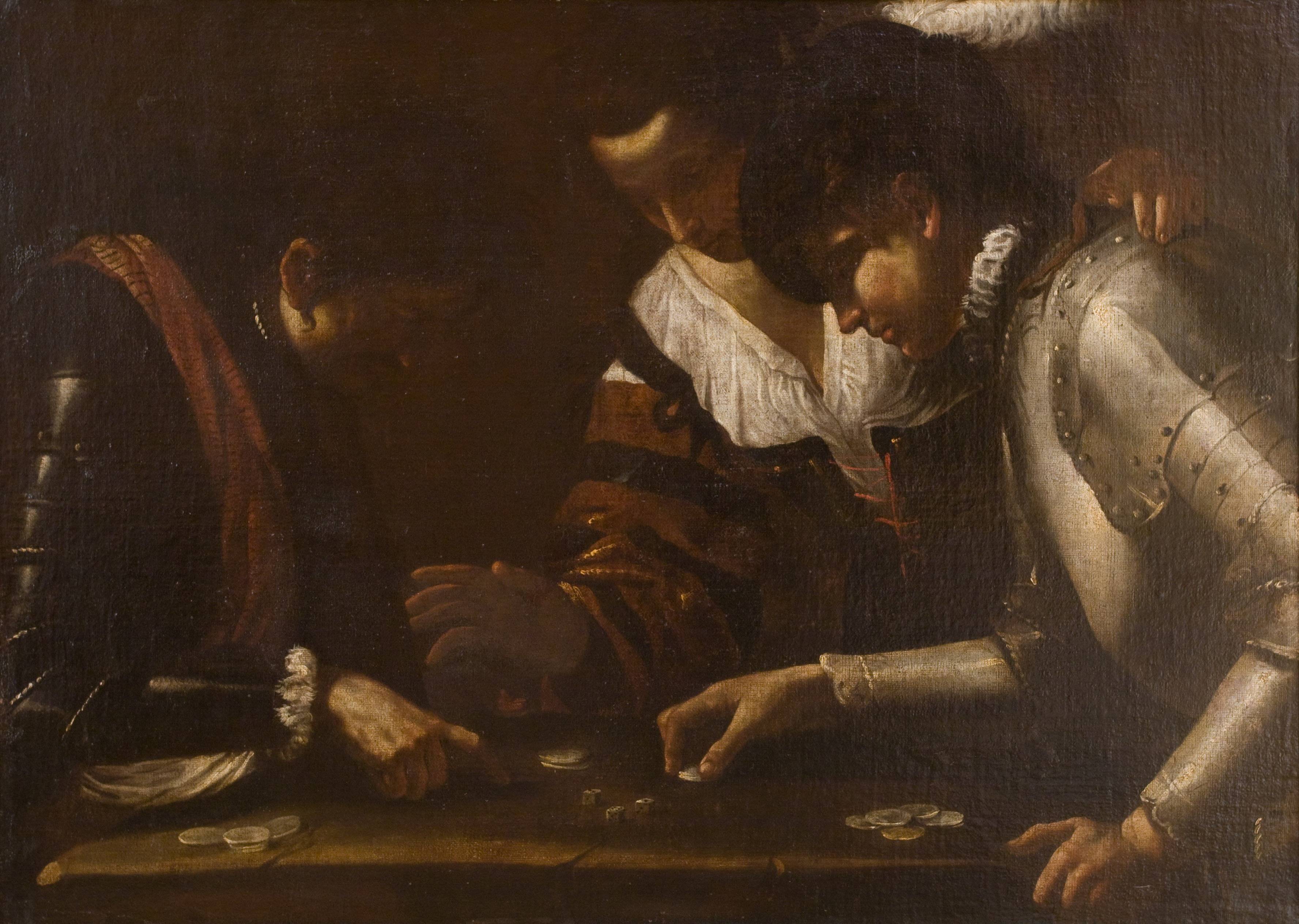
 Mattia Preti
Mattia Preti was born and grew up in the small town of Taverna in Calabria. Around 1630 he settled in Rome, where he became familiar with the art of Michelangelo Caravaggio and his followers. The young artist joined this painting trend with his works from the period circa 1630 to 1640, both concerning the choice of themes and the manner of painting. This painting was inspired by Caravaggio's works, too. Two players (an adult man and a youth accompanied by a courtesan) are drawn out of the dark interior by an intense light, which is sliding across the armor and exposing the white color of the girl's shirt, unbuttoned at her chest. The painting contains certain didactic overtones. It can be interpreted as a warning for the young boy in the white armor (symbolizing innocence) to beware of various dangers lying in wait for him on the threshold of adulthood, symbolized by the man in the black armor and the girl giving signs to help cheat against the young man in the game. In the years circa 1630 to 1635, Mattia Preti often painted scenes presenting a card game, a checkers game, a dice game, or a concert involving only three participants: two men and a woman.
We present today's artwork thanks to the National Museum in Krakow, where the European Art Gallery was recently opened. It is full of the most interesting and best works of European painting and sculpture from the collections of the National Museum in Krakow, created between the 13th and 20th centuries. Take a look at some of its gems that are now on view!