
 Fernand Léger
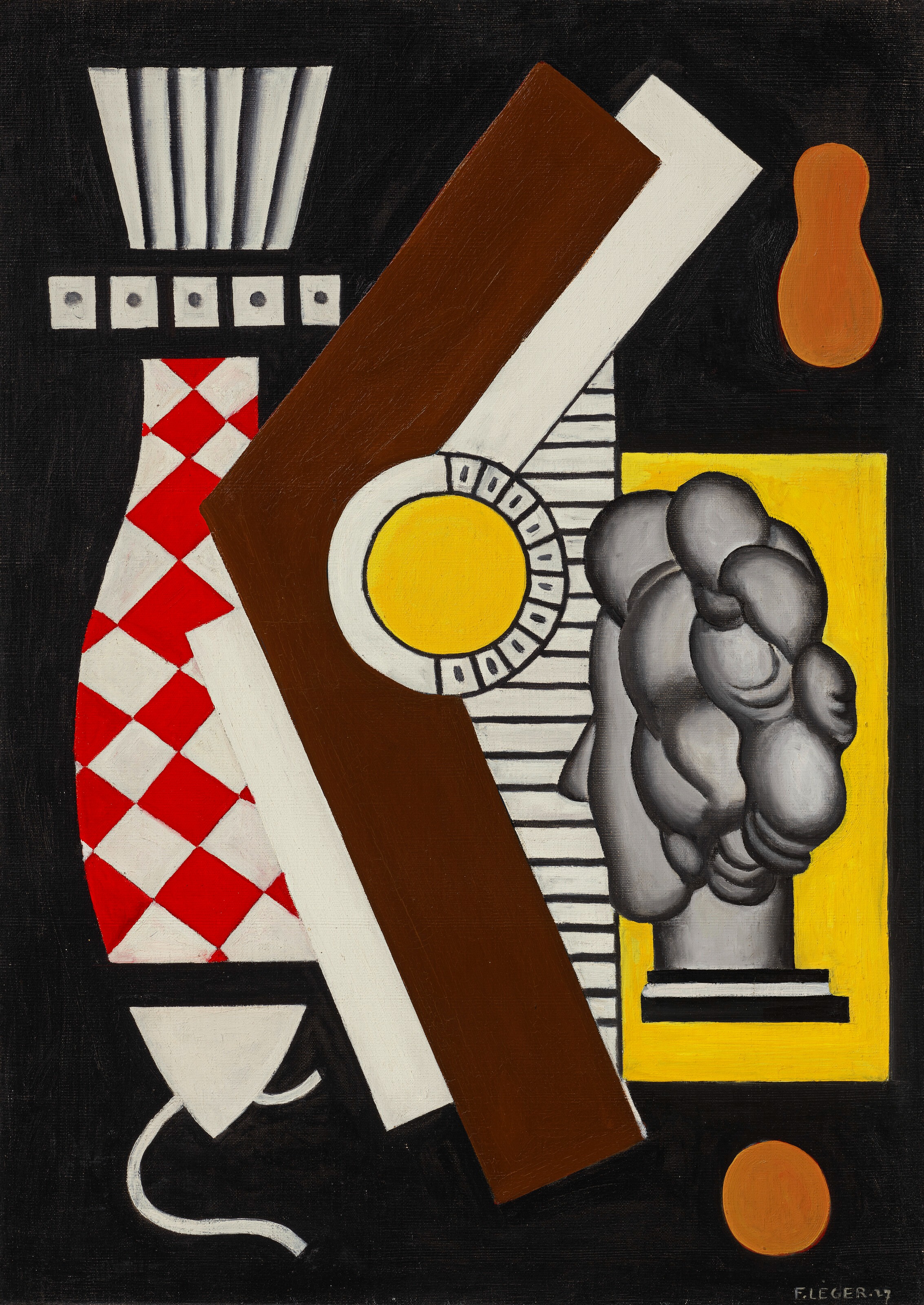
With its sharply defined forms and flattened planes of color and pattern, Still Life shows the visual energy of Fernand Léger’s boldly modern still lifes from his mature period. Painted in 1927, the work reflects his sustained engagement with Purism, the aesthetic advanced by Le Corbusier and Amédée Ozenfant, which championed clarity, logic, and rational order in the pursuit of a lasting art rooted in the modern material world. Drawn to these principles (particularly the belief that order is fundamental to artistic creation), Léger became closely aligned with the movement, contributing to its journal L’Esprit Nouveau and cofounding the Académie de l’art moderne with Ozenfant in 1924. While Purist ideas informed much of Léger’s production, they found especially forceful expression in his still lifes of the mid-1920s, where he explored relationships between space and scale, and between organic and mechanical forms, through carefully constructed compositions.
In these works, Léger achieved a poised, architectonic balance, creating visual tension through the deliberate juxtaposition of everyday objects. Drawn from the industrialized urban world of his time, these forms are simplified, isolated, and rendered monumental within the ambiguous space of the picture plane. In Still Life, Léger assembles a group of recognizable elements—a manufactured fish, a mechanical angle-finder and ruler, and a stone bust of a woman with a classical coiffure—into a complex, multipart composition. A similar grouping appears in two other paintings from the same year, both of which also feature the fish and angle-finder, though in reversed positions. Here, the fish takes on an Art Deco character through its red-and-white checkered pattern, while the centrally placed ruler introduces the theme of precise measurement.
The angle-finder, suspended at an obtuse angle in the center of the canvas, forms a chevron or arrow shape that guides the viewer’s eye across the composition. Its crisp geometry and rhythmic, ladder-like markings contrast sharply with the softly modeled bust to the right—the only object rendered with subtle gradations of light and shadow. Positioned between the antique sculpture and the distinctly modern fishing lure, the arrow-like form may suggest a conceptual link between tradition and modern design, hinting that the principles shaping one may also inform the other.
P.S. Explore more striking still-life artworks in our Food & Drinks 50 Postcards Set—now available at 15% off!
P.P.S. An angle-finder and ruler—this still life presents mathematical tools in its very center! Are you surprised to see these elements in the painting? Well, you shouldn't be, as art and math are closely linked!