
 Fernand Léger
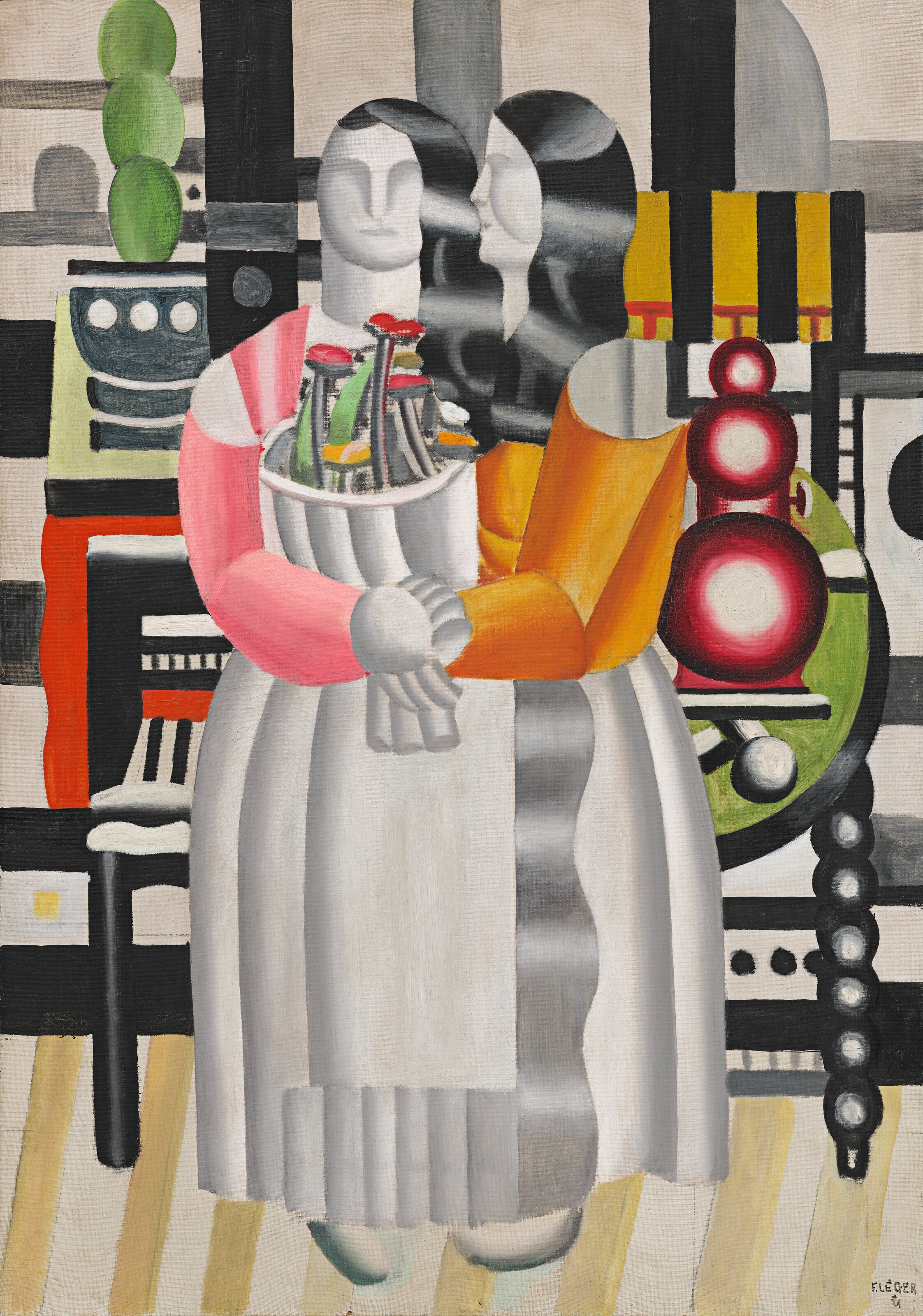
In today's painting, we see two elegantly dressed young women leaning closely together, their bodies nearly merging as they share a private exchange. One figure faces the viewer directly, while the other turns in profile, inclining toward her companion to whisper a secret. Although the surrounding space is animated by Léger’s characteristic interplay of bold color and geometric form—suggesting a carefully furnished interior with houseplants and a piano—the emotional focus of the composition rests firmly on the women’s intimate interaction, a quiet affirmation of their closeness and kinship.
The painting was included in Léger’s landmark retrospective at the Musée National d’Art Moderne in Paris in the autumn of 1949 and was given shortly thereafter to his sister-in-law, Yvette Lohy, following the death of his first wife, Jeanne. Inscribed on the reverse, “To Yvette, in memory of her sister Jeanne,” the work stands as a deeply personal tribute, reflecting the enduring bond between the two sisters—one that Léger observed repeatedly throughout his 30-year marriage.
Executed in Léger’s distinctive figurative style of the early 1920s, Les Confidences reveals the profound transformation in his art following the First World War. After serving on the front lines and spending three years away from painting, Léger returned to his practice with renewed clarity and conviction. He viewed the war as a definitive rupture with the past, ushering in a new, uncompromisingly modern reality. Rejecting decorative refinement and atmospheric subtlety, he embraced pure, localized color and monumental form, confident that he had finally found the visual language he sought.
This shift coincided with the broader rappel à l’ordre—the postwar “return to order” that swept through European art, advocating clarity, structure, and classical restraint. Though initially resistant to anything that appeared backward-looking, Léger soon recognized that aspects of this movement could align with his own goals. His work from the early 1920s thus forges a synthesis of tradition and modernity, uniting classical solidity with the visual rhythms of contemporary life.
P.S. Take a look at these beautiful portrayals of sisterhood in art!
P.P.S. Interested in Cubism? Léger’s work intersects with Cubist principles while forging its own path. Learn more in our online course, Cubism 101: Picasso, Braque, and the Others.