
_-_(MeisterDrucke-909474).jpg) Gustave Caillebotte
Gustave Caillebotte
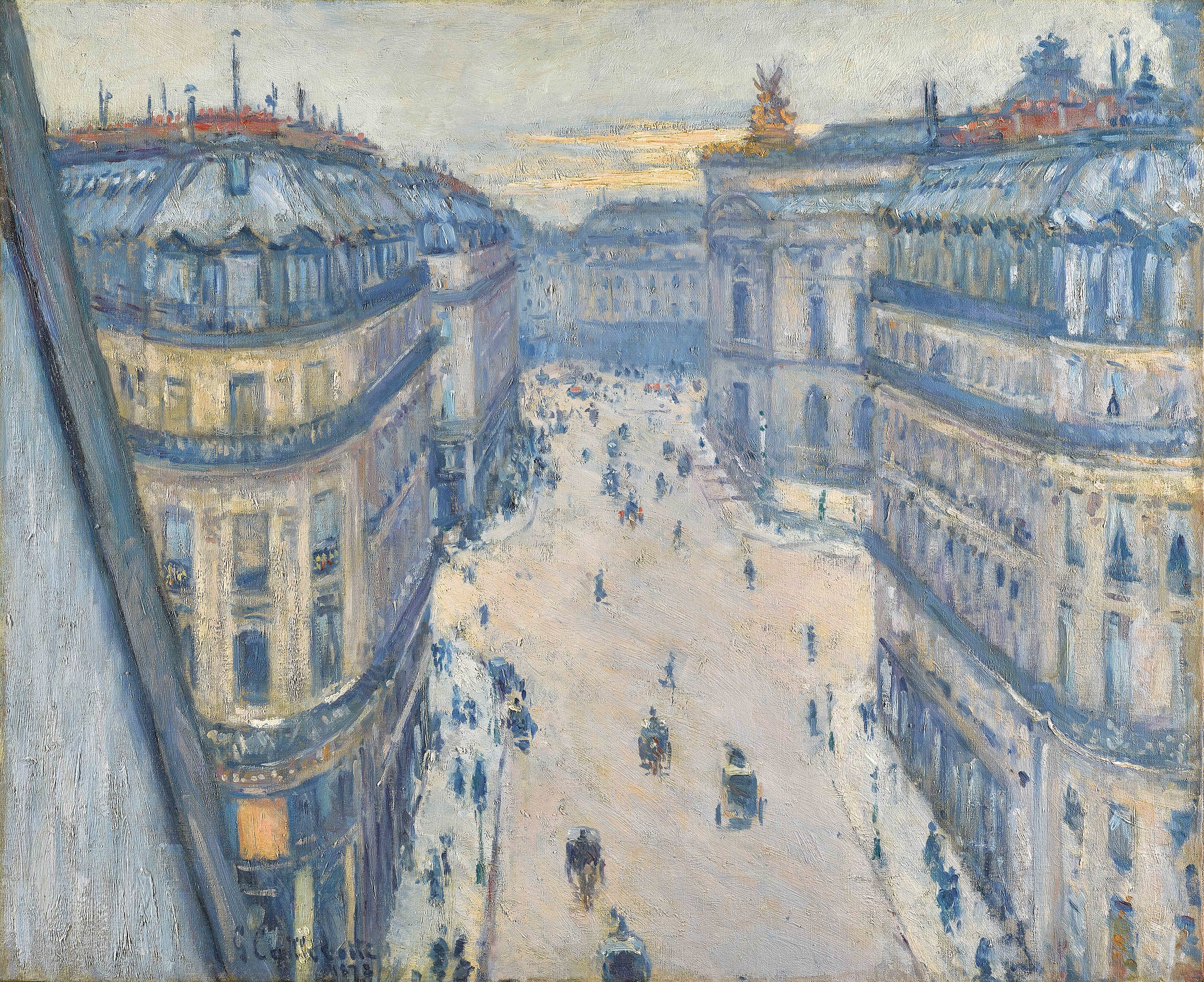
In many of his Parisian cityscapes, Gustave Caillebotte treated the window as a psychological threshold—a point of transition between the sheltered privacy of the bourgeois interior and the impersonal life of the street. In this work, the viewer is positioned on a balcony, making the urban panorama itself the sole subject. The elevated vantage point draws the eye deep into the scene, a sensation heightened by the sharply angled window frame at left, the only visible link to the interior space behind the viewer.
The composition is organized around the vertical thrust of the Rue Halévy as it rises toward the Opéra Garnier. The street appears as a pale, flattened plane laid down in thick brushstrokes, animated only by the indistinct forms of pedestrians and carriages. Both the steep perspective and the atmospheric blur evoke Claude Monet’s Boulevard des Capucines, a work Caillebotte certainly knew and may have encountered at the first Impressionist Exhibition in 1874. Yet despite the loosened handling of paint, he renders the Haussmannian façades with clear architectural definition.
A restrained palette, punctuated by vivid blue-violet accents, enhances the painting’s sketch-like immediacy. Caillebotte exhibited the work at the Fourth Impressionist Exhibition in 1879.