
 Robert Duncanson
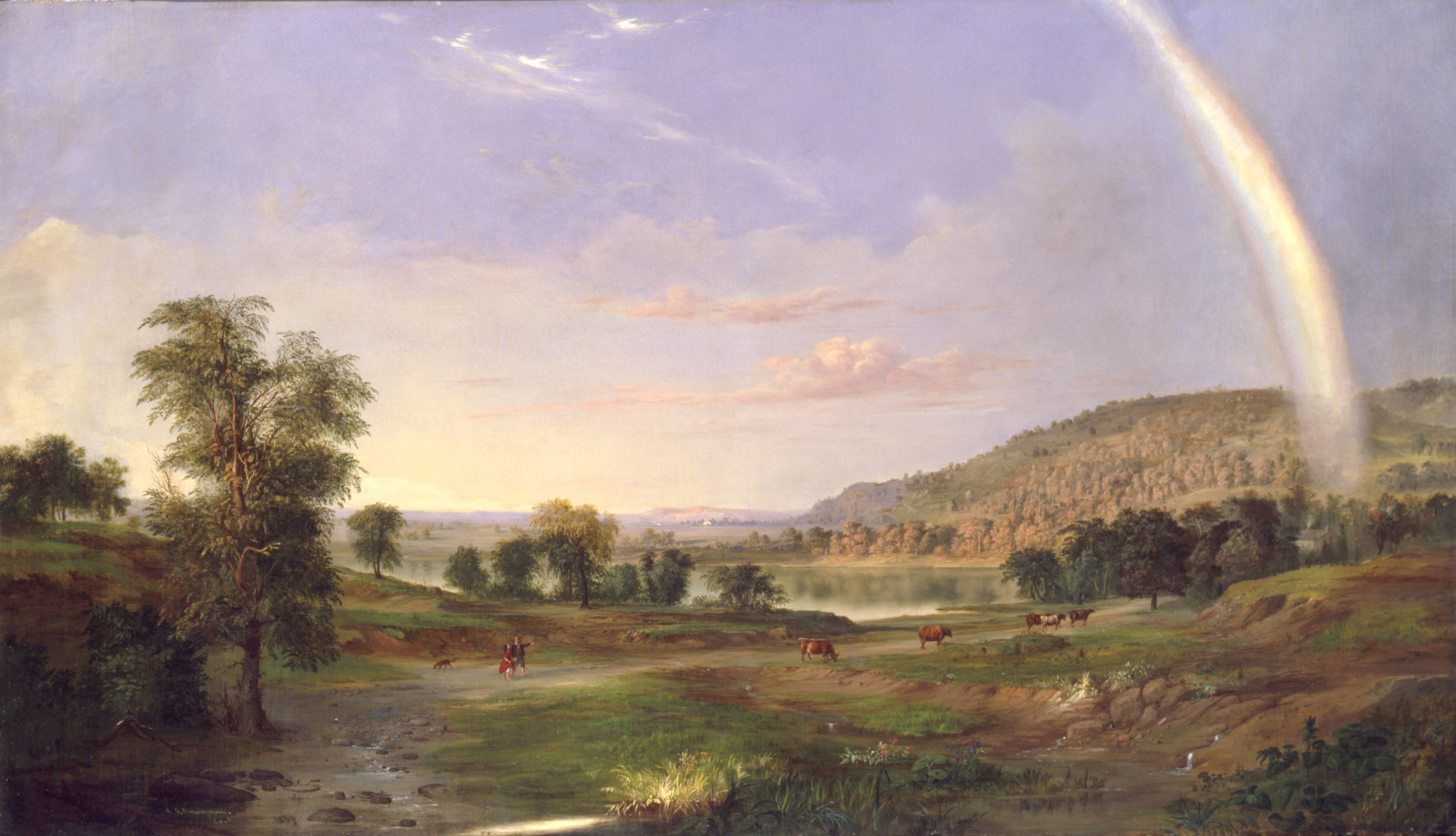
The landscape painter Robert S. Duncanson was a freeborn African American artist active in Cincinnati and widely acclaimed in his lifetime as the “best landscape painter in the West.” Working in the tradition of the Hudson River School, he was also deeply influenced by the French artist Claude Lorrain, whose paintings he encountered during an abolitionist-funded trip to Europe in 1853. Although supported by many abolitionists, Duncanson rarely addressed slavery directly in his imagery.
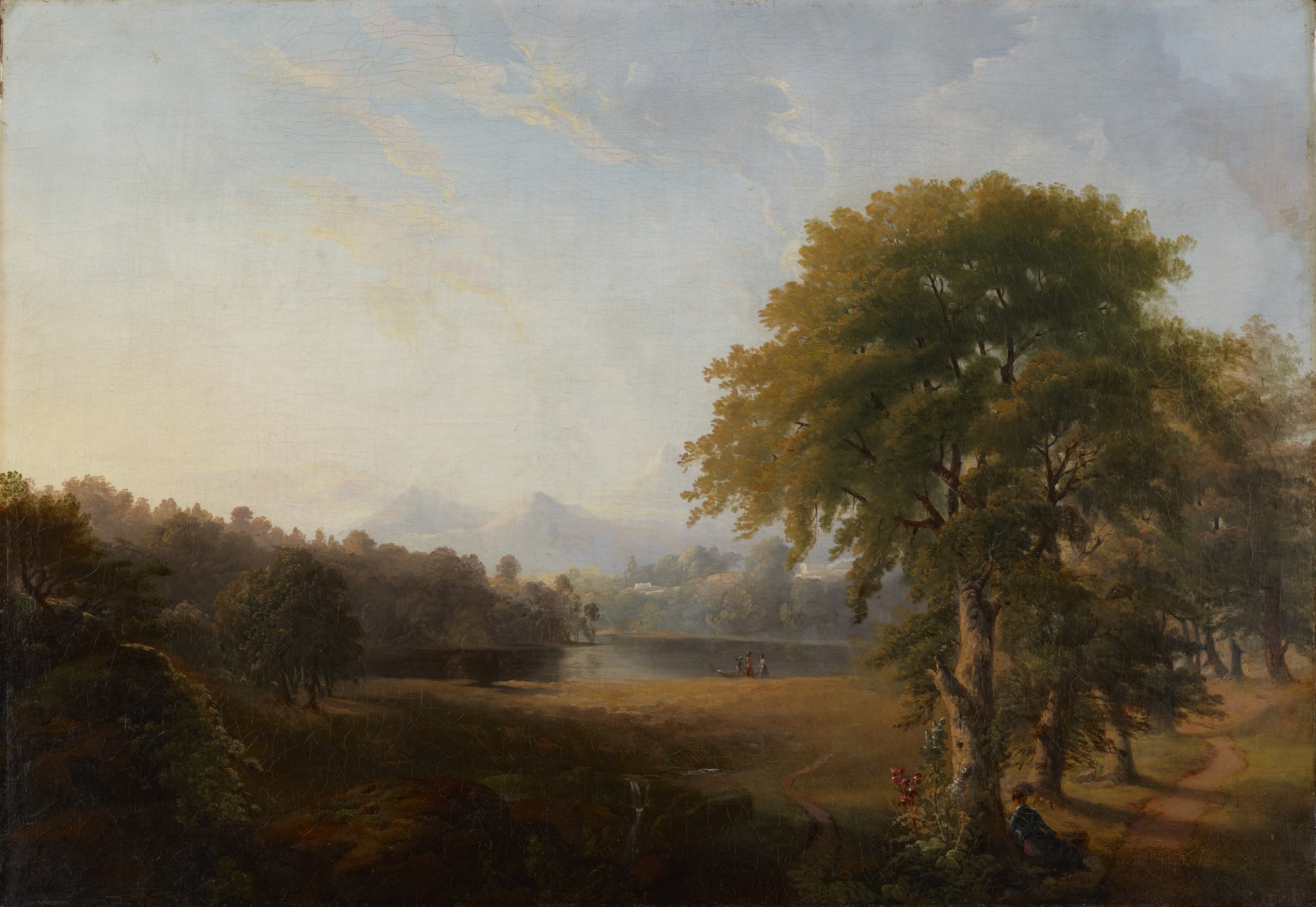
In this work, Duncanson evokes Lorrain's landscapes through a carefully layered composition: a dark foreground anchored by a large tree, a luminous middle ground with water and classical architecture set on a rise, and distant blue mountains in the background. He animates this Arcadian setting with four figures of differing skin tones. Closest to the viewer, a seated figure beneath the tree in the right foreground—likely a white woman—turns to look back toward the pond, her pronounced gesture guiding the viewer’s gaze to the three figures beyond. At the water’s edge stand three individuals whose skin tones range from black to brown to white. The Black figure, a man, stands in a boat holding an oar or pole, while the brown-skinned man and white woman appear to converse on the bank. Their precise relationships remain ambiguous, and the man in the boat may be working for the pair on shore. Even so, the scene conveys a sense of balance and coexistence, which may function as a quiet, understated statement against slavery. Set within an idealized, classical landscape, this harmony gains added resonance from both ancient tradition and more recent art-historical precedents.
Landscapes have always carried deeper meaning. Our Landscapes Postcards Set covers them all—from Arcadian ideals to quiet modern reflections.
P.S. Explore the paintings of Robert S. Duncanson—the pioneering African American painter!