
 Lawrence Alma-Tadema
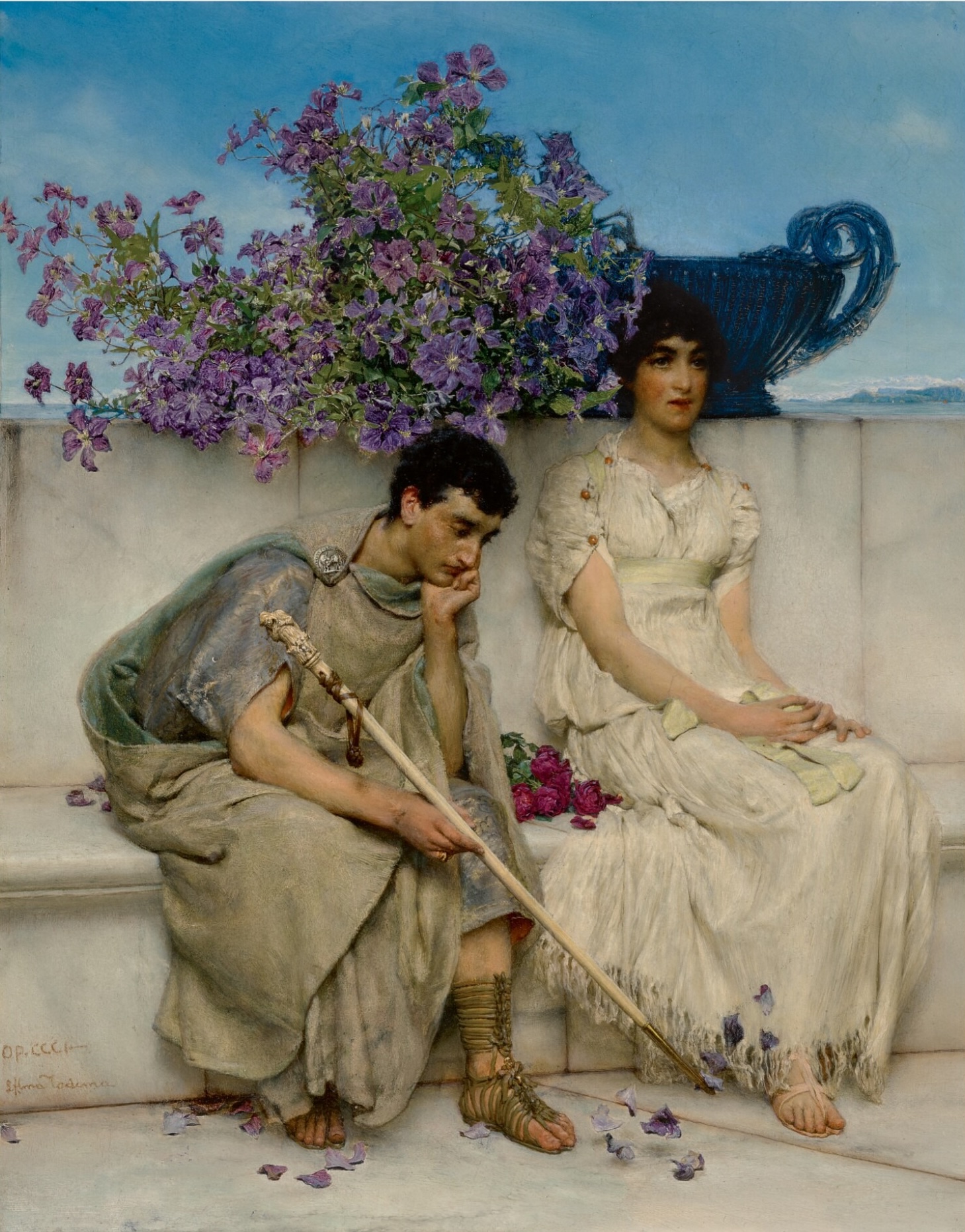
In 1890, the year An Eloquent Silence was painted, Sir Lawrence Alma-Tadema and his family were staying at the summer residence of Georg Ebers in Tutzing, Bavaria. The tranquil vision of a white marble balcony beneath clear cyan skies, overlooking the deep blue Mediterranean, stands in marked contrast to the political and social realities of Kaiser Wilhelm’s Europe. Yet it was precisely this idealized classical world that provided fertile inspiration for the artist.
Alma-Tadema was deeply inspired by the historical romance novels of Georg Ebers, an eminent Egyptologist who also discovered and translated the ancient medical text now known as the Ebers Papyrus. His works helped establish the genre and include titles such as An Egyptian Princess, Bride of the Nile, Cleopatra, and, most notably, A Question.
While Alma-Tadema’s patrons may not have been intimately familiar with Ebers’ romantic literature, they deeply admired the artist’s technical brilliance and meticulous attention to detail. Published in 1882, A Question was conceived as a literary counterpart to the idealized ancient world depicted in Alma-Tadema’s paintings.
Themes of courtship recur throughout Alma-Tadema’s oeuvre, and An Eloquent Silence is particularly indebted to another episode from A Question. In this work, two lovers sit on a marble bench amid vibrant flowers, gazing out toward the sea—an image that encapsulates the artist’s enduring fascination with restrained emotion and classical beauty.
P.S. Ancient Egypt wasn't the only inspiration for Alma-Tadema. He also depicted scenes from the history of Greece and the Roman Empire. The Roman world, in particular, inspired one of his most famous paintings—a lavish, hedonistic banquet with a macabre twist.
P.P.S. Don't miss out on our newest launch: Women Artists vol. 2 - 50 Postcards Set :)