
 Claude Monet
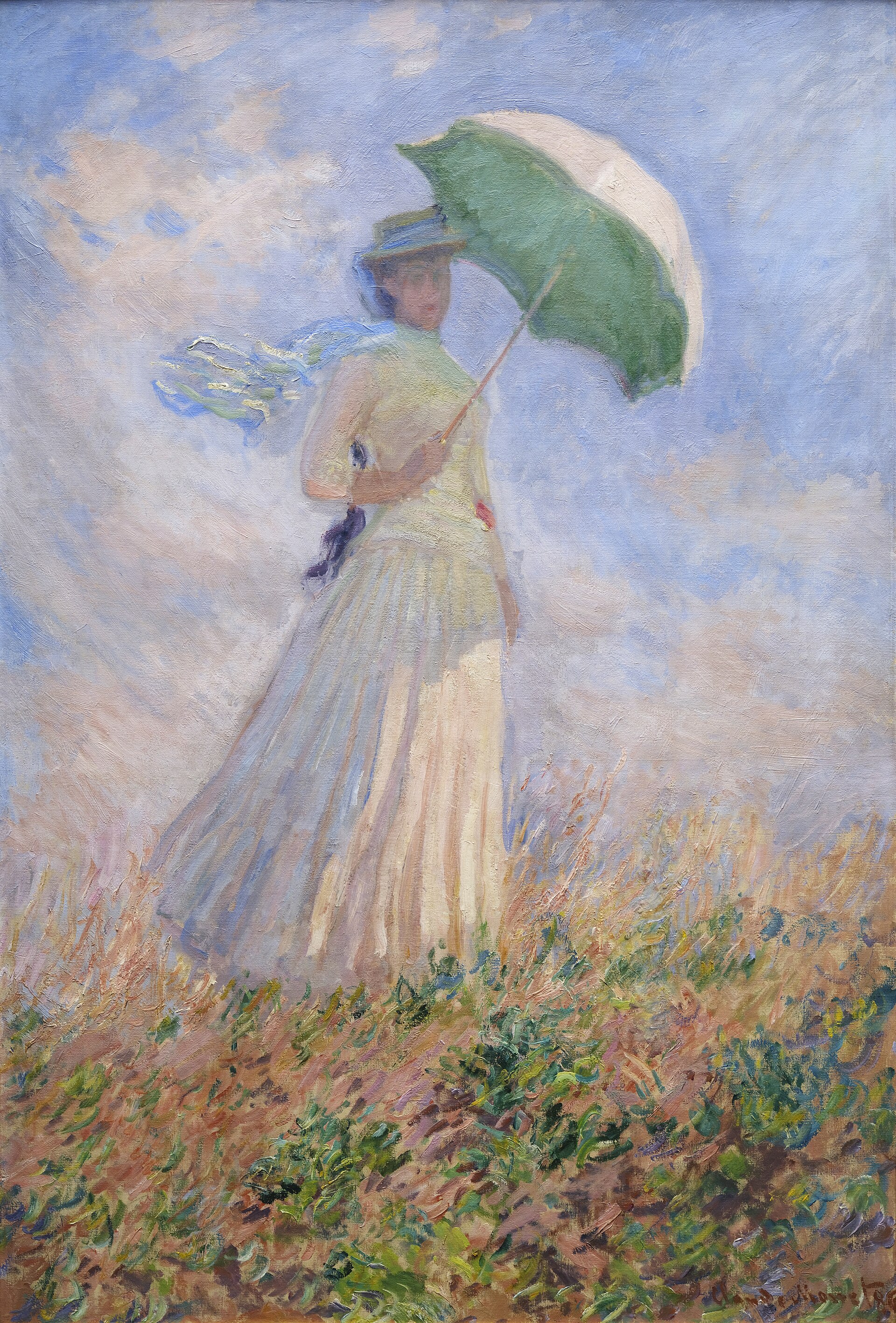
Claude Monet’s return to the human figure in 1886—after largely abandoning it following the death of his first wife, Camille, in 1879—is also a return to his earlier work. In this canvas he revisits the composition of Woman with a Parasol, adopting the same low viewpoint and backlighting. What appears to be a light scene of bourgeois leisure becomes, when seen alongside the earlier painting, a meditation on memory. It is as if figures from a new generation replace those of the former one. Monet seems to project Camille’s image onto his stepdaughter Suzanne, giving her similar features and a comparable, introspective presence.
By placing Suzanne in the exact pose once held by Camille, Monet revisits not only a motif but his own past. In contrast to the earlier painting, where Camille’s gaze meets the viewer, Suzanne’s face dissolves into bluish shadow, lending her an almost spectral quality. A striking red touch on Suzanne’s bodice has been interpreted as a subtle reference to the illness that claimed Camille’s life. Through such biographical and visual echoes, the painting reflects Monet’s growing preoccupation with memory and loss.
P.S. Want to understand Monet and the stories behind his masterpieces? Explore his life and art in our French Impressionism Mega Online Course, and discover the techniques, motifs, and emotions that shaped Impressionism.
P.P.S. Claude Monet often included members of his family in his paintings, yet only one of his children picked up a brush. Discover the art of Monet's stepdaughter, Blanche Hoschedé-Monet!