
 Julia Margaret Cameron
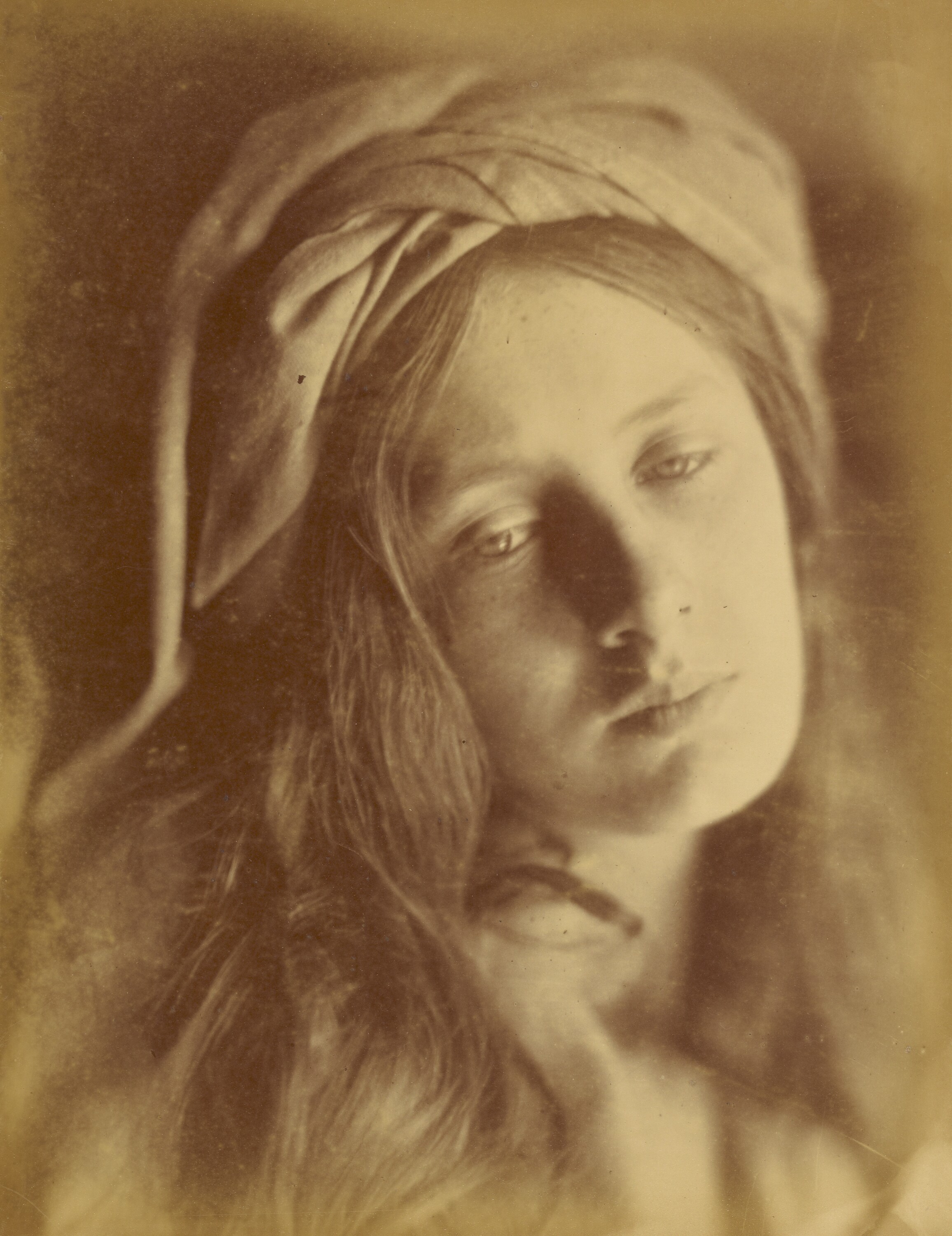
In Julia Margaret Cameron’s most compelling portraits of women, her sitters are often drawn from her own family. She observed many of them from childhood into adulthood, and her photography served both to record their growth and to elevate them into idealized, almost timeless figures. Among her favorite models was her niece May Prinsep, who, at the age of 13, was adopted (along with other orphans) by Sara and Thoby Prinsep. Possessing a striking, classical beauty with distinctly Italianate features, she became the subject of numerous portraits between 1866 and 1874.
The title of this work refers to a character from Percy Shelley’s play The Cenci (1819), itself based on the tragic history of a 16th-century Roman family. Beatrice Cenci was the daughter of Count Francesco Cenci, a violent and oppressive figure. In response to his abuse, Beatrice conspired with her stepmother and brother to murder him. Although the exact perpetrator was never definitively identified, the plot was uncovered, and Beatrice, her stepmother, and her brother Giacomo were executed on September 10, 1599; only her younger brother Bernardo was spared.
Cameron was deeply drawn to this story and created several interpretations of Beatrice. This particular image is inspired by a painting once attributed to Guido Reni, now held in the Galleria Nazionale d’Arte Antica in Rome. Widely reproduced through engravings in the 18th and 19th centuries, the composition would have been familiar to Cameron—especially through prints such as those by Samuel Cousins, available at London’s Colnaghi gallery, where she also exhibited her work.
Cameron’s photograph is carefully staged. As Beatrice, Prinsep wears a headdress, her downcast gaze and wistful expression suggesting quiet acceptance of her tragic fate. The lighting is delicately controlled, and a lock of hair falls in a soft curve along the left side of her face.
P.S. Cameron's photographs possess a unique aura. Explore the captivating images by the queen of Pre-Raphaelite photography! For more on Pre-Raphaelite art, see the articles below.