
 Henri Matisse
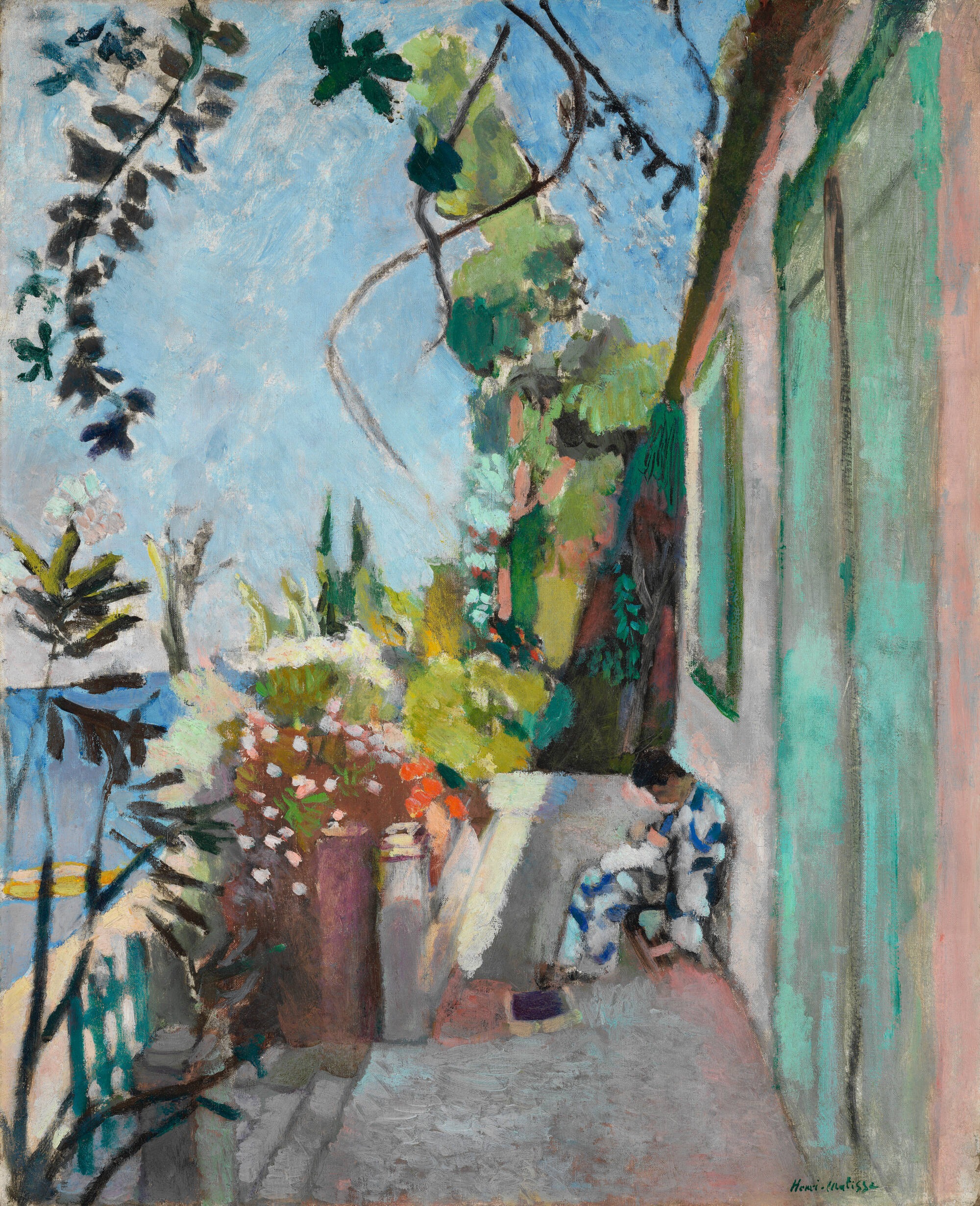
Henri Matisse's wife, Amélie, dressed in a kimono, sits quietly beside a boathouse, almost disappearing into the surrounding landscape. Matisse flattens what he sees: the blue sea, the building's broad shadow, and the twisting branches overhead changes the composition into a richly patterned surface, revealing his growing interest in decorative structure and expressive color.
The painting was created during the Matisses' nearly yearlong stay with fellow artist Paul Signac in southern France, a period that proved formative in Matisse's artistic development. Matisse briefly experimented with a Neo-Impressionist technique, prompted in part by the publication of Signac's manifesto From Eugène Delacroix to Neo-Impressionism. Rather than simply imitating Neo-Impressionism, Matisse absorbed its lessons and transformed them into a more spontaneous, liberated style. These experiments would soon culminate in the revolutionary paintings of Fauvism.
P.S. Curious how artists like Matisse transformed the legacy of Impressionism into something entirely new? In our online course, Post-Impressionism 101, you'll discover how artists such as Cézanne, Van Gogh, Gauguin, Signac, and Matisse paved the way for modern art through bold experiments with color, form, and expression.
P.P.S. Here's Henri Matisse in 10 paintings!