
 Leonardo da Vinci
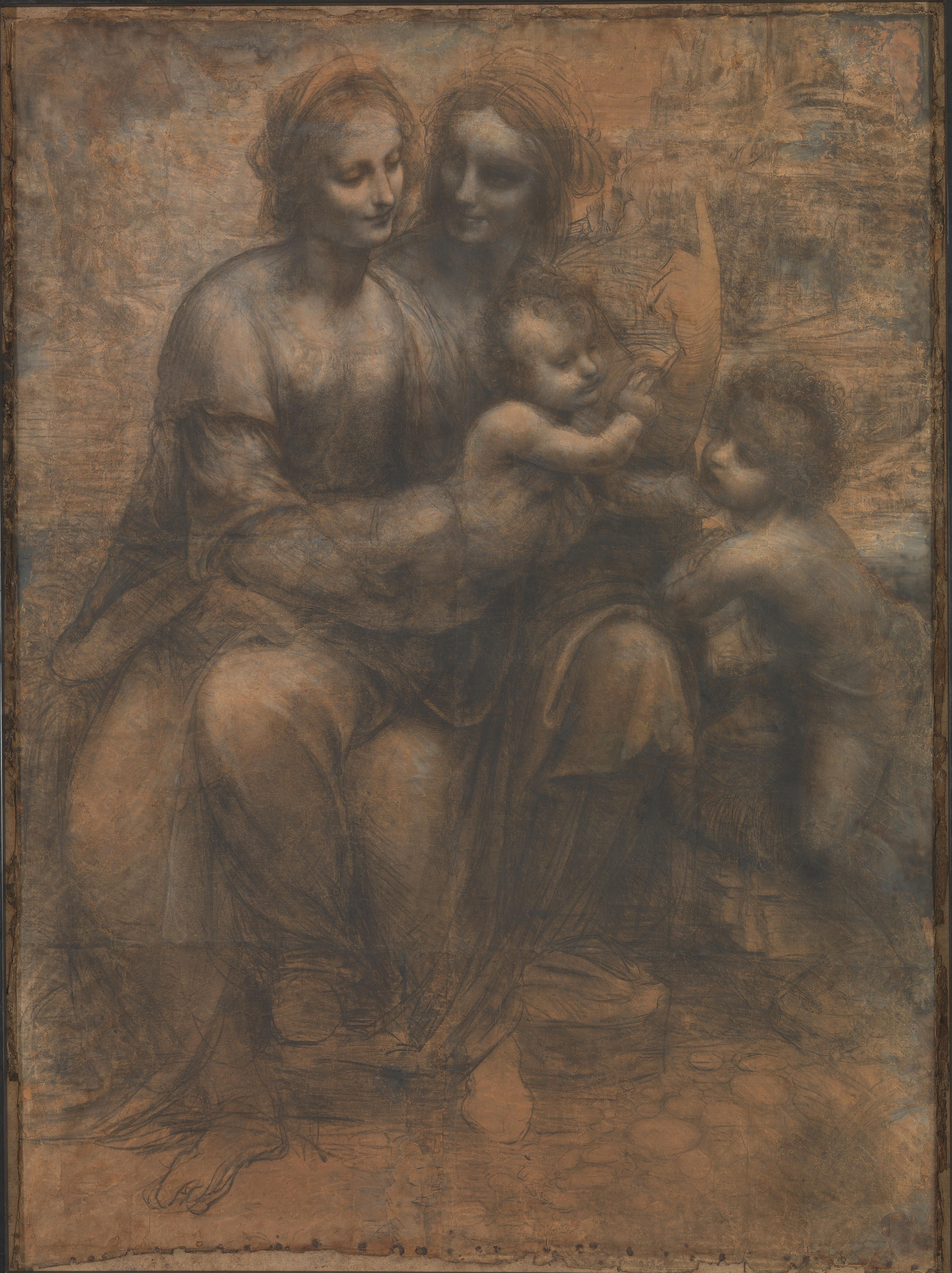
The Virgin and Child with Saint Anne and Saint John the Baptist (better known as the Burlington House Cartoon) is a large drawing by Leonardo da Vinci. Its scale and format suggest it was intended as a cartoon for a painting, though no surviving work by Leonardo is based directly on it; it may have been made in preparation for a lost or never-executed commission for Louis XII of France. It remains the only large-scale drawing by Leonardo to survive.
The subject fuses two themes popular in 15th-century Florentine painting: the Virgin and Child with John the Baptist, and the Virgin and Child with Saint Anne. The composition is remarkably complex. The two women's knees point in different directions, Mary's turning out of the frame to the left while her torso twists sharply right, creating a sinuous, spiraling movement. Yet even as their lower bodies diverge, their faces turn toward one another, mirroring each other so closely that the boundary between their upper bodies nearly dissolves, as if they share a single form. This twisting energy carries into the Christ Child, whose body, held almost horizontal by his mother, rotates on its own axis, the lower half turned up and the upper half turned down.
The two pairs of heads are carefully staged: the gaze and lighting on Christ mirror his mother's, while John the Baptist mirrors Saint Anne. A quiet drama unfolds in the exchange of glances. Anne smiles adoringly at Mary, perhaps honoring the one all generations would call blessed; Mary watches Christ, who raises a hand in blessing over his older cousin John, who, despite his age, humbly accepts it, foreshadowing his own words that he was "not worthy even to unloose his sandals." Anne's raised index finger, pointing toward heaven near the children's heads, seems to gesture toward the true source of that blessing—an ambiguous gesture typical of Leonardo, echoed in The Last Supper and his Saint John the Baptist.
P.S. Discover the unfinished works of Leonardo da Vinci! For more articles on the Italian master, see the articles below.