
 Carl Spitzweg
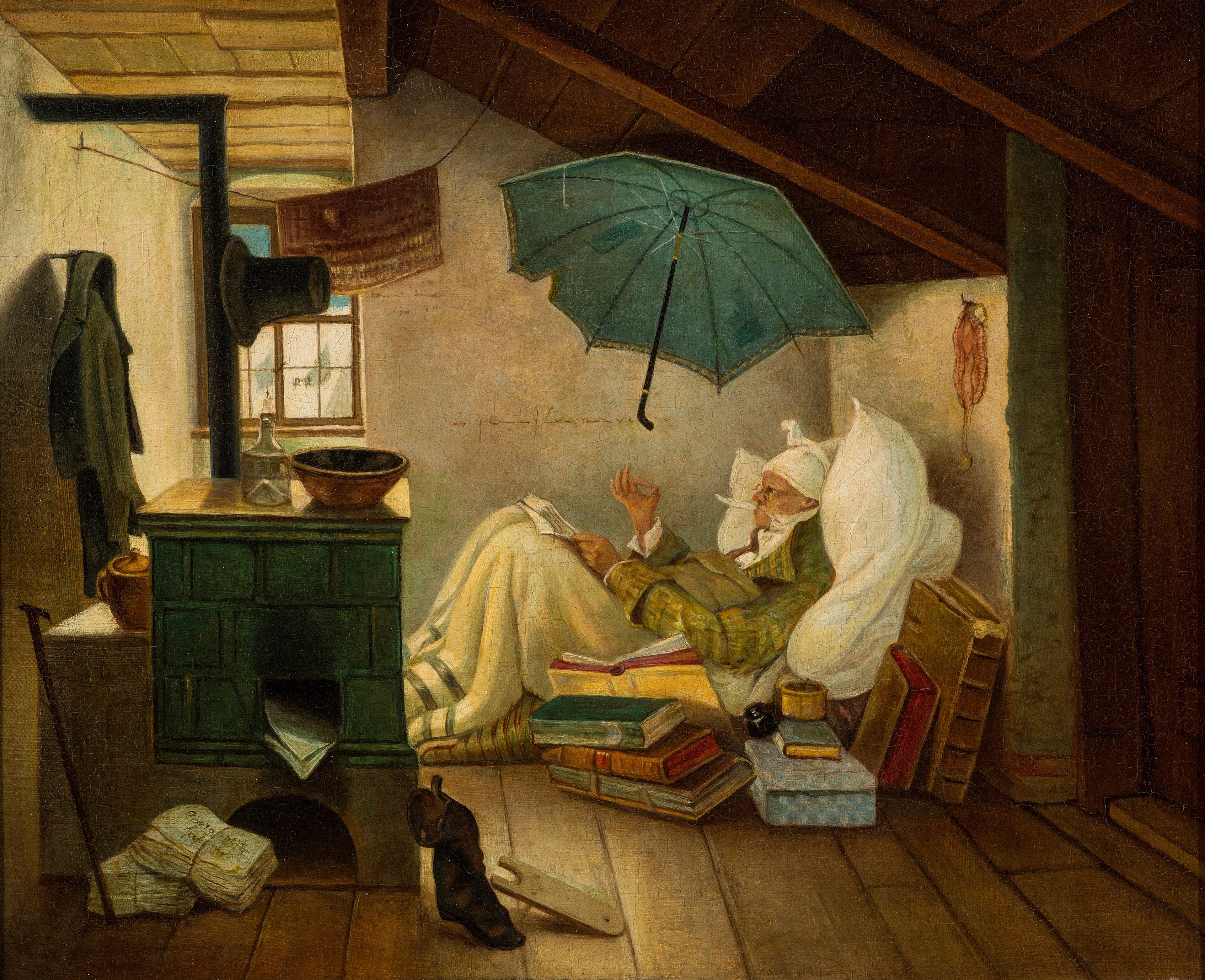
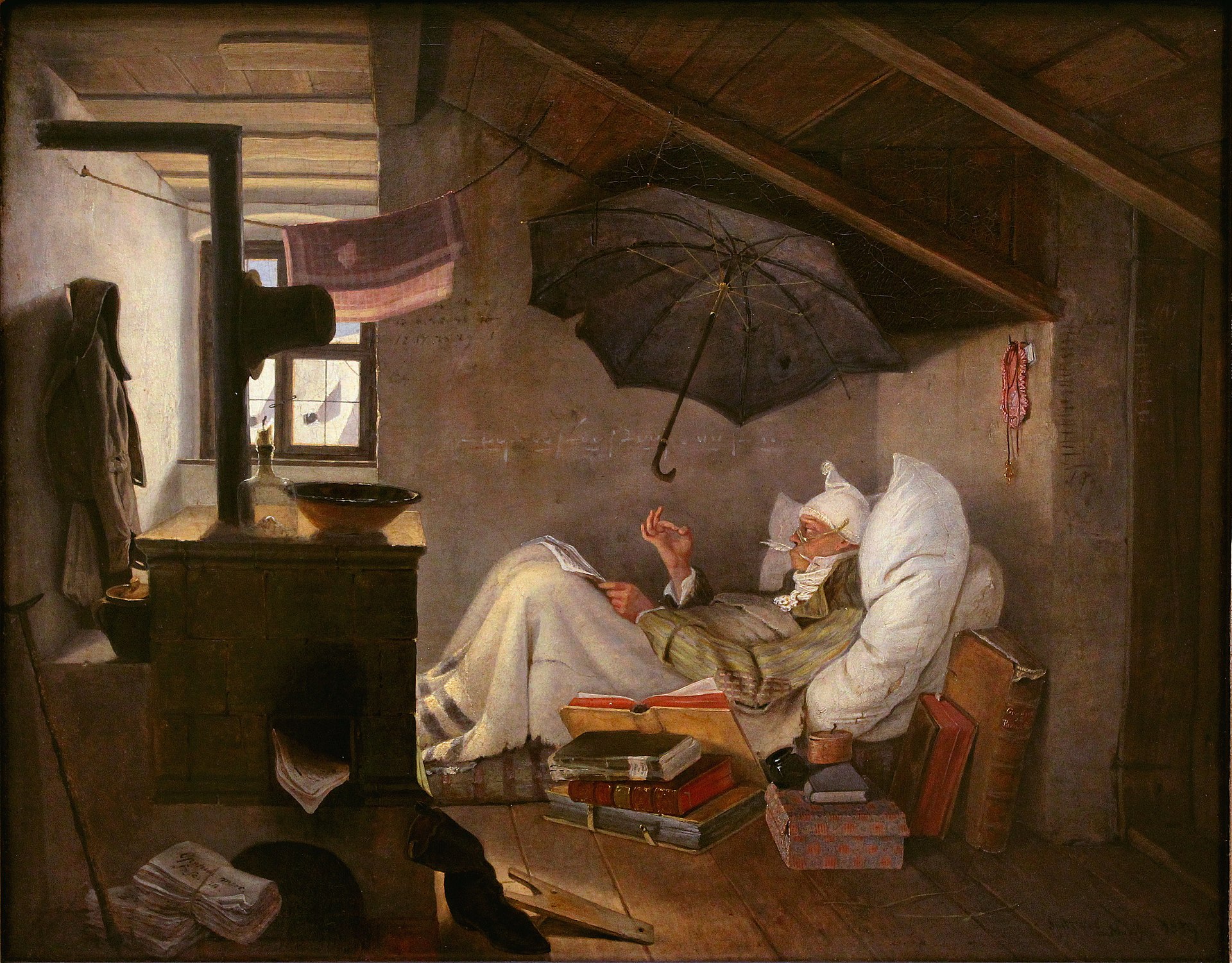
In The Poor Poet, Carl Spitzweg, the German painter of the Biedermeier period (an era in the art and culture of the German Confederation between 1815 and 1848), presents an impoverished writer living in a cramped attic room. The poet lies on a mattress on the floor because he cannot afford a proper bed, while an open umbrella hangs above him to protect him from rain leaking through the roof. In Spitzweg's time, the umbrella was a fashionable middle-class accessory and frequently appeared in contemporary caricatures. Spitzweg himself used the motif repeatedly, both in the three versions of The Poor Poet and in other paintings.
The room appears cold, yet the poet is apparently too poor to use the stove. Beside it lies a rejected manuscript bearing the Latin title “The Third Bundle of My Works.” He could burn his unsuccessful writing for warmth, but there is so little of it that the fire would not last long. Despite his uncomfortable circumstances, however, he continues working on a new poem. An almost completely burned-down candle suggests that he may have been writing throughout the night.
Everything around him points to his devotion to literature. Books are piled beside his mattress, while a hexameter, the classical meter of ancient epic poetry, is marked out on the wall as an aid to his writing. Yet Spitzweg treats his struggling intellectual with gentle humor. At this particular moment, the poet is not entirely absorbed in composing his masterpiece: he is trying to catch a flea, crushing it between his fingers. The comic detail may even allude to Mephistopheles' famous “Song of the Flea” in Goethe's Faust.
P.S. It is nearly the end of October; in some places, it is getting colder and colder. If you would like to warm yourself up (or your close ones!) please check out our artsy socks. Warmth is guaranteed!
P.P.S. If art and literature go hand in hand for you, explore how The Odyssey has inspired artists throughout the centuries.