
 Marie Bashkirtseff
Born in 1858 into a wealthy aristocratic family in Gavrontsy (then in part of the Russian Empire but now in present-day Ukraine), Marie Bashkirtseff spent much of her childhood traveling across Europe before eventually settling in Paris. Determined to become a professional artist at a time when the prestigious École des Beaux-Arts did not admit women, she trained at the Académie Julian, one of the few major Parisian art schools open to female students.
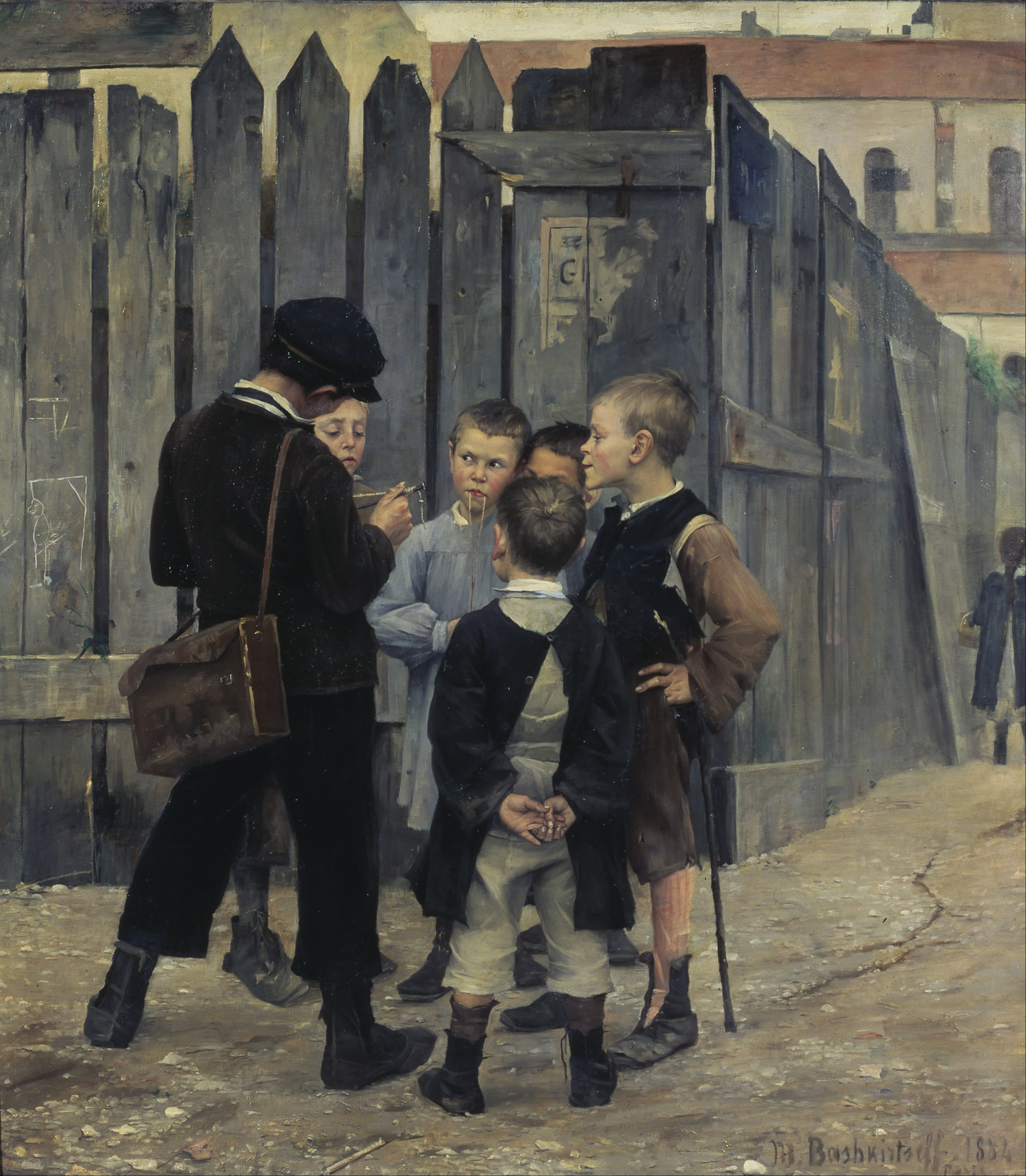
Bashkirtseff exhibited A Meeting at the Salon of 1884, where it attracted considerable attention and enthusiastic reviews. Yet she was bitterly disappointed when it failed to win a medal. Her reaction, recorded in her famously candid diary, was intense: she felt less accomplished works had been rewarded and feared she would disappear into obscurity. This ambition carried particular urgency. At just 25, Bashkirtseff already knew that she was seriously ill with tuberculosis. She died only a few months after the Salon, leaving behind a remarkable body of work and a diary that documents her fierce determination to achieve recognition as an artist.
In A Meeting, Bashkirtseff brings the naturalism she admired in Jules Bastien-Lepage into the streets of modern Paris. Six working-class boys gather in a tight circle around an older child holding what appears to be a homemade bow. Their worn clothes, the rough wooden fence, graffiti, and layers of torn posters establish the setting, while Bashkirtseff observes their expressions and gestures with extraordinary seriousness. Their school clothes also place the scene firmly in contemporary France, shortly after the Ferry Laws introduced free, secular, and compulsory primary education.
The title adds a wonderfully subtle joke. A meeting normally suggests adults gathered to debate important political or social questions, yet Bashkirtseff treats the boys’ discussion about a toy with precisely that kind of gravity. She even lowers our viewpoint to their level, letting their miniature world fill the entire scene. But the painting may have another layer. Bashkirtseff was deeply interested in women’s rights, and this little society is conspicuously male. At the far right, a small girl seen from behind stands apart from the boys’ gathering. In a painting of a young woman fighting for her place in the male-dominated art world, that exclusion is hard to miss.
Hungry for stories like this? Check out our 2027 calendars; they are full of art and DailyArt stories. :)
P.S. Marie Bashkirtseff was not the only 19th-century woman determined to make her mark on the art world. Meet five Pre-Raphaelite women painters who deserve to be better known.