
 Caspar David Friedrich
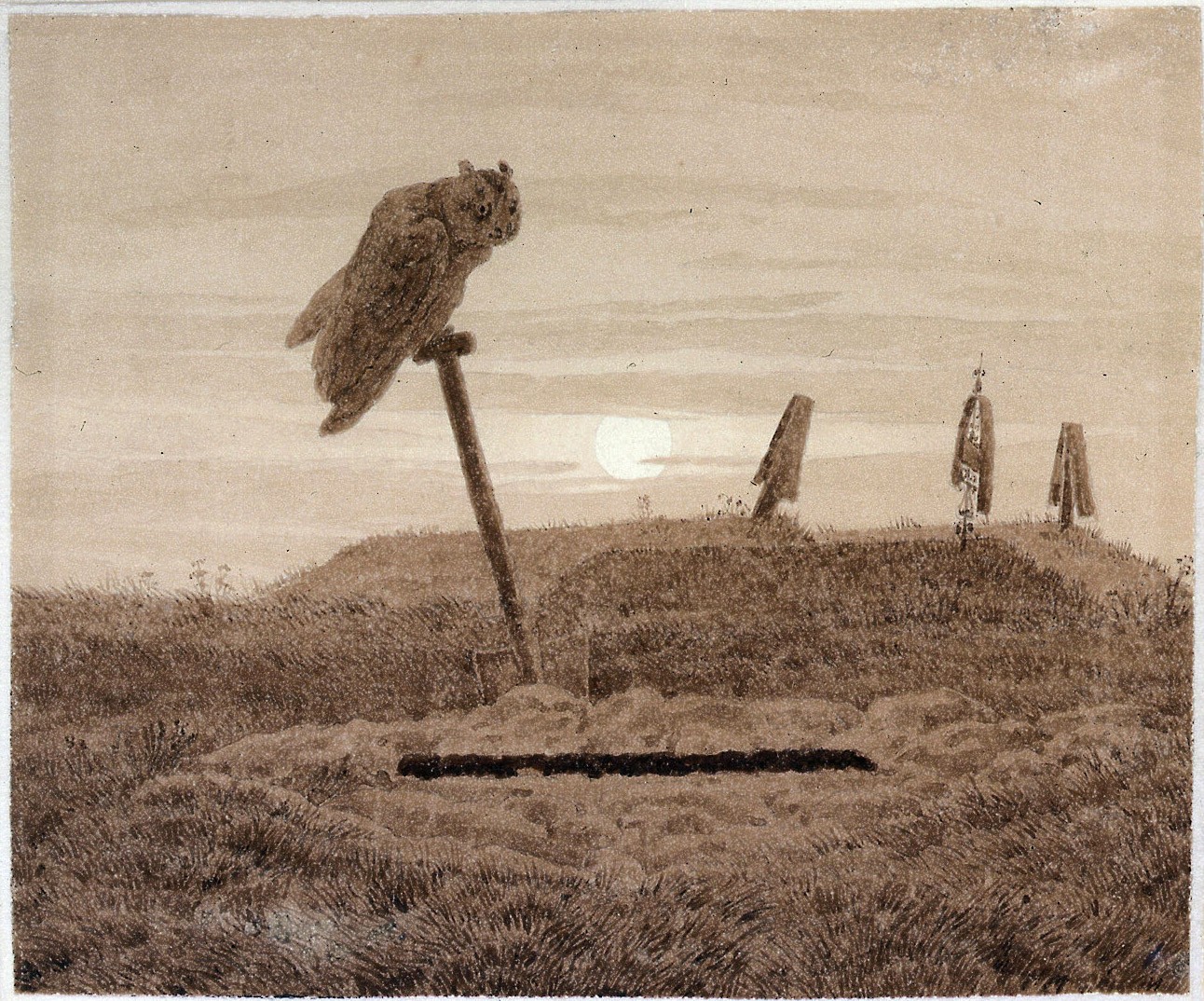
In 1834, Caspar David Friedrich gave this drawing to the French sculptor Pierre-Jean David d’Angers, providing a clear date before which the artist had returned to using brown ink and wash as his main medium. Friedrich had first made his mark with this technique between 1803 and 1807, but largely abandoned it in the 1810s, favoring watercolor for finished works. His renewed use of monochrome coincided with a fresh interest in atmospheric moonlit scenes—many, like this one, set in graveyards.
A lone owl—an age-old emblem of death—perches on the gravedigger’s spade. Notably, Friedrich omits the cemetery gate and any hint of surrounding architecture, leaving the scene untethered to a specific place. With no visible path out, the only “exit” is a spiritual one—the soul’s ascent.
David d’Angers, traveling through Germany in 1834, sought out Friedrich in Dresden and later made a bronze medallion portrait of him. In his journal, he described this drawing in detail, even noting an ink blot on the left. When asked to sign the work, Friedrich accidentally dropped ink on the sheet; he was ready to destroy it until David d’Angers assured him the mark could pass as a bird. The artist smiled—“with that childlike expression one only finds among the remarkable men of Germany.”
P.S. If you love what we do, please check our 2026 DailyArt Wall and Desk Calendars, full of amazing art! :)
P.P.S. Here are 9 facts you should know about Caspar David Friedrich, the most famous Romantic painter.