
.jpg) Wiktoria Goryńska
Wiktoria Goryńska
Wiktoria Goryńska (1902–1945) was one of the most outstanding representatives of the Warsaw school of woodcut during the interwar period. Born in Vienna, she spent her childhood in the United Kingdom, studied in Vienna and Warsaw.
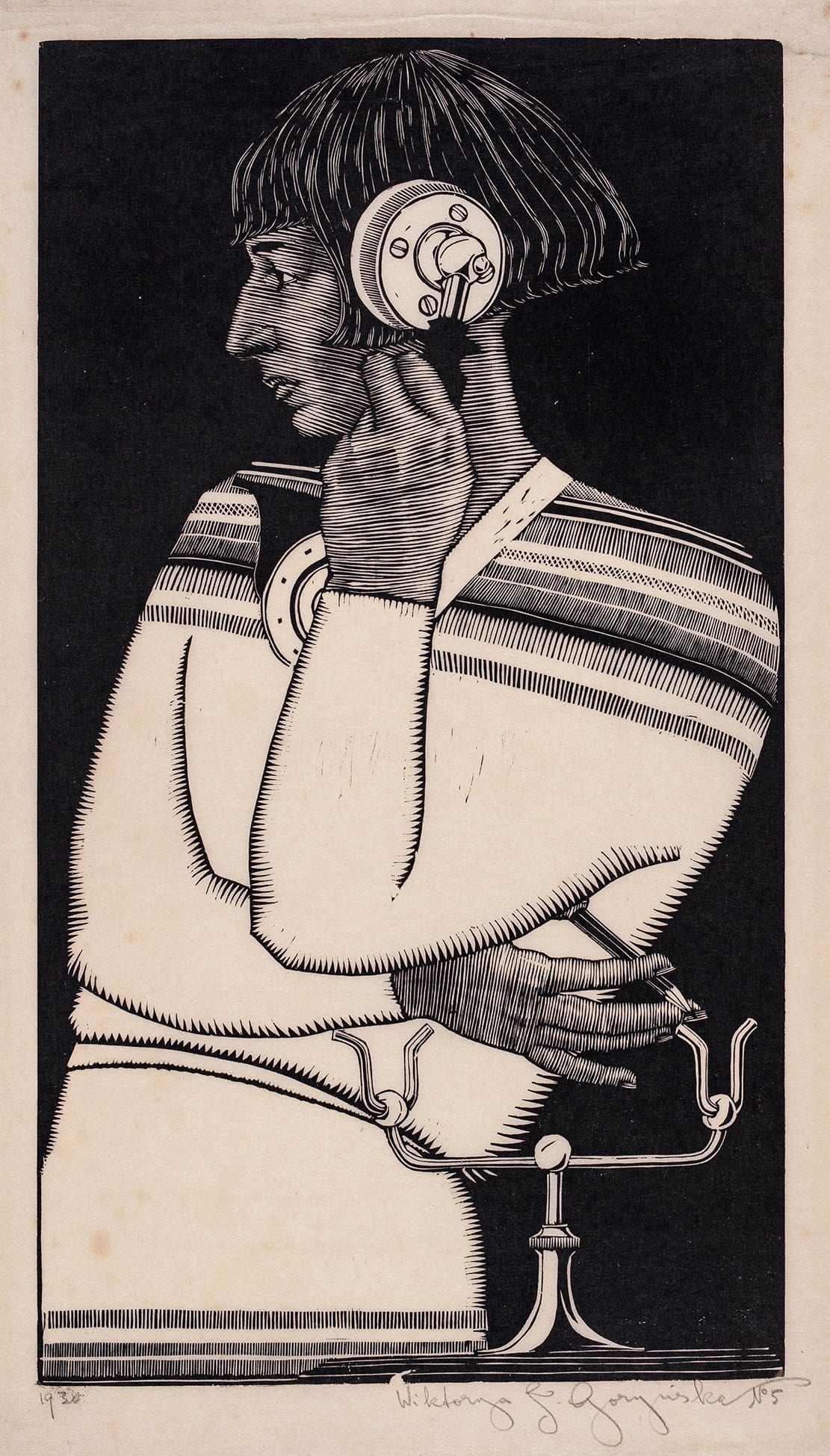
The most well-known woodcut of Goryńska, Self-Portrait with the Telephone, shows the artist in a Norwegian sweater with a pointed neckline, holding a telephone receiver in one hand and a pencil in the other. This combination of objects suggests she was a working professional, independent and self-sufficient, without the need for male support. The phone interrupting her from the drawing board could relate to her work, social activities, or even sports. She is clearly a woman engaged in many spheres of life. Nothing is known of Goryńska’s romantic life—it seems she never formed a lasting relationship. Her deep affection for animals, particularly cats, appears to have compensated for the absence of a personal relationship.
This modern image of an active, independent woman does not reflect the popular notion of "women’s art" from the interwar period—focused on themes like fashion or nature—but instead portrays the emerging emancipated woman. At the same time, Goryńska was a devoted daughter, as her portraits of her parents suggest, and a declared patriot. She did not distance herself from family life, and her worldview appears more conservative than progressive, even though she encouraged women to engage in sports, including the unusual choice of fencing.
During the Second World War and the Nazi occupation of Poland, she was active in the resistance. After the failure of the Warsaw Uprising, she was sent to a transit camp and then deported to the Ravensbrück concentration camp, where she died.
P.S. There's something magical about early 20th-century woodcuts which look both modern and often mysterious. Step into the fascinating black and white world of Felix Vallotton's prints!