
 Edward Hopper
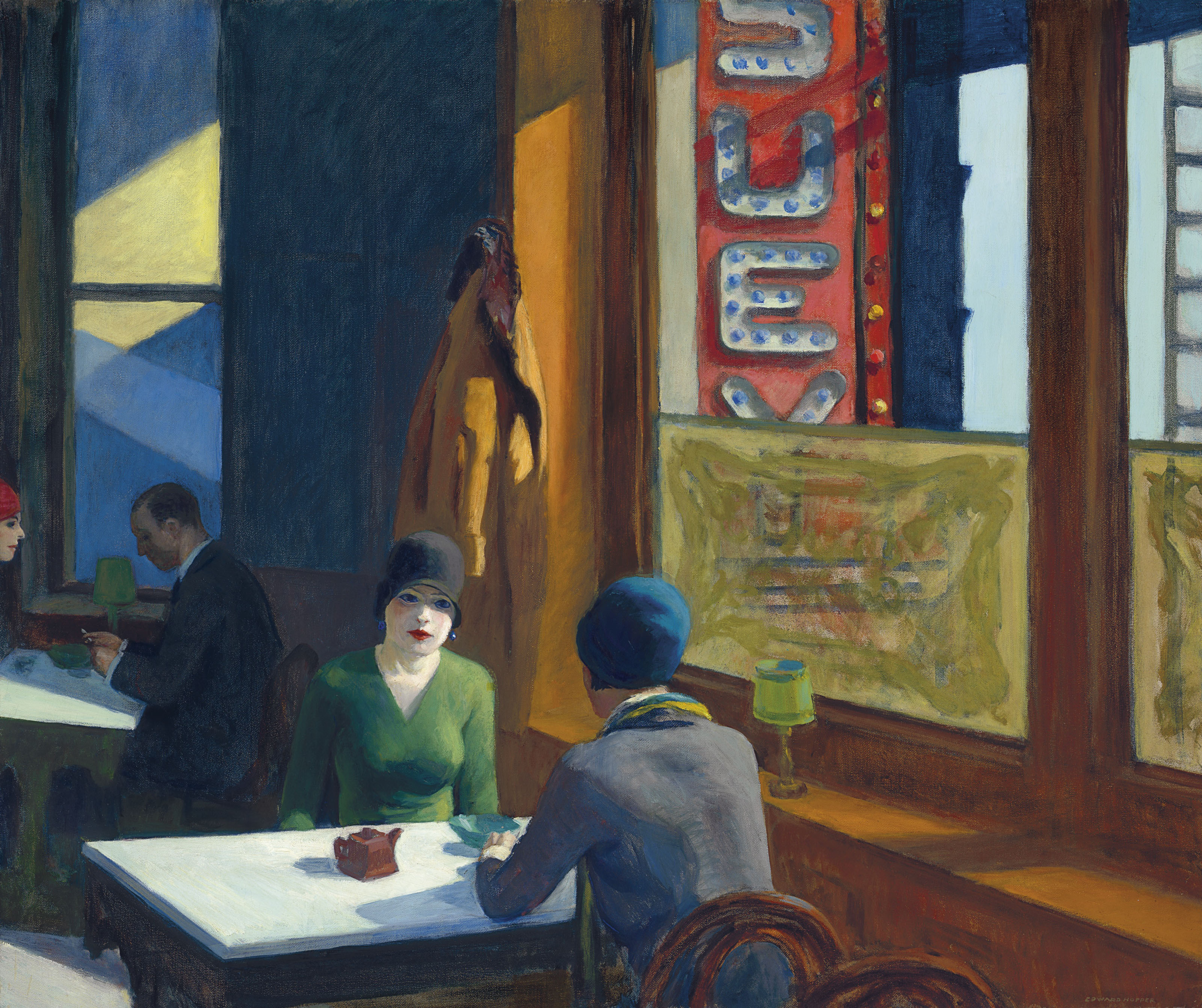
In the painting we present today, Edward Hopper transforms the everyday setting of a modest eatery into a cinematic meditation. The painting hints at an implied narrative while also opening onto broader reflections on social isolation, gender roles, and the art-historical lineage through which such issues can be explored.
Chop Suey was inspired by the Chinese restaurants Hopper frequented, both in New York and during summer travels. By the early 20th century, the chop suey house had become a uniquely American phenomenon, emblematic of the nation’s cultural melting pot. Adapted from the Cantonese phrase tsap sui (“odds and ends”), chop suey referred not only to a low-cost stir-fry dish but also to a modern gathering place where one could witness the mingling of diverse urban populations. Once flashy Chinatown nightspots, these restaurants evolved by the mid-1920s into accessible luncheonettes serving a burgeoning working class.
Hopper distills this lively cultural milieu into an intimate scene: two women converse in the foreground while a couple appears faintly in the background, framed by the restaurant’s stark interior. Strikingly, the tables are empty—save for an Asian teapot—underscoring Hopper’s characteristic minimalism. But what anchors Chop Suey is not the meal but the light: streaming through the window, illuminating the bold sign with the word “SUEY,” and falling across the central female figure. Modeled by Jo Hopper, she sits opposite another woman but appears emotionally distant, her pale face lit like a stage performer’s under a spotlight.
P.S. Just as Hopper distilled a bustling city into a single, luminous moment, our 2026 Weekly Desk Calendar offers you a year of art, one week at a time.
P.P.S. Edward Hopper could turn a gas station into an existential crisis. How much do you know about him? Take our Edward Hopper QUIZ and see how well you know one of the most famous American artists!
P.P.P.S. For more stories on Hopper, see the articles below.