
 Domenico Ghirlandaio
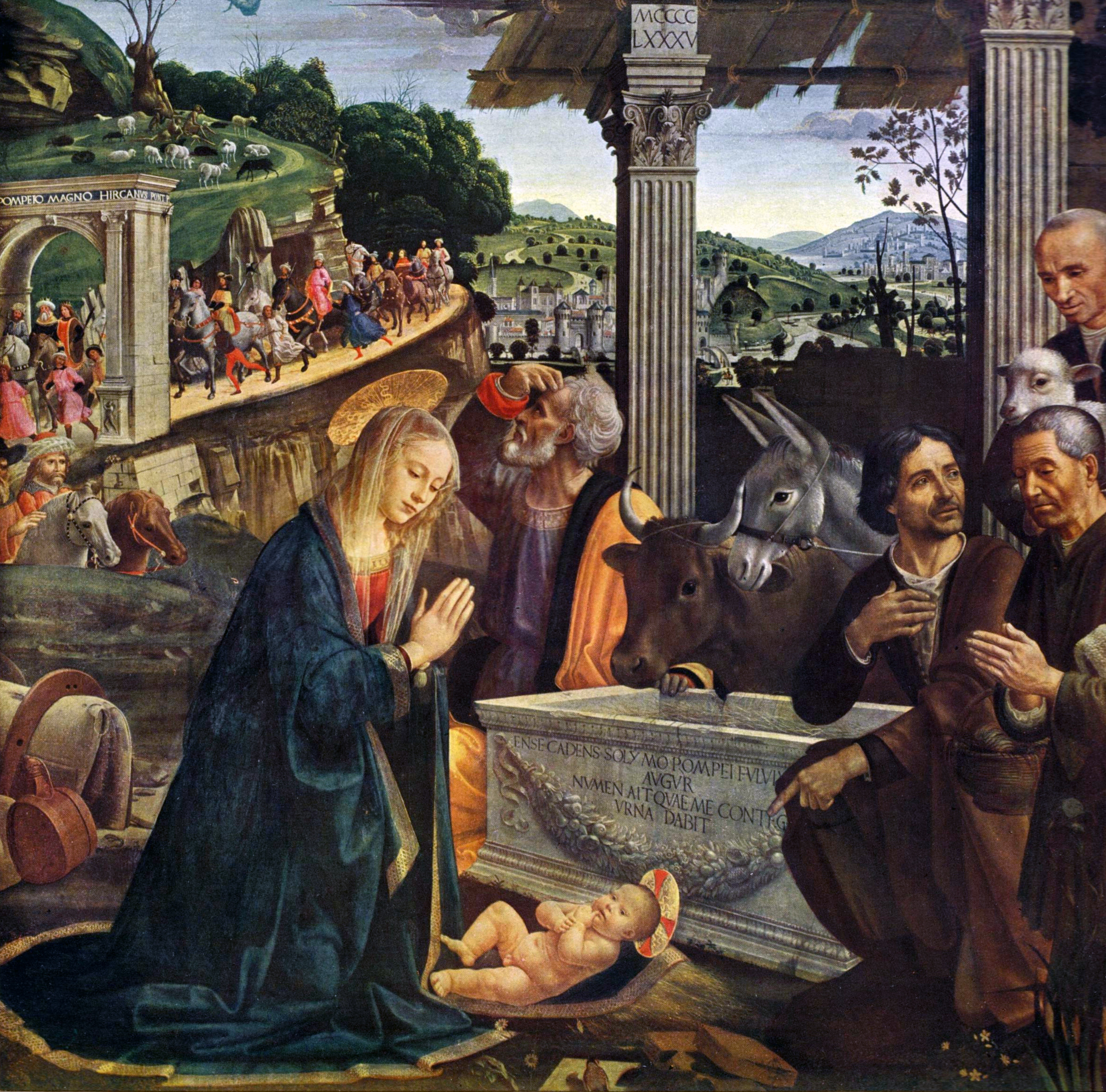
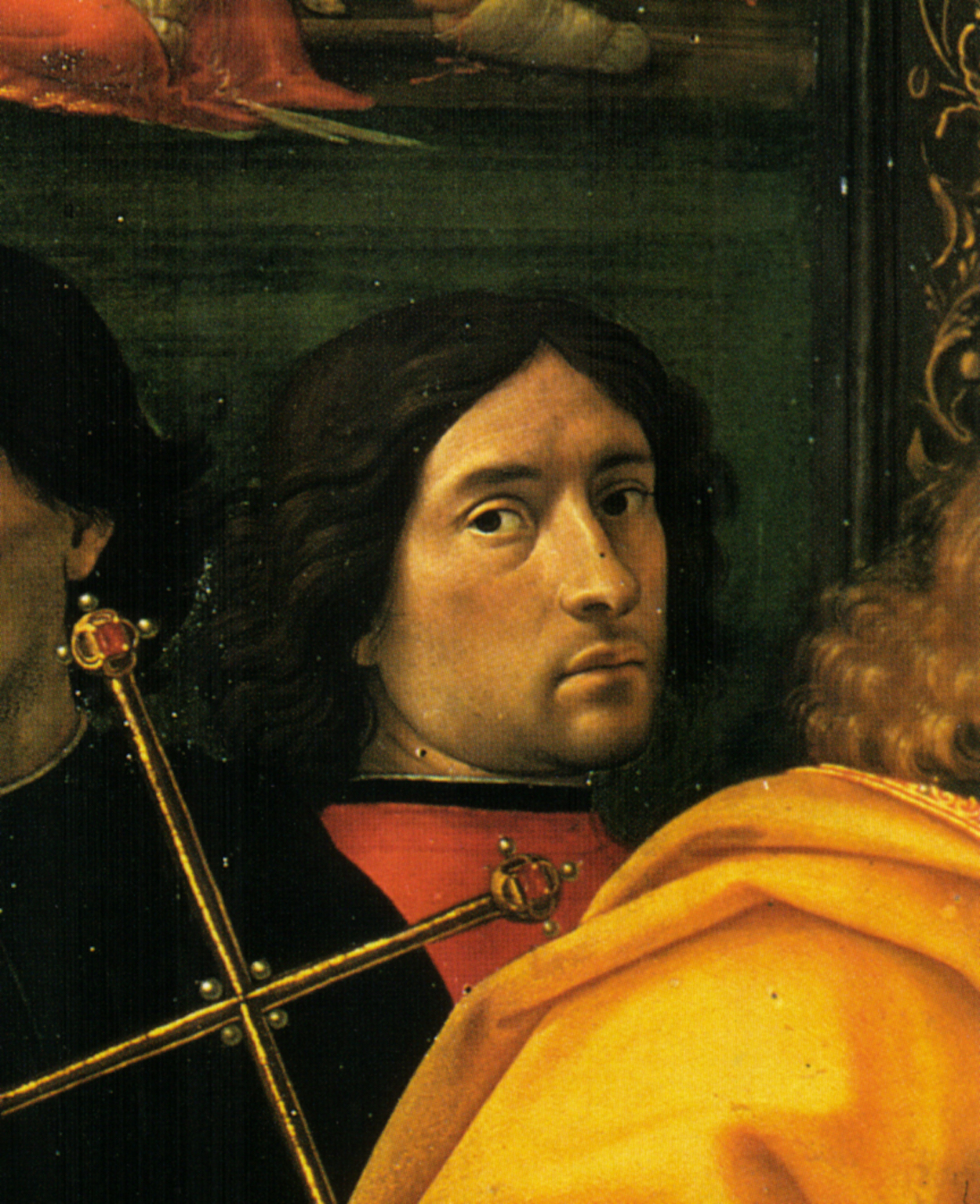
The famous chronicle of the Renaissance painters, Giorgio Vasari, wrote of this work: “He painted in tempera, as a companion to this piece, a Nativity of Christ that must excite the wonder of every thinking man, including his own portrait and the heads of shepherds so divine they seem heaven-sent.”
The Sassetti Chapel, dedicated to the birth of Christ, centers around Ghirlandaio’s Adoration of the Shepherds—its principal and most celebrated work. This altarpiece, both thematically and artistically, became so admired that it was widely imitated by later painters. Ghirlandaio included himself in the scene, appearing among the shepherds. Uniquely, he kneels closer to the Christ Child than even the donors depicted in the surrounding frescoes, as if guiding the humble visitors—and the viewer—toward the divine miracle. His finely rendered left hand points toward the infant Christ, while his right hand touches his chest, a gesture recalling his self-portraits elsewhere. With this dual motion, he may be suggesting: “This holy child was painted for you by me, Ghirlandaio—the garland-maker.”
At the heart of the composition lies a Roman marble sarcophagus, serving both as the manger and as a symbolic link between antiquity and Christianity. Its Latin inscription reads: “Ense cadens Solymo Pompeii Fulvius Augur Numen ait: quae me contegit urna dabit.” (“Falling by the sword in Jerusalem, the augur Fulvius said: The urn that covers me shall bring forth a god.”) This ancient prophecy foreshadows the coming of Christ—the cradle of the Redeemer rising from a pagan tomb.
Ghirlandaio’s Adoration masterfully weaves classical references with Flemish realism. The influence of Hugo van der Goes’s Portinari Altarpiece, which arrived in Florence in 1483, is especially evident. Florentine artists saw Van der Goes’s naturalistic shepherds and luminous detail as revolutionary, and Ghirlandaio responded in kind: his rugged shepherds press into the composition from the right, their faces rendered with lifelike precision, while the northern-inspired landscape stretches behind them.
Dear users, Merry Christmas! May your holidays be filled with warmth, wonder, and a touch of beauty—just like your favorite painting! :)) Hugs!
P.S. Discover 10 beautiful Nativity scenes! Do you know all of them?