
 Georgia O'Keeffe
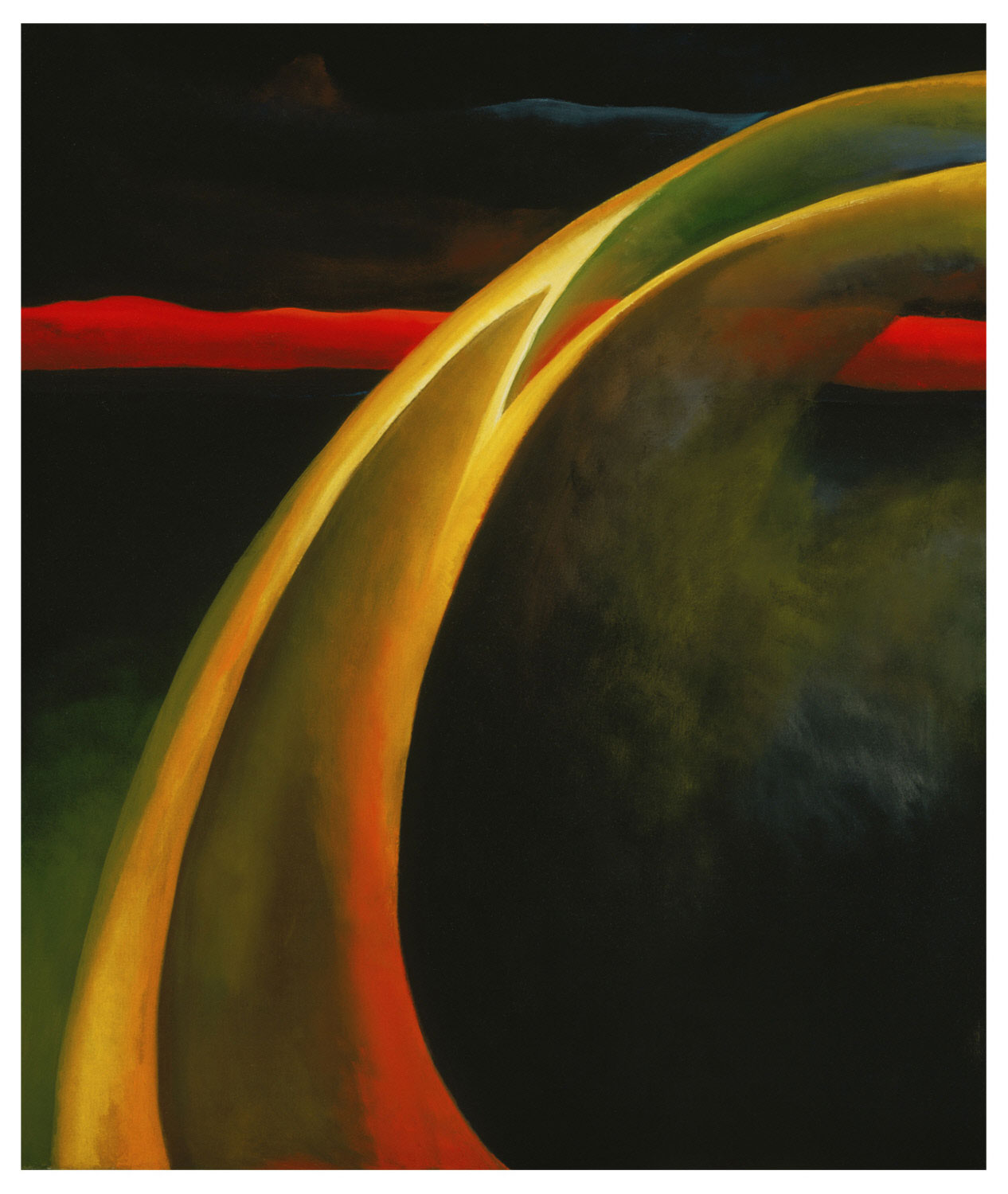
What’s happening in this mysterious, glowing painting? Two broad arcs of orange rise from the lower left and shoot out toward the upper right, framing a bright yellow zigzag shape that seems to flash with movement against the dark background. Behind it, a deep red band stretches quietly across the composition, like a distant horizon. The intersecting orange curves and red line form a glowing cross, and at their center, the sharp yellow form pulses with energy—the painting’s focal point.
Georgia O’Keeffe created Red and Orange Streak in 1919, shortly after moving from Texas to New York City. The work recalls her nights in the vast Texas plains, where she wandered alone beneath an immense sky. In the darkness, distant sounds—a train whistle, lowing cattle—evoked colors and shapes in her imagination. Most of all, she was captivated by lightning storms that lit up the horizon like writing across the sky. As she once described, the night would “light up—first in one place, then in another—flashes of sheet lightning, then a sharp, bright zigzag flashing across.”
In New York, O’Keeffe translated these vivid memories into abstract form. She simplified her impressions, removing details to capture only the pure rhythm of nature and emotion. The sharp angles and curves, the contrast of warm and dark tones, suggest both movement and stillness—lightning cutting through the night sky and the vast silence that follows. The painting stands at the threshold of abstraction, inviting viewers to feel rather than recognize the landscape she remembered.
O’Keeffe, born in 1887 in Sun Prairie, Wisconsin, was one of America’s pioneering modern artists. Her bold experiments with color, form, and symbolism redefined what painting could express, making her one of the most original and influential voices in 20th-century art. Want to know more? Discover Georgia O'Keeffe in 10 paintings!