
 Claude Monet
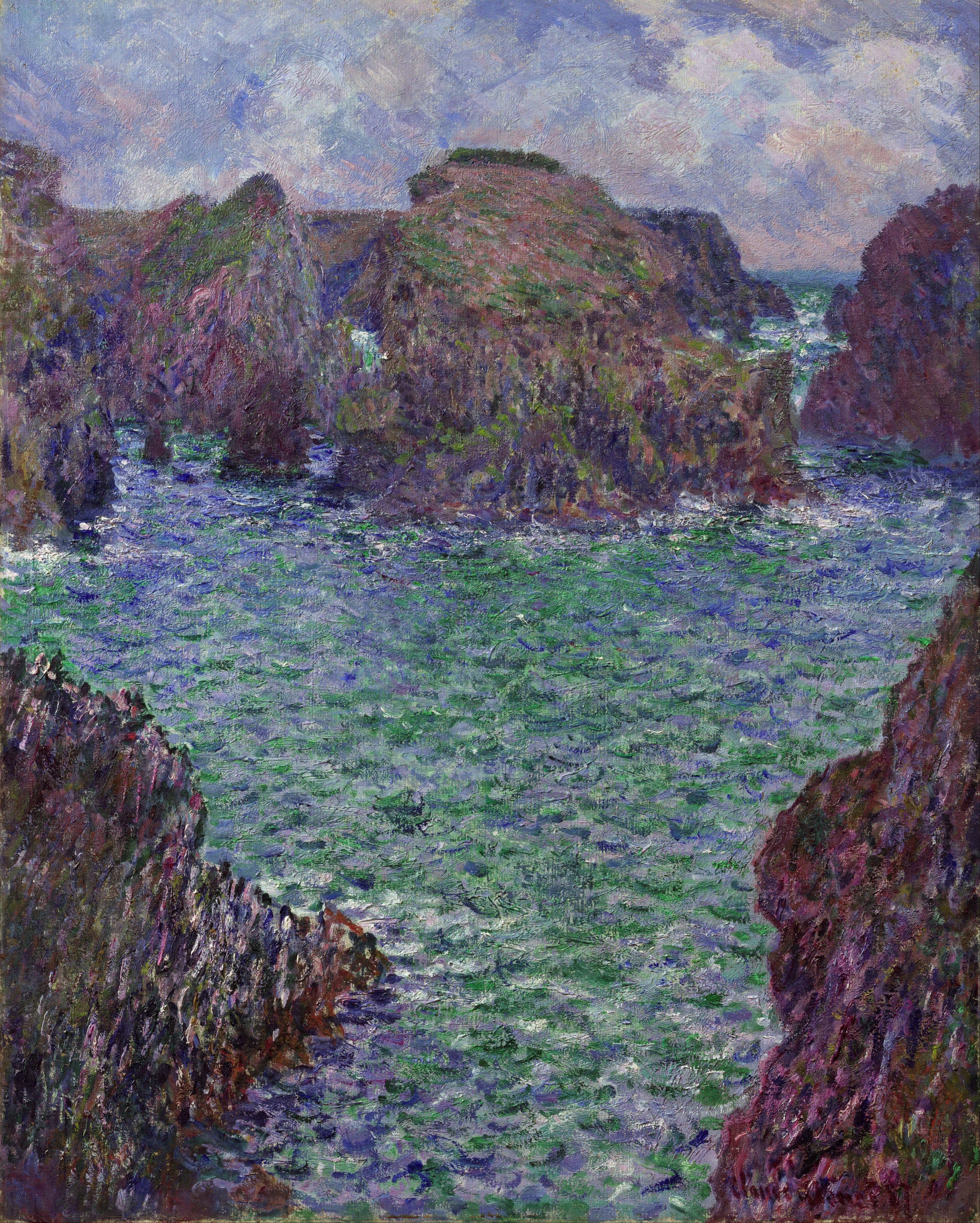
Painted in 1886, this seascape seems to be quite traditional, but when you dig deeper into it, you will see that it reveals Monet's willingness to challenge traditional conventions of marine painting. Basically, he didn't use the horizon to organize and stabilize the composition; he eliminated it entirely, enclosing the viewer within the rugged landscape of Belle-Île. Towering rock formations and steep cliffs stretch across the upper portion of the canvas, while smaller rocky outcrops frame the foreground. This compressed arrangement creates an unexpectedly intimate and almost claustrophobic space. The narrow expanse of water trapped between the rocks becomes the true focus of the painting, animated by countless flickering brushstrokes that capture the sea's movement and energy.
The composition also reflects the influence of Japanese woodblock prints, which offered European artists new ways of organizing pictorial space. Monet was particularly receptive to their unconventional viewpoints, cropped forms, and flattened perspectives. Here, those influences are transformed into a distinctly Impressionist vision.
P.S. If you love the atmosphere of seascapes like Monet’s, discover our Sea, Ships & Beaches 50 Postcards Set. Featuring beautiful maritime scenes by celebrated artists, it captures the ever-changing moods of the ocean; from peaceful shores to dramatic waves and distant horizons.
P.P.S. Test your knowledge on the art of the most famous Impressionist in our Claude Monet QUIZ!