
 Piero di Cosimo
Who doesn't like Renaissance Italian art, especially when it is depicting mythology?
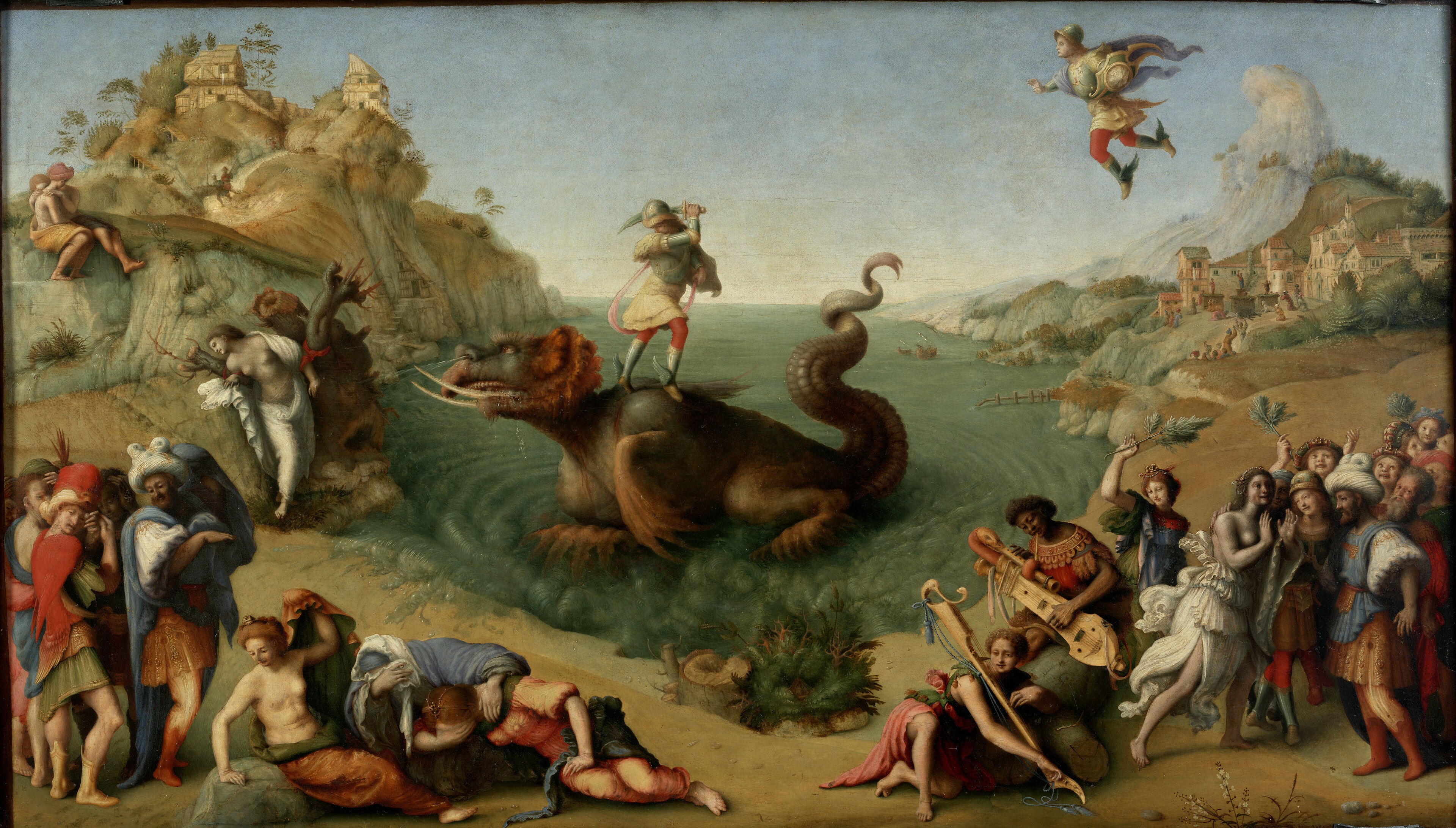
At the center of today's composition, Perseus battles the sea monster threatening Andromeda, daughter of the King of Ethiopia, who has been offered as a sacrifice to appease the creature. The monster was sent by Poseidon to punish Andromeda's mother, Cassiopeia, whose vanity had provoked the god's wrath. Piero di Cosimo depicts Perseus three times within the same narrative: first as he flies overhead on his winged sandals and discovers Andromeda and the monster, then in the central scene where he defeats the beast, and finally celebrating Andromeda's rescue, before she becomes his bride. The joyful crowd gathered on the right contrasts with the anguish of Andromeda's family on the left, who await her fate.
Drawn from Ovid's Metamorphoses, the story of Perseus and Andromeda was particularly appropriate for the painting's original function as part of the decoration of a nuptial chamber, most likely created for the marriage of Filippo Strozzi the Younger and Clarice de' Medici in Florence's Palazzo Strozzi around 1510 or 1511. The furnishings for the room were being produced by the cabinetmaker Baccio d'Agnolo at the time. The imaginative Florentine painter Piero di Cosimo let his imagination run wild; the scene is full of exotic costumes and fantastical musical instruments. Even the fearsome sea monster appears almost domesticated.
P.S. Fascinated by stories like Perseus and Andromeda? Discover the myths, masterpieces, and hidden symbolism of Italian Renaissance art in our online course, The Art of Renaissance Florence. From Botticelli to Piero di Cosimo, you'll explore the artists who brought classical mythology back to life.
P.P.S. See the most famous depiction of this mythological theme, the one that challenged the famous David by Michelangelo!