
.jpg) Hishida Shunsō
Hishida Shunsō
As Western painting became widely introduced in Japan from the Meiji period onward, Japanese-style painters were strongly influenced by its use of perspective and the modeling of light and shadow to create a three-dimensional sense of space.
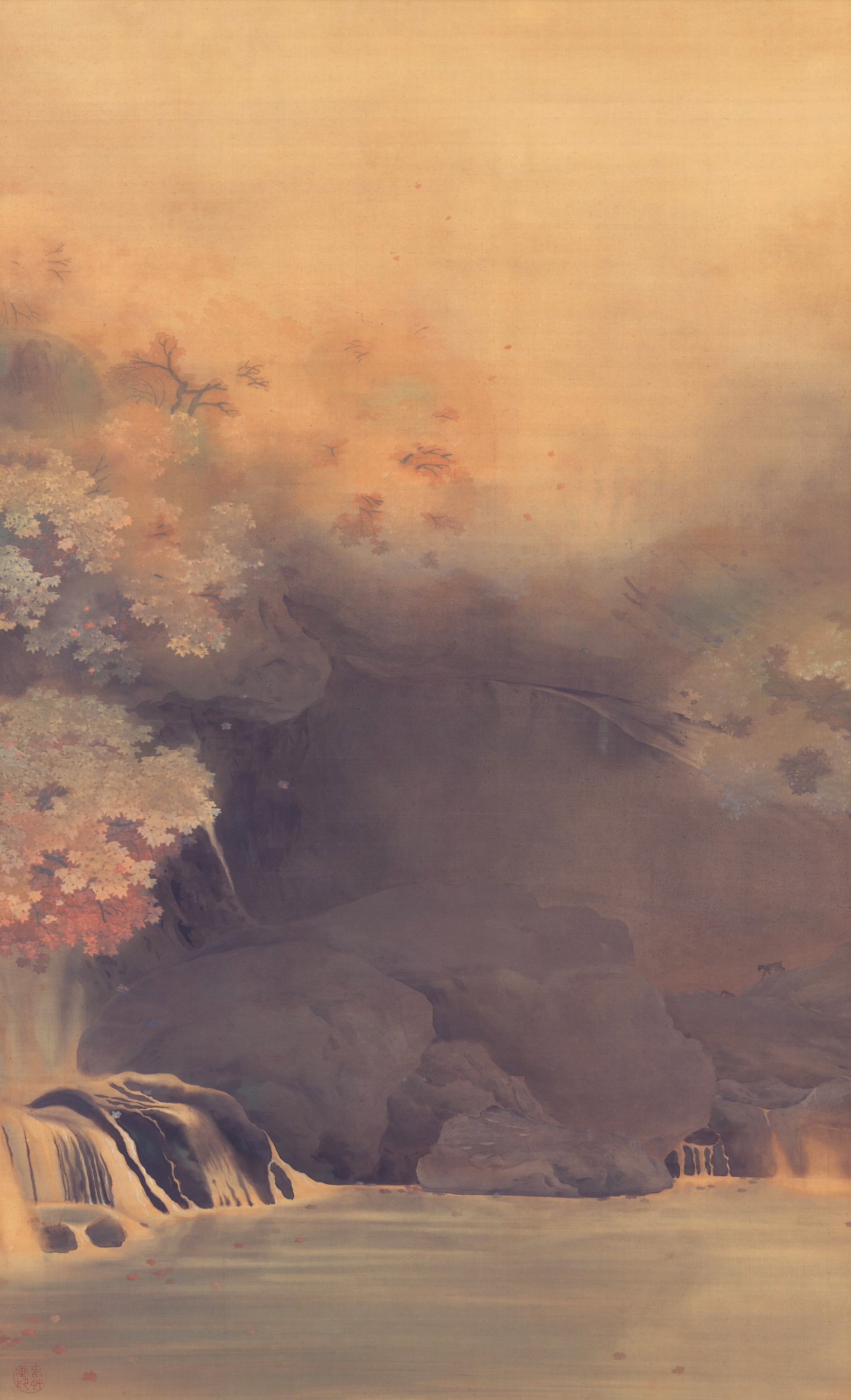
In 1898, the year before this work was exhibited, Hishida Shunsō joined Yokoyama Taikan and others in founding the Japan Art Institute (Nihon Bijutsuin) under Okakura Tenshin. Responding to Tenshin’s question, “Is there a way to paint the air?” Shunsō and Taikan experimented with ways of representing atmosphere and light. Their efforts led to the development of a new technique in Japanese painting that later became known as mōrōtai (“vague” or “hazy style”).
This large-scale work dates from the early phase of mōrōtai, a technique characterized by the avoidance of distinct outlines. Shunsō painted the entire composition using soft, blurred effects, skillfully conveying a sense of moisture within a quiet, mysterious atmosphere. His delicate attention to composition can also be seen in the subtle variations of color among the autumn leaves and in the placement of the two monkeys on the rocks.
P.S. If you love the atmospheric beauty of Japanese art, take a look at our Japanese Art 50 Postcards Set! Featuring 50 beautiful works from across Japanese art history, it's a perfect way to bring a little of Japan's artistic heritage into your everyday life. :)
P.P.S. There are some stunning depictions of autumn in art history. How well do you know them? Take our Autumn Art Quiz and find out!