
 Félix Vallotton
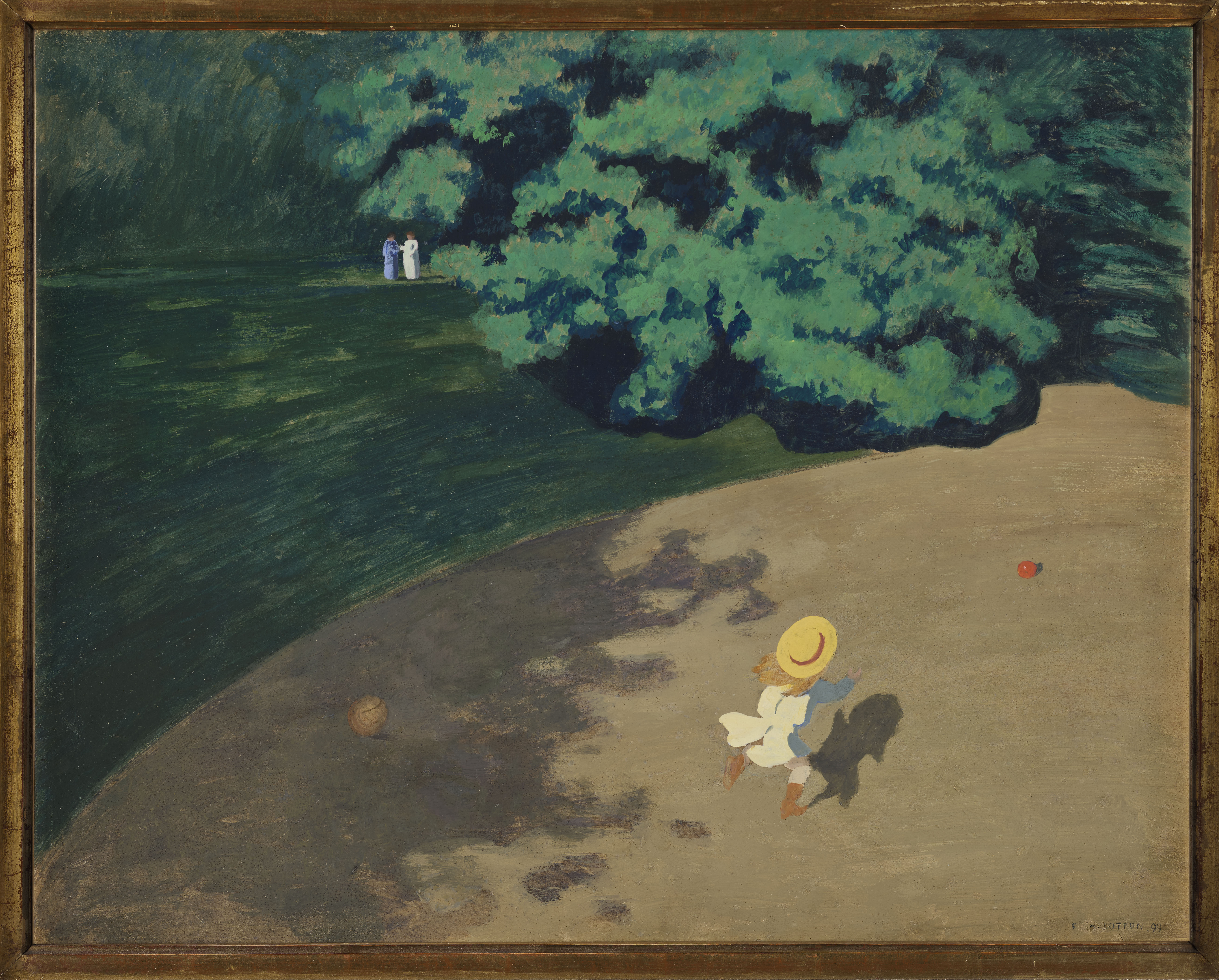
The Ball is one of the most recognizable works by Félix Vallotton, a Swiss painter who joined the Nabis (a group of young artists advocating a radical renewal of art) in Paris in 1890. The painting was created in 1899, towards the end of the group’s activity, on the eve of new avant-garde movements such as Fauvism and Cubism.
The artist depicts a city park from above. At the bottom, we see a sandy park path, along which a child in a hat is running, alongside a shaded expanse of lawn and tree canopies. This unusual perspective makes the composition teeter on the edge of reality. From above, the dense tree canopies resemble heavy green clouds suspended above the earth. The silhouette of the running child is dominated by the intense yellow of the hat and the white of the clothes. The effect of the dazzling light on a scorching day is captured here through bold patches of color.
This refined form is matched by the enigmatic nature of the scene, allowing for a Symbolist interpretation of the painting. On the one hand, Vallotton expresses an interest in the rhythm of life and carefree play, which he may have observed in Parisian parks and gardens every day. On the other hand, the depiction of a child abandoning the ball and running after a smaller red one, captured as if in a camera snapshot, creates an atmosphere of ambiguity.
This beautiful artwork is now on show at the Royal Łazienki Museum in Warsaw until 15 November 2026, in The Nabis. Prophets of a New Art exhibition. The exhibition reveals the fundamental role that the Nabis played in shaping modern art. Don't miss it while in Warsaw!
If you’ve recently visited a museum and would like to share your thoughts, impressions, or reflections with us, we’d love to hear from you. Please feel free to get in touch!
P.S. Vallotton was a master of enigmatic, yet fascinating scenes. Discover his intriguing family dinner scene, where tension simmers beneath the surface!