
 Henri Rousseau
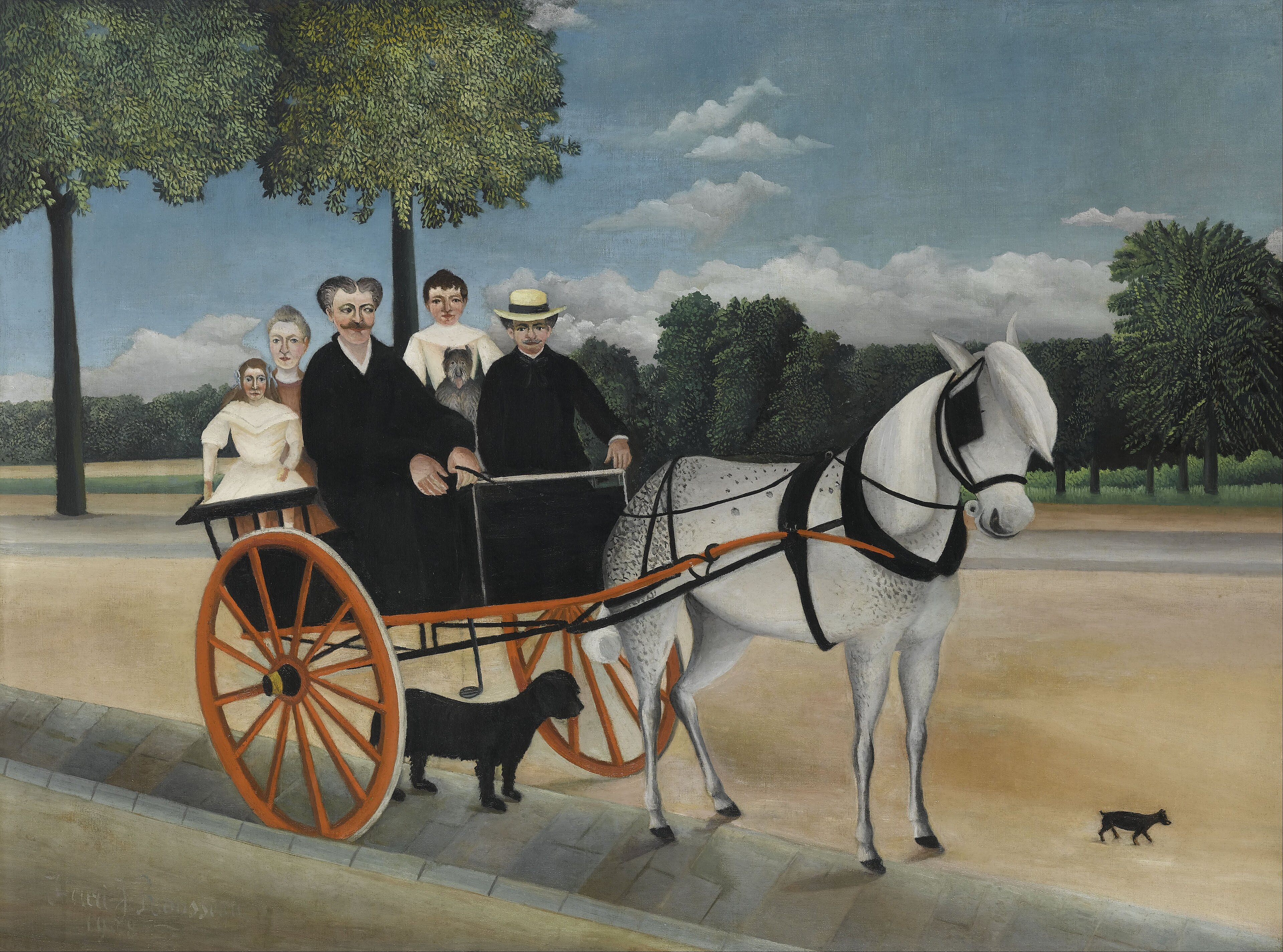
Père Junier sold vegetables that he went to buy every morning from the market gardeners of Bagneux or Verrière-le-Buisson. He had long been a friend of Rousseau; his wife used to cook for the painter. Because Rousseau owed him some money, and Monsieur Junier had just bought a horse he was very proud of, it was agreed that Rousseau would paint him a picture.
Rousseau worked from a photograph. He introduced significant changes, however, revealing the nature of his working method. He removed a tree from the boulevard and, more notably, played with the size and position of the three dogs. They take on a formal, compositional role. The large black dog gives depth to the cart. It's known that when a German sociologist, Max Weber, pointed out to Rousseau that the black dog was too large relative to the scale of the whole, the artist retorted that his canvas required it to be so. The miniature dog trotting in front of the cart, on the other hand, adds to the monumentality of the mare. She stands curiously on the tips of her hooves, an effect heightened by the shadows cast on the ground. This dancing mare seems almost suspended in space. Rousseau was fond of this kind of paradox, which makes certain figures float in a purely pictorial space.
This painting is featured in our Weekly Desk Calendar, which I hope is familiar to you by now. :)
P.S. Isn't this piece fascinating? See 10 amazing paintings by Henri Rousseau!