
 James Abbott McNeill Whistler
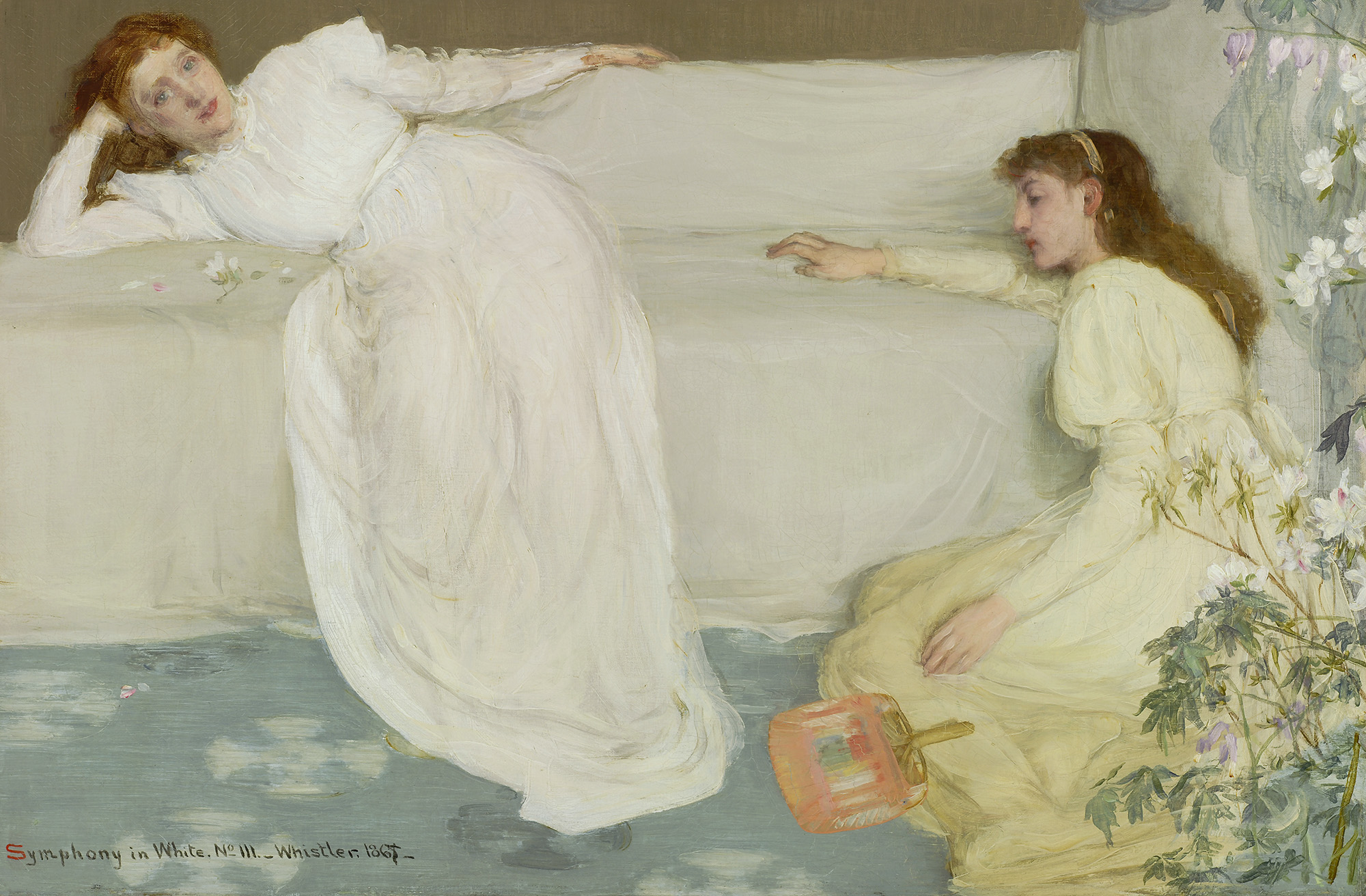
James McNeill Whistler was an American-born artist who spent most of his career in Europe and became one of the most influential figures of the Aesthetic Movement, championing the idea of “art for art’s sake.” By 1867, Whistler was obsessed with painting women in white. These paintings were augmented with the titles Symphony in White, No. 1, 2, and 3, followed by Arrangement in Grey and Black: Portrait of the Painter's Mother. This decade continued to be dominated by full-length, oil-on-canvas commissioned portraits such as Harmony in Grey and Green: Miss Cicely Alexander and Miss May Alexander, and "studio experiments" of models and partners. Having begun with a girl in white, then the arrangements in grey, Whistler started a longer series in black.
Although Whistler was not the first visual artist to draw a comparison with music, he used musical terms (such as nocturne, symphony, arrangement and harmony) in the titles of very many of his paintings. Whistler was the first to do so overtly and persuasively, paving the way for formalist abstract painting in the 20th century.
We are delighted to present today’s painting thanks to the Van Gogh Museum in Amsterdam, where you can see it as part of the Whistler. Dandy and Disruptor exhibition. It is the largest European retrospective of Whistler in 30 years and the first retrospective devoted to him in the Netherlands. The exhibition explores Whistler not only as a painter and printmaker, but also as an aesthete and provocateur who argued that art did not need to tell a story or serve a moral purpose: like music, it could exist primarily to create a mood. The exhibition runs until 10 January 2027; don't miss it!
P.S. Whistler’s ideas about art famously landed him in court with critic John Ruskin. Read the story behind one of the most famous trials in art history.