
 Hilma af Klint
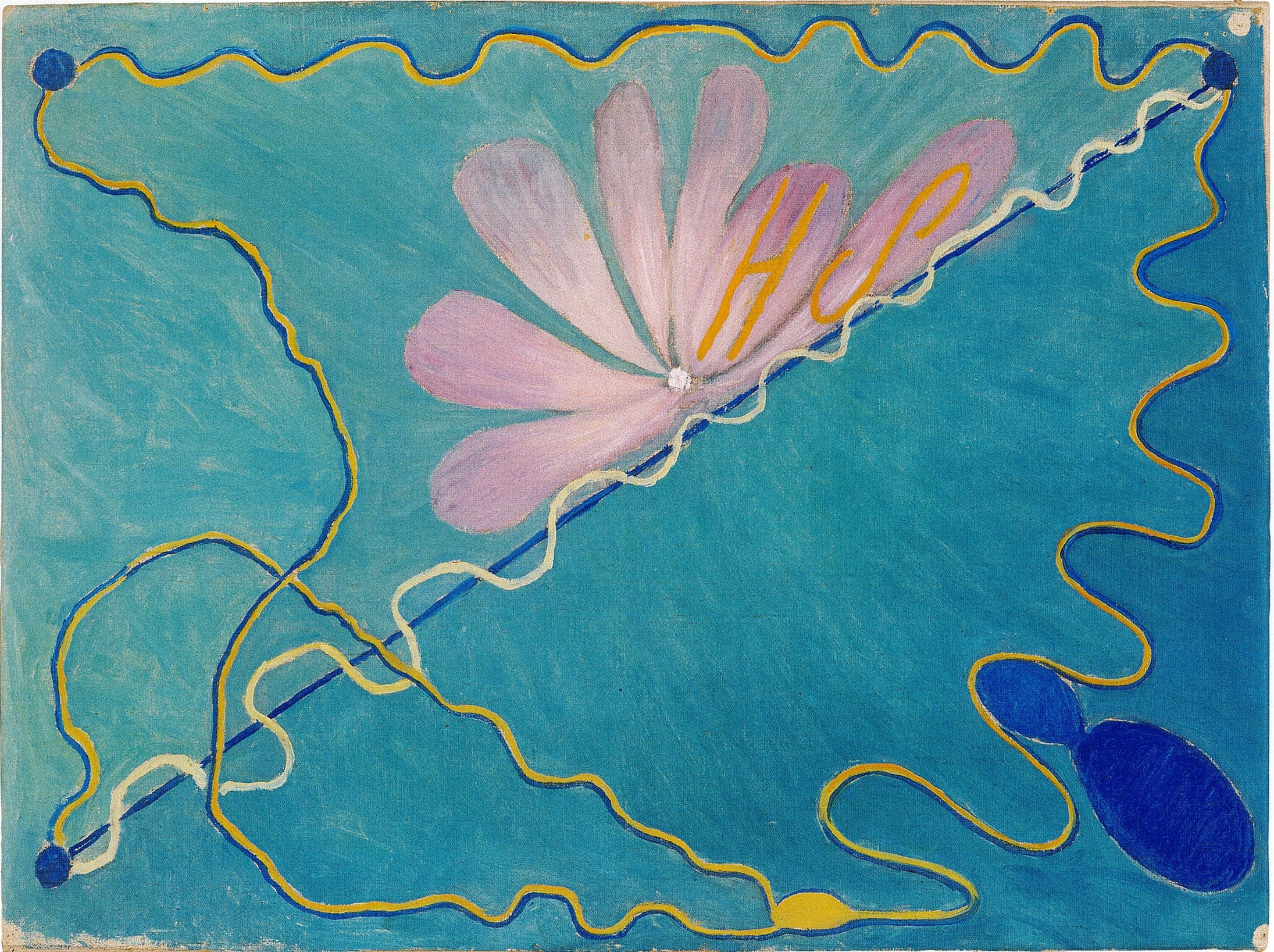
Today is Hilma af Klint’s birthday, so we’re celebrating the pioneering Swedish artist by featuring one of her extraordinary abstract works from the Eros series. Have you heard of it before?
Hilma af Klint's Paintings for the Temple was the most ambitious project of her career: a vast cycle of nearly 200 works created between 1906 and 1915. Af Klint believed she had been commissioned to undertake the project by spiritual guides, whom she called the High Masters, and imagined the paintings eventually displayed together in a temple devoted to spiritual understanding. The cycle explores human and cosmic evolution, particularly the idea that the visible world is divided into opposing forces—spirit and matter, male and female, light and darkness—which ultimately strive toward unity. Af Klint developed her own visual language to express these invisible relationships, combining geometric forms, spirals, flowers, letters, words, and carefully chosen colors.
The Eros series, painted in 1907, forms the second group within Paintings for the Temple. Its title refers to Eros, the Greek god of love, fertility, and desire, but af Klint was interested in love not only a romantic attraction but also a force capable of bringing opposites together. Throughout the series, yellow represents the masculine principle and blue the feminine, while their interaction suggests a gradual movement toward balance and unity. Soft pinks, delicate lines, ovals, flowers, and other organic forms give these paintings a lighter, almost joyful quality compared with some of the other groups in the Temple cycle. Letters and words appear among the abstract shapes as part of af Klint's private symbolic vocabulary. She herself described Eros as the fusion of colors and connected it with understanding through love.
P.S. We love Hilma af Klint. In our DailyArt Shop you can find our 2027 Planner (with her work on the cover) and a museum-quality fine art print. :)
P.P.S. There’s much more to Hilma af Klint’s visionary world. Read more about the artist who was creating radical abstract art long before it became mainstream.