
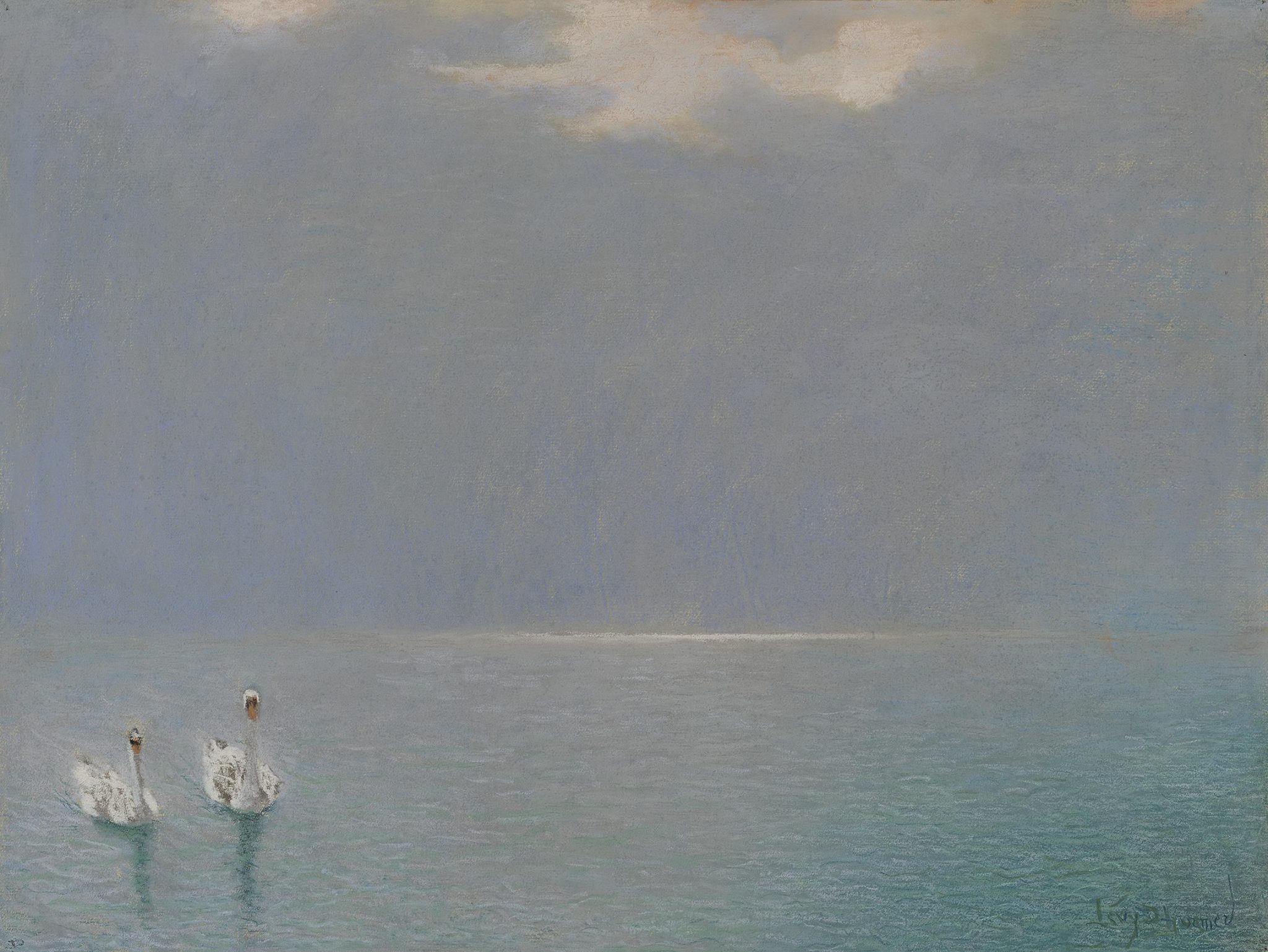
_-_Lucien_Lévy-Dhurmer.jpg) Lucien Lévy-Dhurmer
Lucien Lévy-Dhurmer
Born in Algeria, Lucien Lévy returned to France as a child and completed his artistic education. He was accepted into the Paris Salon as early as 1882, before finishing his studies, and exhibited there regularly until 1889. Then, at the height of a promising Parisian career, he abruptly left for the Côte d’Azur and disappeared from the art scene for six years.
Approaching his 30th birthday, Lévy traveled to Venice and Florence in 1895. There, the art of Leonardo da Vinci and the Renaissance masters was transformative for his art. The journey reignited his artistic ambitions and prompted his return to Paris, where he adopted his mother’s name, becoming Lévy-Dhurmer, and established a studio near that of Gustave Moreau. In that time, the critics hailed him as both a debutant and a master, comparing him to Leonardo, Botticelli, and Memling.
The swan has long carried rich and contradictory meanings. While often associated with masculinity—most famously in the myth of Zeus transforming himself into a swan to seduce Leda, or in German mythology where Valkyries could take swan form—it also symbolized purity, beauty, grace, love, and balance. This painting may not have any symbolic meaning, but it is beautiful as it is.
P.S. Some artworks don’t need decoding; they simply invite us to pause and look. If you enjoy images chosen for their quiet beauty, check out our Sea, Ships & Beaches 50 Postcards Set. :)
P.P.S. Take a short journey through the finest lake paintings in art history!