
 Theodore Robinson
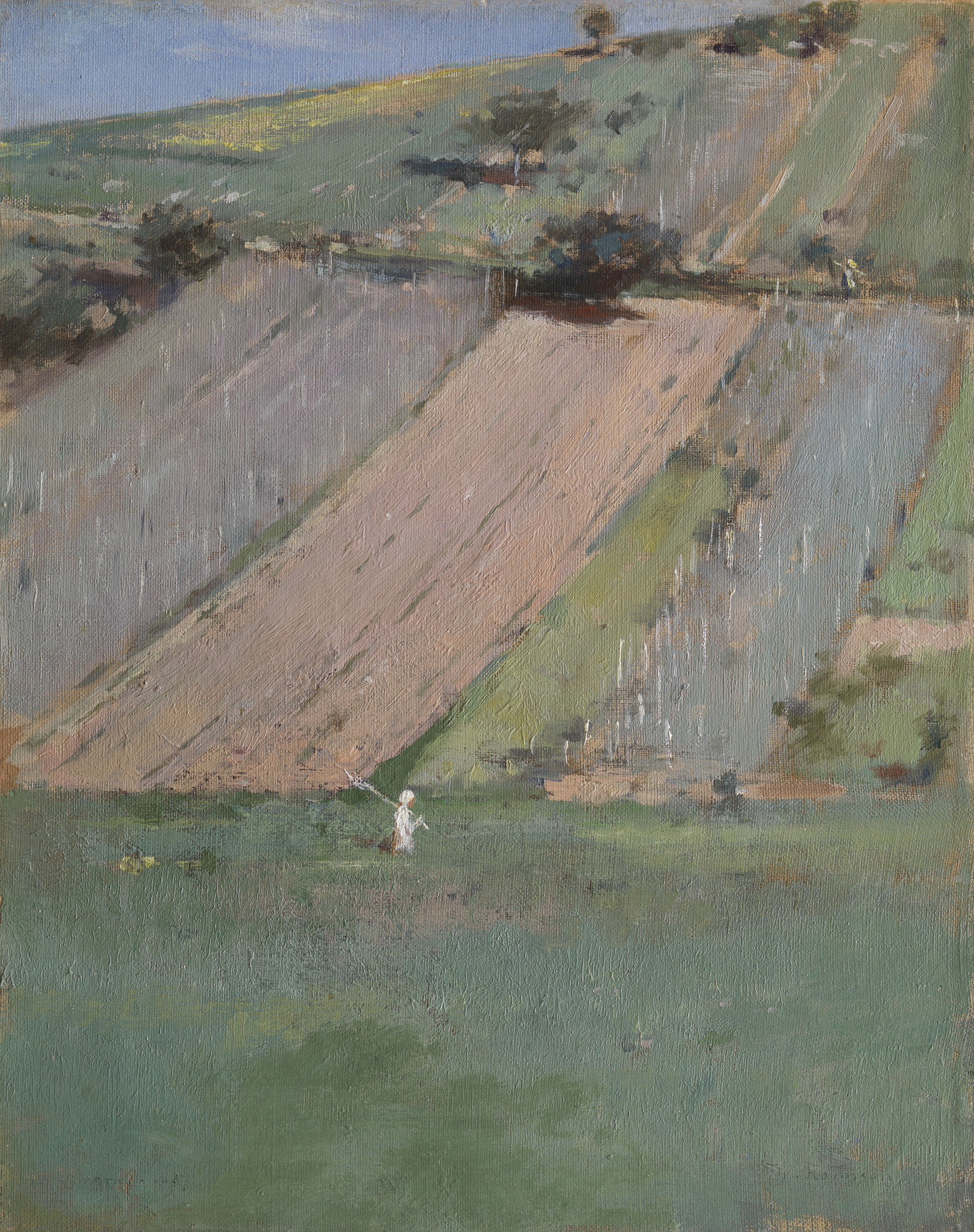
Theodore Robinson was one of the key figures in the first generation of American Impressionists. Today's painting was painted during his first stay in the village where Claude Monet had settled a few years earlier. That summer, Robinson was among a small group of Americans who helped establish what would become the Giverny art colony. Although he was never formally Monet’s student, Robinson worked more closely with him than the others and absorbed much from his approach to painting outdoors. At the same time, Robinson brought his own sensibility to Impressionism. Like many American artists of the period, he had been influenced by James McNeill Whistler and the Aesthetic movement, which encouraged a heightened awareness of surface, pattern, and design.
This dual influence is clear in the painting. On the one hand, it is a direct plein-air study: the bright light, the warmth of the day, and the varied greens and ochres of the fields are conveyed through broken brushwork and fresh color. On the other, the composition is strikingly structured. Broad, angular strips of farmland descend the hillside and stop sharply at a horizontal band of green below, creating a strong decorative rhythm across the surface. The picture can be seen both as a record of a particular place and as a carefully arranged pattern of shapes. In this tension between observation and design, Robinson begins to define the qualities that would distinguish his later landscapes.
Stay tuned for tomorrow, as we are going to share a work ... of the one and only Claude Monet! :)
P.S. Looking for something to do next? Check out our free online course, How to Look at Art, and learn simple, practical ways to understand and appreciate paintings.
P.P.S. Meet 5 American Impressionists you need to know!