
 Witold Wojtkiewicz
During the several years he spent in Kraków, Witold Wojtkiewicz spent a great deal of time in the home of Stanisław and Eliza Pareńska. There, he also met their daughters: Maryna, Zofia, and Eliza (known in the family as Liza). Intelligent, widely read, and somewhat eccentric, the sisters became celebrated muses of the Young Poland artistic milieu and were immortalized in literature and painting.
Liza Pareńska herself was a fragile and troubled figure. Shy, sensitive, and emotionally unstable, she struggled from a young age with social anxiety and began using alcohol and morphine as a way to cope. In 1910, she married the poet Edward Leszczyński; both were psychologically vulnerable and lived in a rarefied, detached world of artistic sensibility. Over time, Liza turned to stronger drugs, which deepened her anxiety and depression. She died by suicide at the age of 35.
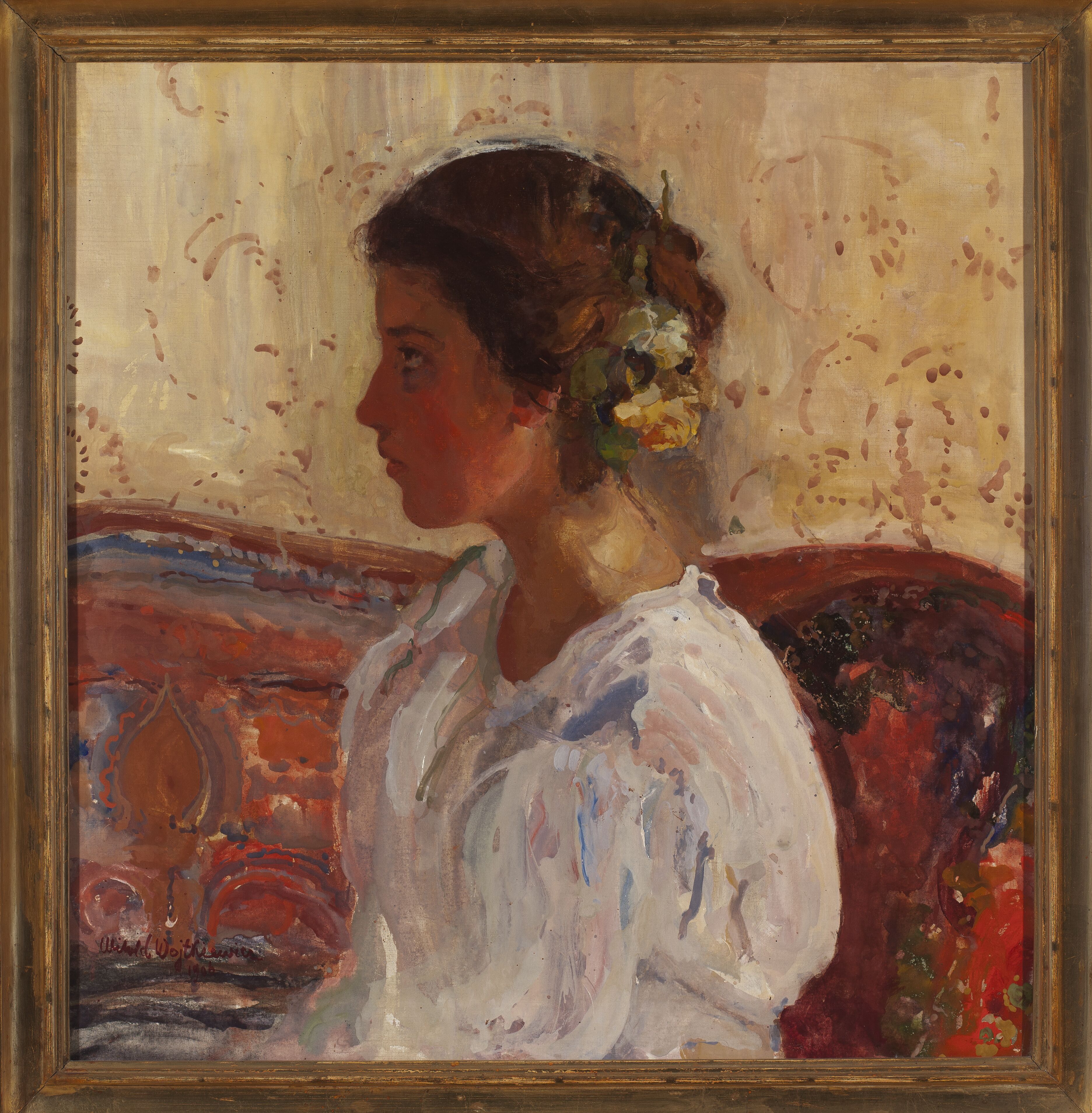
In the Portrait of Liza Pareńska, Wojtkiewicz reveals his most lyrical and sensitive side. There is none of the irony or grotesque tone often found in his work of this period. Although Liza was considered the most beautiful of the sisters, the portrait avoids idealization. Her face—more intriguing than conventionally beautiful—bears a quiet expression of melancholy and reflection. Her gaze turns away from the viewer, avoiding eye contact and suggesting a sense of inward withdrawal, as if she were absorbed in her own private world.
The lighting intensifies this mood: a warm lamp glow from the right softly illuminates her neck and the flowers in her hair, while her face remains partly in shadow. The subdued, lyrical atmosphere is reinforced by a delicate palette of yellows, reds, and oranges. Against these warm tones, the white dress stands out, shimmering with subtle hints of pink, blue, and violet. The loosely sketched background and clothing draw attention to the sitter’s face, modeled with light, sensitive brushstrokes. Her hair, pinned high and adorned with rose flowers, lends both charm and a quiet dignity to the 18-year-old girl, emphasizing her ethereal femininity.
P.S. Young Poland was one of the most creative periods in Polish art history. Meet Stanisław Wyspiański—an Art Nouveau genius from Poland!