
 Edward Wadsworth
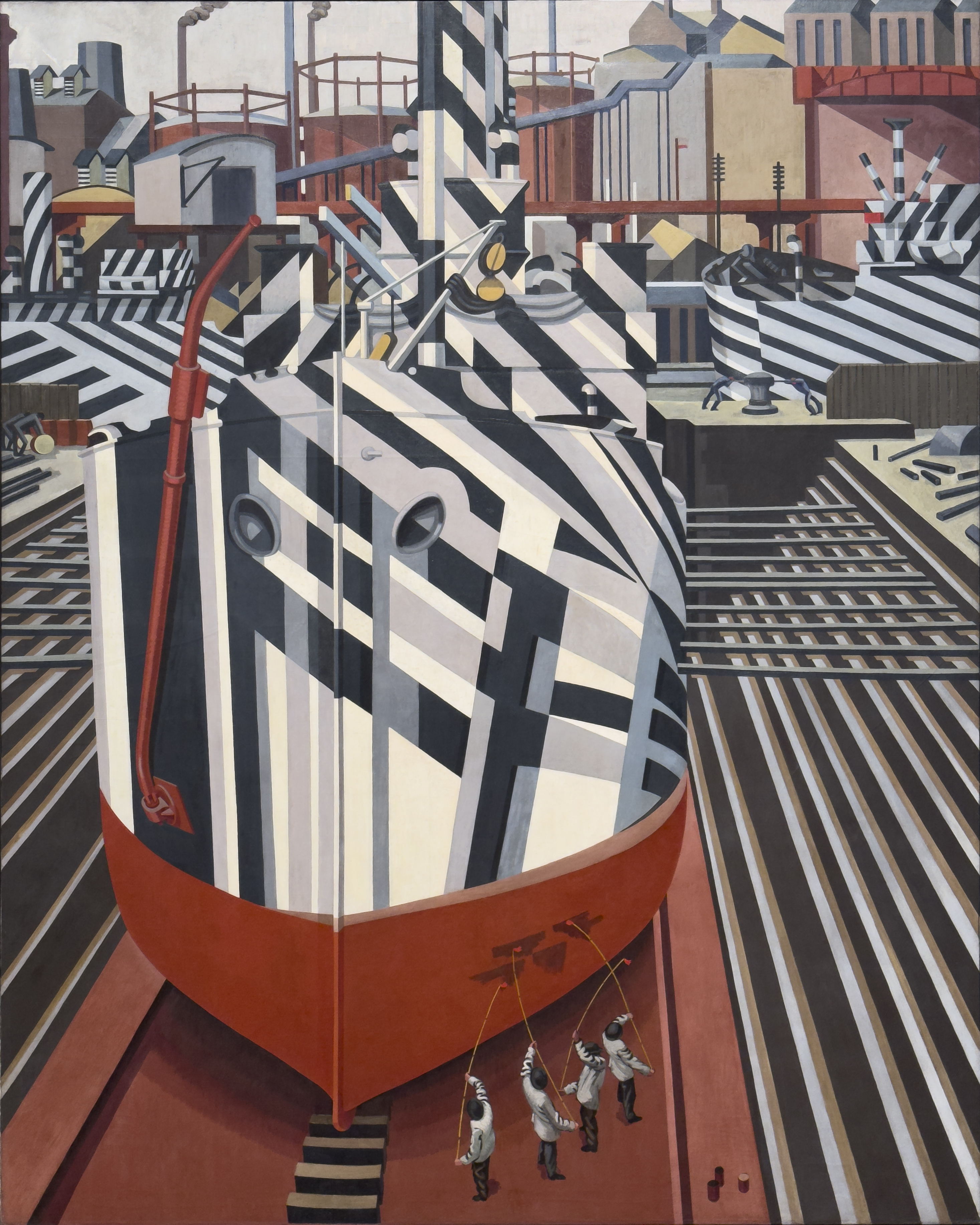
Dazzle-ships in Drydock at Liverpool is one of Edward Wadsworth's best-known works, a large painting and woodcut showing the extraordinary visual chaos of "dazzle camouflage," the geometric, high-contrast paint schemes applied to Allied ships during the First World War to confuse enemy submarines.
Wadsworth had direct, hands-on experience with the scheme: during the war he served in the Royal Navy Volunteer Reserve and was put in charge of overseeing the dazzle-painting of merchant ships at the ports of Liverpool and Bristol, working under the guidance of the scheme's inventor, the marine artist Norman Wilkinson. That practical, supervisory role gave him an unusually intimate knowledge of the patterns and their jagged diagonals, clashing stripes, and false shadows, which he then carried directly into his art once the war ended.
The composition stacks several dazzle-painted ships in dry dock, their hulls' fractured black-and-white and colored patterns rendered in bold, angular woodcut lines that echo the geometric abstraction of Vorticism, the British avant-garde movement with which Wadsworth had been closely associated before the war. The dazzle ships gave him, in a sense, a ready-made real-world subject perfectly suited to the fractured, machine-age aesthetic Vorticism had already been pursuing. The disorienting geometry wasn't invented by the artist but adapted from what he'd actually helped paint onto working ships.
This painting is featured in our 12 Months Weekly Planner for 2027. Get your copy and bring a piece of art history into your everyday planning! Check it out in the DailyArt Shop!
P.S. Edward Wadsworth wasn't the only painter involved in the army at the time; meet 5 artists who became soldiers during the First World War.