
 Vincent van Gogh
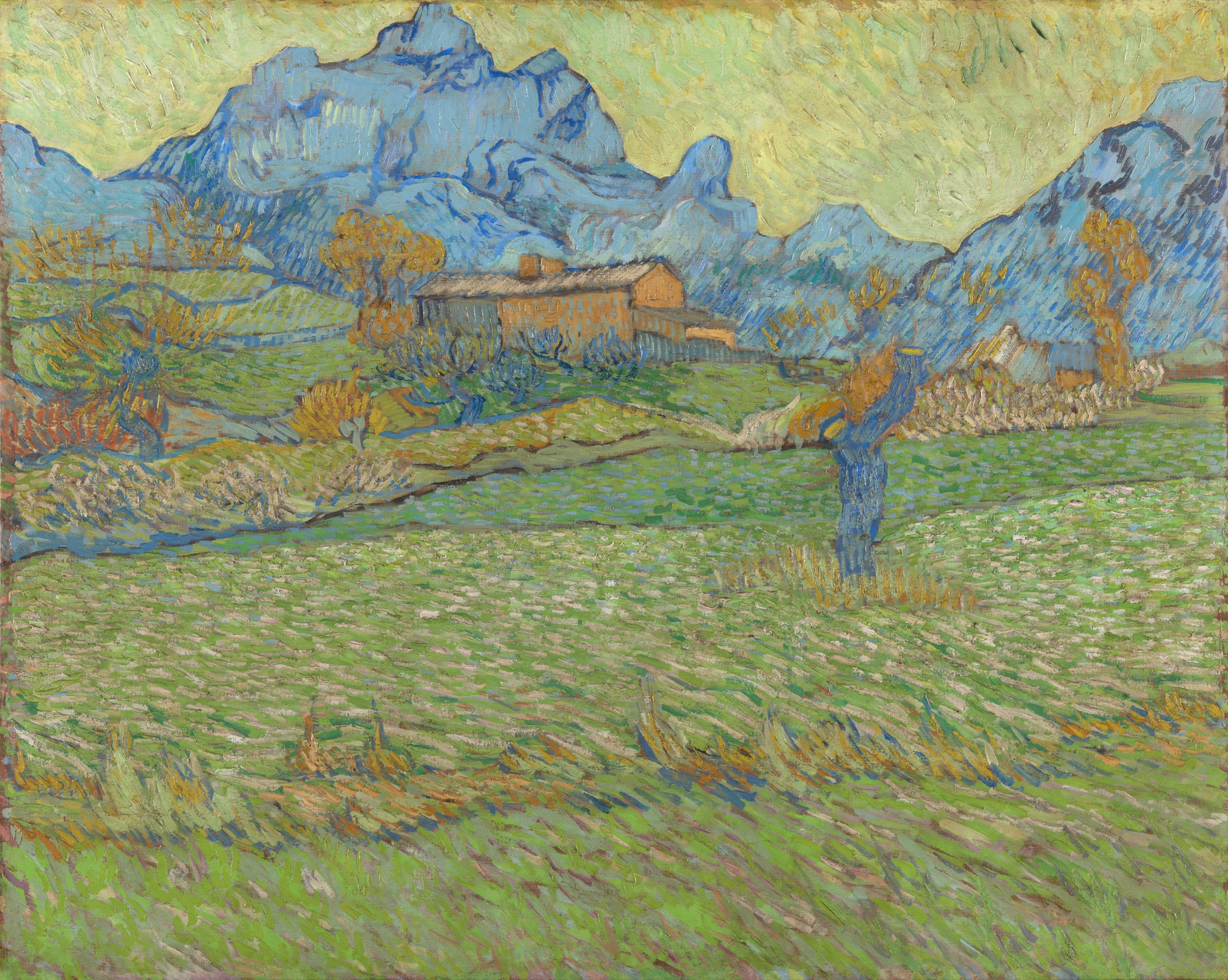
In November 1889, Van Gogh asked his brother to send ten meters of canvas as soon as possible, because he had run out completely. Before the canvas arrived, however, he started work on this painting. He used a tablecloth with a dense pattern of small red blocks woven into it. This pattern remains visible in unpainted areas on the canvas.
Van Gogh first used a brown-purple color to apply the contours of the mountains and the farm, and the main lines of the fields. He then filled the scene with flat and impasto brushstrokes, using green tones for the foreground, ochres for the foliage and farm, blue-purple for mountains, and a green-yellow sky. With a layered structure and varied brushstrokes, he created convincing depth in the mountain scene.
The farmhouse is the Mas de Saint-Paul. This 17th-century farmhouse is one of the oldest in the area and still exists today. The angular extension on the roof is a dovecote, suggesting the original occupant was a person of stature. The Mas got its name in the mid-19th century when it was inhabited by a doctor from Saint-Paul-de-Mausole, the asylum near Saint-Rémy-de-Provence where Van Gogh stayed for a year from the beginning of 1889.
Today we continue something special in DailyArt: a month dedicated to Van Gogh and the extraordinary collection of the Kröller-Müller Museum! The occasion is the Van Gogh, All Our Paintings exhibition, which brings together all 88 Van Gogh paintings in the museum’s collection for the first time since 1984. Running until 3 January 2027, the exhibition explores his work through the themes of faith, hope, and love—values that accompanied Van Gogh from his early religious ambitions into his life as an artist. So expect plenty more Vincent in DailyArt this month!
P.S. Van Gogh’s landscapes are full of movement, color, and emotion. Explore five of his most remarkable landscapes.
P.P.S. Carry Van Gogh’s world with you. Our Vincent van Gogh Notebook features reproductions of 11 of his most captivating paintings, intricate details from his artwork, and heartfelt quotations from his letters—perfect for capturing your own ideas, sketches, and inspiration.