
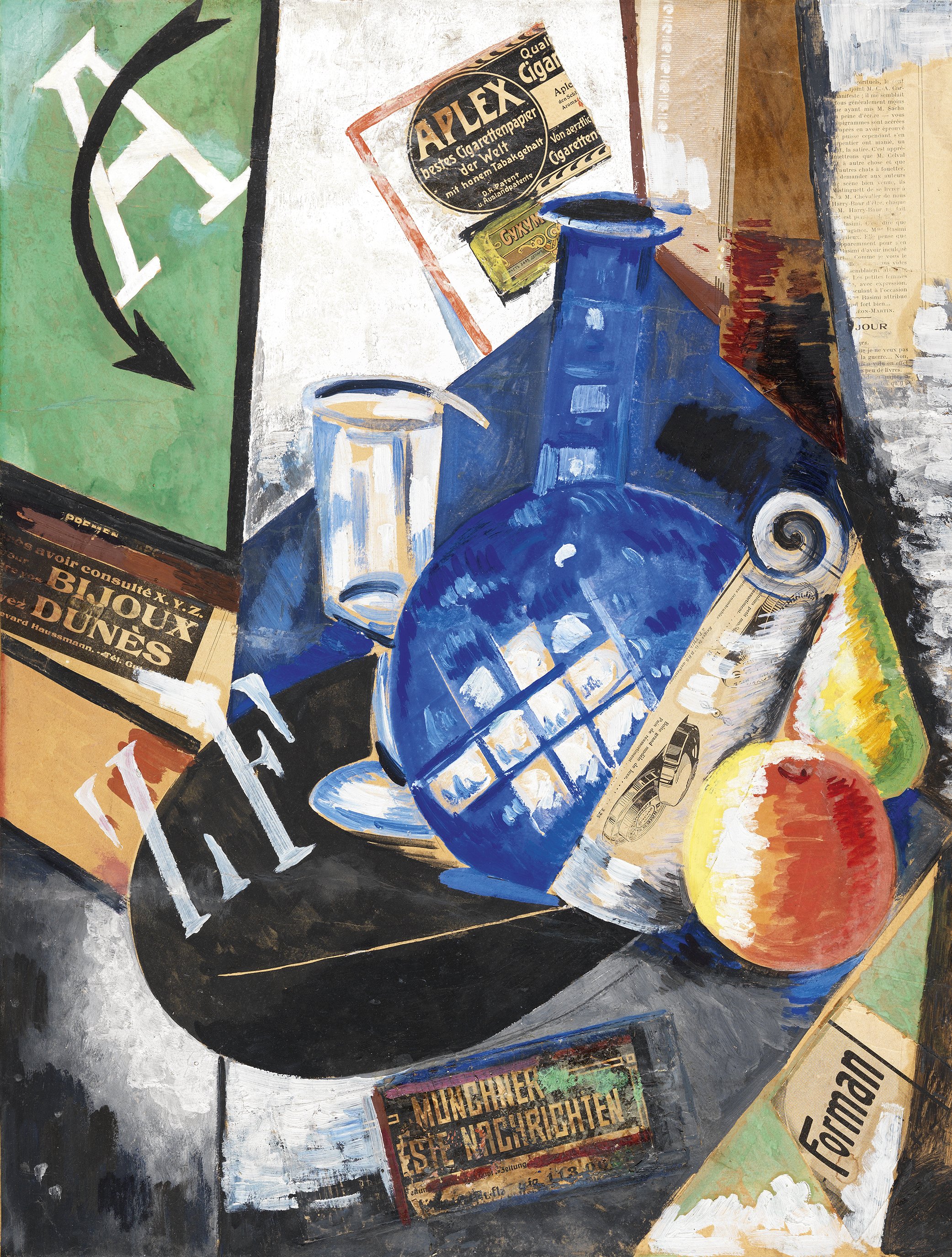
 Alexandra Exter
The Ukrainian artist Alexandra Exter was a leading figure of the early 20th-century avant-garde. Moving frequently between Kyiv and Paris, she became an important link between the artistic experiments taking place in Western and Eastern Europe. In Paris, she met Pablo Picasso, Georges Braque, and Italian Futurists such as Filippo Tommaso Marinetti, bringing ideas from French Cubism and Italian Futurism into dialogue with the emerging Cubo-Futurist movement. Yet Exter remained closely connected to Kyiv and to the avant-garde circles of the Russian Empire, participating in important exhibitions such as Jack of Diamonds and 5 × 5 = 25.
This Still Life was probably painted during Exter's stay in Paris between 1912 and 1914, and may have been shown at the Jack of Diamonds exhibition in Moscow in 1914. Its fractured space and overlapping planes clearly reveal the influence of Cubism, but Exter makes the language distinctly her own. A bottle and glass—the familiar props of Cubist still lifes—are mixed with fragments of newspaper articles, advertisements, and other pieces of collage, while a mysterious letter “A” pierced by an arrow appears in the upper-left corner. Most strikingly, Exter moves away from the restrained browns and grays associated with much early Cubism, filling the composition with intense, vivid color. The result combines the radical experiments she encountered in Paris with visual traditions connected to her homeland, perfectly reflecting Exter's position as an artist moving between—and connecting—different centers of the European avant-garde.
P.S. Want to understand why artists like Exter started breaking bottles, tables, and entire rooms into geometric fragments? Explore our online Cubism 101 course and discover how one of modern art's most revolutionary movements changed the way we see the world.
P.P.S. Exter’s art also reflects the influence of Futurism. Learn more about the movement and its revolutionary manifesto.