
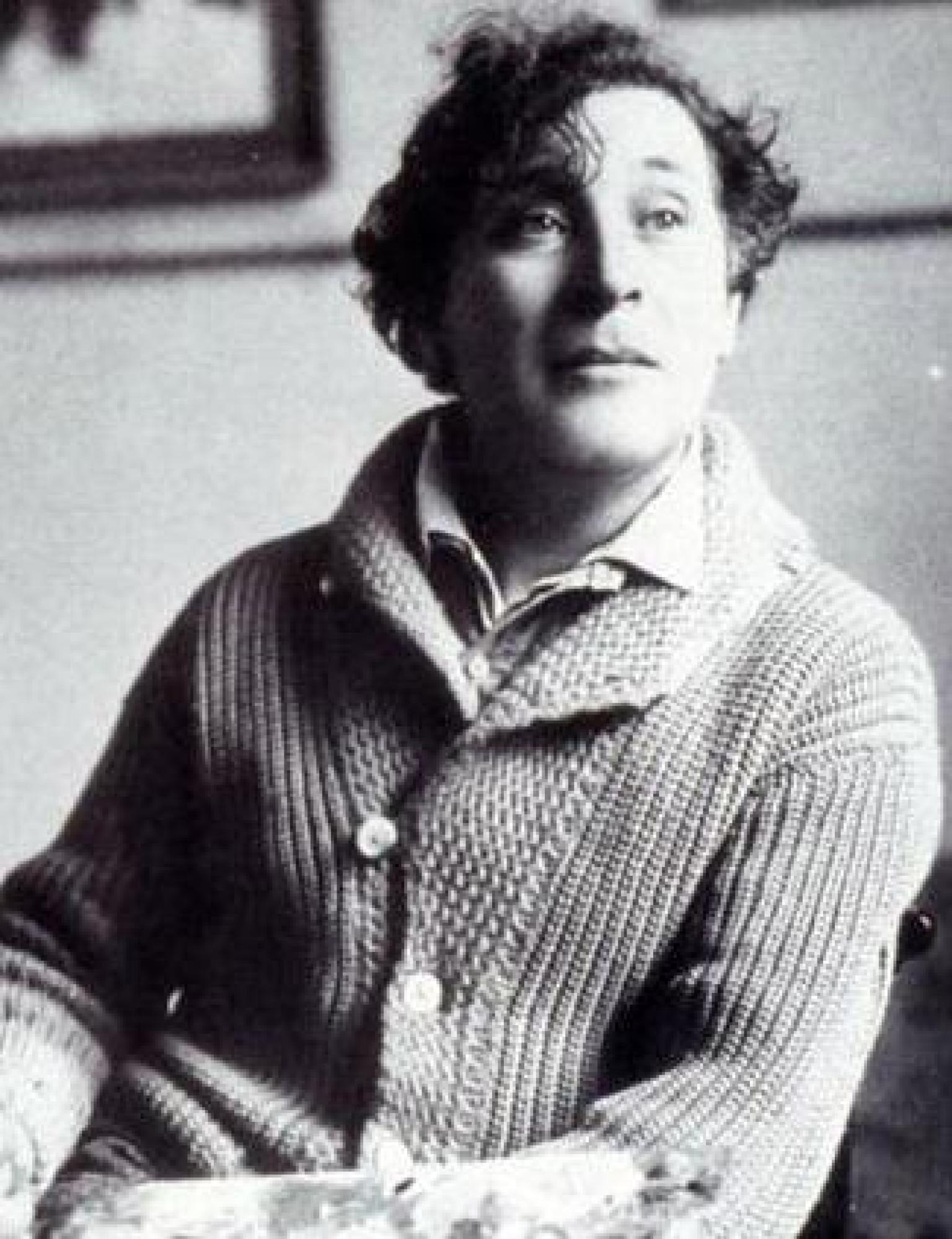
Marc Chagall
July 6, 1887 • March 28, 1985
Marc Chagall (1887-1985), born Moishe Shagal, was a Russian-French artist. He came from a Jewish family near Vitebsk (today in Belarus, but at the time in the Pale of Settlement of the Russian Empire). Chagall was the eldest of nine children. His father Khatski Shagal was employed by a herring merchant and his mother, Feige-Ite sold groceries from their home. His father worked hard, carrying heavy barrels, but earning only 20 roubles a month. Chagall would later include motifs 'out of respect for his father', writes Chagall's biographer, Jacob Baal-Teshuva. Most of what is known about Chagall's early life comes from his autobiography My Life. In it he described the major influence that the culture at Hasidic Judaism had on his life as an artist. In the Russian Empire at that time Jewish children were not allowed to attend regular schools or universities. Their movement in the city was also restricted. Chagall therefore received his primary education at the local Jewish religious school, where he studied Hebrew and the Bible. At the age of 13, his mother tried to enroll him in a regular high school. She offered the headmaster 50 roubles to let him attend, which he accepted.
Between 1908 and 1910, Chagall was a student of Léon Bakst at the Zvantseva School of Drawing and Painting. In 1910 Chagall moved to Paris to develop his artistic style. Because he missed his fiancée, Bella Rosenfeld, who was still in Vitebsk, Chagall accepted an invitation to exhibit his work in Berlin, his intention being to continue on to Belarus, marry Bela, and then return to Paris with her. The exhibit was a huge success. And according to plan he travelled to Vitebsk after, where he wanted to stay long enough to marry Bella.
A year later the couple got married and they had their first child. In 1915 Chagall began exhibiting his works at a well-known salon. At the age of 30, Chagall had begun to become well known. In Moscow he was offered a job as a stage designer for the newly formed State Jewish Chamber Theatre. In 1921 Chagall lived in a small town near Moscow and worked as an art teacher He created a series illustrations for the Yiddish poetry cycle Grief. After spending the years 1921 en 1922 in primitive conditions, he decided to go back to France. In France he stayed during the period 1923-1941. 1944 his wife, Bella, died. Eight years later he he remarried Valentina Brodsky.
As an early modernist, he was associated with several major artistic styles and created works in virtually every artistic format, including painting, book illustrations, stained glass, stage sets, ceramic, tapestries and fine art prints. Art critic Robert Hughes referred to Chagall as 'the quintessential Jewish artist of the twentieth century' (though Chagall saw his work as 'not the dream of one people but of all humanity'). According to art historian Michael J. Lewis, Chagall was considered to be 'the last survivor of the first generation of European modernists'. For decades, he 'had also been respected as the world's prominent Jewish artist'. Using the medium of stained glass, he produced windows for the cathedrals of Reims and Metz, windows for the UN, and the Jerusalem Windows in Israel. He also did large-scale paintings, including part of the ceiling of the Paris Opéra. Before World War I, he traveled between St. Petersburg, Paris, and Berlin. During this period he created his own mixture and style of modern art based on his idea of Eastern European Jewish folk culture. He spent the wartime years in Soviet Belarus, becoming one of the country's most distinguished artists and a member of the modernist avant-garde, founding the Vitebsk Arts College before leaving again for Paris in 1922. He had two basic reputations, writes Lewis: as a pioneer of modernism and as a major Jewish artist. He experienced modernism's 'golden age' in Paris, where 'he synthesised the art forms of Cubism, Symbolism, and Fauvism, and the influence of Fauvism gave rise to Surrealism'. Yet throughout these phases of his style 'he remained most emphatically a Jewish artist, whose work was one long dreamy reverie of life in his native village of Vitebsk.' 'When Matisse dies', Pablo Picasso remarked in the 1950s, 'Chagall will be the only painter left who understands what colour really is'.
Chagall died at the age of 97 in Saint-Paul-de Vence (France).